The Ghost Franchises of the NFL
APFA Pioneers
The First Huddle
In 1920, representatives from a handful of professional football teams met in a Canton, Ohio, auto dealership. There was no grand ceremony. Their goal was simple: create a league to bring order to a chaotic sport. They called it the American Professional Football Association (APFA), the forerunner to today's NFL.
This new league was a loose confederation of 14 teams, mostly scattered across Ohio, Illinois, and Indiana. Scheduling was haphazard, with teams often playing non-league opponents, and standings were messy. Some teams were little more than local athletic clubs, while others had managed to sign the biggest stars of the day.
| Team | 1920 Record (W-L-T) | Fate |
|---|---|---|
| Akron Pros | 8-0-3 | Folded after 1926 season |
| Decatur Staleys | 10-1-2 | Became the Chicago Bears |
| Buffalo All-Americans | 9-1-1 | Folded after 1929 season |
| Chicago Cardinals | 6-2-2 | Became the Arizona Cardinals |
| Rock Island Independents | 6-2-2 | Folded after 1926 season |
| Dayton Triangles | 5-2-2 | Folded after 1929 season |
| Rochester Jeffersons | 6-3-2 | Folded after 1925 season |
| Canton Bulldogs | 7-4-2 | Folded after 1926 season |
| Detroit Heralds | 2-3-3 | Folded after 1921 season |
| Cleveland Tigers | 2-4-2 | Folded after 1921 season |
| Chicago Tigers | 2-5-1 | Folded after 1920 season |
| Hammond Pros | 2-5-0 | Folded after 1926 season |
| Columbus Panhandles | 2-6-2 | Folded after 1926 season |
| Muncie Flyers | 0-1-0 | Folded after 1921 season |
At the end of the first season, the championship was awarded to the Akron Pros. They finished with an undefeated record of 8 wins, 0 losses, and 3 ties. The title wasn't won in a final game but awarded at a league meeting, a common practice at the time. The Pros' success was built on a stifling defense that didn't allow a single point all season.
Stars and Struggles
While Akron claimed the first title, the Canton Bulldogs quickly became the league's powerhouse. Their success was built around the legendary Jim Thorpe, who served as the APFA's first president. Thorpe was more than just a player; he was the sport's biggest gate attraction. In an era where teams lived and died by ticket sales, having a star like Thorpe could mean the difference between solvency and collapse.
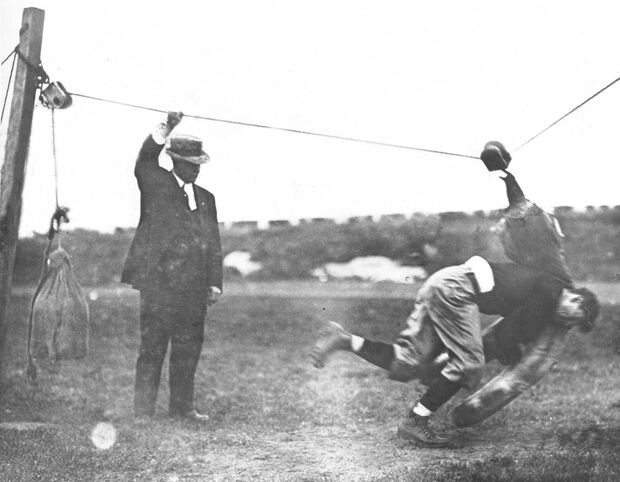
Despite their on-field dominance and Thorpe's star power, the Bulldogs were not immune to the financial precarity of the era. The league was not the stable, money-making machine it is today. High travel costs and inconsistent attendance plagued nearly every franchise. Even the mighty Bulldogs struggled to stay afloat, and the team was eventually sold and temporarily moved to Cleveland in 1924, a common story for teams trying to find a market that could support them.
The First Wave of Failures
For every Canton Bulldogs, there were several Muncie Flyers. The Flyers played only one league game in 1920, a 45-0 loss, before retreating to playing non-league opponents. They folded soon after.
The Rock Island Independents were a more successful small-town team, even beating the Decatur Staleys (who would become the Chicago Bears). But they couldn't compete financially with big-city teams. A lack of capital and the crushing expense of travel meant that many of the original 14 franchises vanished within a few seasons.
These early failures were brutal but necessary. They revealed the essential ingredients for a professional football team's survival: a large enough city to draw consistent crowds, strong financial backing, and a stable league structure. The APFA's chaotic first years were the first, painful steps toward building that.
In what city was the American Professional Football Association (APFA), the forerunner of the NFL, founded in 1920?
Who served as the first president of the APFA and was considered the sport's biggest gate attraction?
The league's early years were a constant battle for survival, setting the stage for the powerhouse organization the NFL would one day become.