The Geometry of Circles
Circle Basics
What Makes a Circle?
Imagine a dog tied to a post with a leash. If the dog walks as far as the leash will allow, it traces a perfect circle on the ground. The post is the center, and the length of the leash is constant.
That's the core idea of a circle. It's a collection of all the points on a flat surface that are the exact same distance from a central point. Every single point on the edge is perfectly equidistant from the middle.
Core Measurements
Two key measurements define any circle's size: the radius and the diameter. Think of them as the circle's fundamental building blocks.
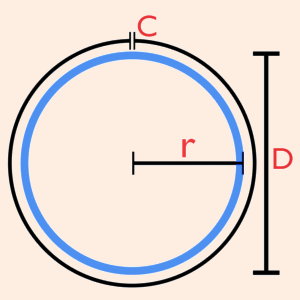
The radius is the distance from the center of the circle to any point on its edge. It's the length of the dog's leash in our example.
The diameter is the distance straight across the circle, passing through the center. It's essentially two leashes placed end-to-end in a straight line.
Because the diameter is just two radii put together, it's always exactly twice as long as the radius. This simple relationship is crucial for many calculations involving circles.
The Magic of Pi
The distance around the edge of a circle is called the circumference. For thousands of years, mathematicians were fascinated by the relationship between a circle's circumference and its diameter. They discovered something amazing.
If you measure the circumference of any circle, from a tiny coin to a giant planet, and divide it by its diameter, you always get the same number: about 3.14159... This special, never-ending number is called pi, and it's represented by the Greek letter .
Defined as the ratio of a circle’s circumference to its diameter, π is both ancient and infinite.
This constant relationship allows us to calculate the circumference of any circle if we know its diameter or radius.
Finding the Area
What about the space inside the circle? This is its area. Calculating the area also involves our constant friend, pi. The formula connects the area directly to the circle's radius.
For a circle: A = π(r²)
The formula tells us to first find the square of the radius (multiply the radius by itself), and then multiply that result by . This will give you the total area enclosed by the circle.
What is the defining characteristic of a circle?
The diameter of a circle is always half the length of its radius.