The Geology and Geography of Boulder Colorado
Introduction to Geology
Our Planet's Layers
The ground beneath our feet feels solid and stable, but it’s just the thin outer skin of a dynamic, layered planet. Earth is structured a bit like a peach, with a thin skin (crust), fleshy fruit (mantle), and a hard pit (core).
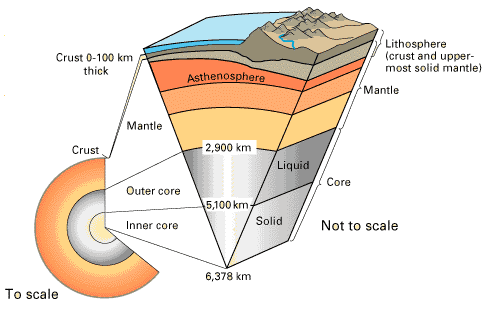
The Crust is where we live. It’s the thinnest layer, varying in thickness from about 5 km under the oceans to 70 km under continents. Below it lies the Mantle, a thick layer of hot, dense rock that makes up about 84% of Earth's volume. While mostly solid, parts of the mantle can flow like very thick tar over millions of years.
The very top of the mantle combines with the crust to form a rigid layer called the lithosphere.
At the center is the Core, which is made mostly of iron and nickel. It's divided into two parts: a liquid Outer Core that flows and generates Earth's magnetic field, and a solid Inner Core, which is scorching hot but remains solid due to immense pressure.
A Restless Surface
That rigid lithosphere isn't one solid piece. It’s broken into massive slabs called tectonic plates, which fit together like a puzzle. These plates are not static; they are constantly moving, floating on the slowly flowing part of the mantle just below them. This movement is known as plate tectonics.
The interactions at the edges of these plates, or boundaries, are responsible for most of Earth's major geological events. There are three main types of boundaries:
- Divergent: Where plates pull apart. Magma from the mantle rises to create new crust, often forming underwater mountain ranges.
- Convergent: Where plates collide. One plate might slide under another (subduction), creating deep ocean trenches and volcanoes, or both plates might crumple upwards to form vast mountain ranges like the Himalayas.
- Transform: Where plates slide past each other horizontally. This movement isn't smooth; the plates lock up, build stress, and then release it suddenly in the form of earthquakes.
The Endless Rock Cycle
Just as plates are constantly in motion, so are the rocks that form them. The rock cycle describes how rocks are continuously formed, broken down, and reformed into different types. It's a slow and perpetual recycling system driven by heat from Earth's interior and energy from the sun.
There are three main families of rock:
-
Igneous rocks are formed when molten rock (magma or lava) cools and solidifies. When this happens below the surface, it's called intrusive igneous rock (like granite). When it happens on the surface after a volcanic eruption, it's extrusive igneous rock (like basalt or pumice).
-
Sedimentary rocks are formed from fragments of other rocks. Over time, wind and water break down existing rocks into smaller pieces called sediments. These particles settle in layers, and over millions of years, the pressure from overlying layers compacts them and cements them together. Sandstone, shale, and limestone are common examples.
-
Metamorphic rocks are created when existing igneous or sedimentary rocks are changed by intense heat and pressure deep within the Earth's crust. This process, called metamorphism, transforms them into new rocks without melting them. For example, limestone can metamorphose into marble, and shale into slate.
Geological Time
The processes of plate tectonics and the rock cycle happen over immense timescales that are hard to comprehend. To organize Earth's 4.6-billion-year history, geologists use the geological time scale. This is a calendar of the planet’s past, divided into eons, eras, periods, and epochs.
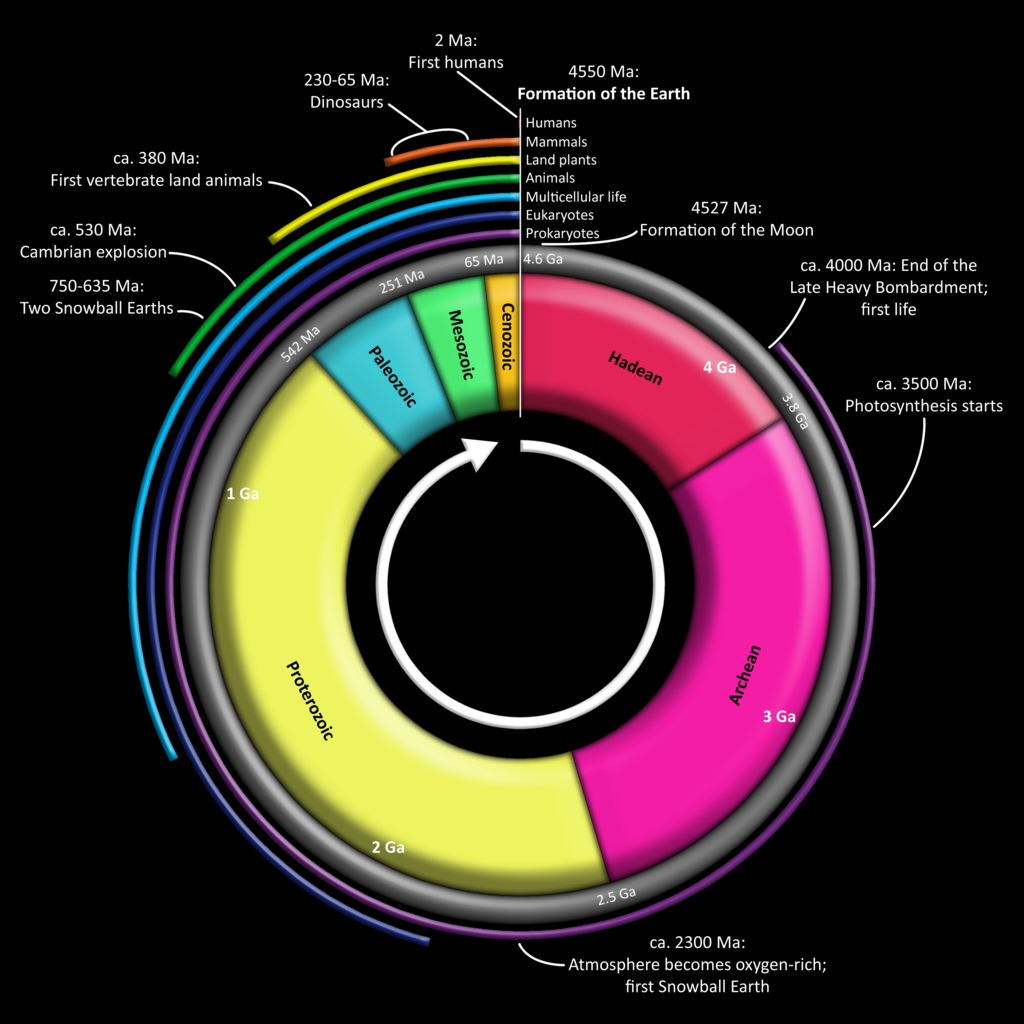
The divisions aren't arbitrary; they mark major events in Earth's history, like the emergence of new life forms or mass extinctions. For example, the Mesozoic Era is known as the "Age of Dinosaurs," and it ended with a major extinction event that paved the way for mammals to thrive in the Cenozoic Era, the one we live in today. Studying rock layers and the fossils within them allows geologists to piece together this incredible history.
Ready to test your understanding? This quiz covers the fundamental concepts we've just explored.
Which layer of the Earth is a liquid metal that generates the planet's magnetic field?
What type of tectonic plate boundary is most associated with the formation of massive, non-volcanic mountain ranges like the Himalayas?
Understanding these core principles—the planet's structure, its moving surface, the recycling of rocks, and its vast history—provides the foundation for exploring any geological landscape on Earth.