The Genesis of Deep Learning
Early AI Concepts
The First Thinking Machines
The dream of creating a machine that thinks isn't new. But in the mid-20th century, scientists and mathematicians began turning this dream into a tangible pursuit. Instead of focusing on building a whole artificial brain, they started with a single component: the neuron.
In 1943, neurophysiologist Warren McCulloch and logician Walter Pitts proposed a simple mathematical model of a biological neuron. Their goal was to understand how a network of these simple cells could perform complex logical operations. The McCulloch-Pitts (MCP) neuron, as it came to be known, was a foundational concept.
The MCP neuron was a simple logic gate. It took several binary inputs (either 1 for 'on' or 0 for 'off'). Inside the neuron, these inputs were summed. If the total sum reached a specific threshold, the neuron would 'fire' and produce an output of 1. If not, the output was 0. By connecting these simple units, you could create networks that performed logical functions like AND, OR, and NOT. It was a brilliant theoretical model, but it had one major drawback: it couldn't learn. The thresholds and connections were fixed.
A Machine That Learns
The idea of a machine that could learn from experience was the next great leap. In 1958, psychologist Frank Rosenblatt introduced the Perceptron, an innovation that built directly on the MCP neuron. The Perceptron wasn't just a theoretical model; it was a physical machine designed for pattern recognition.
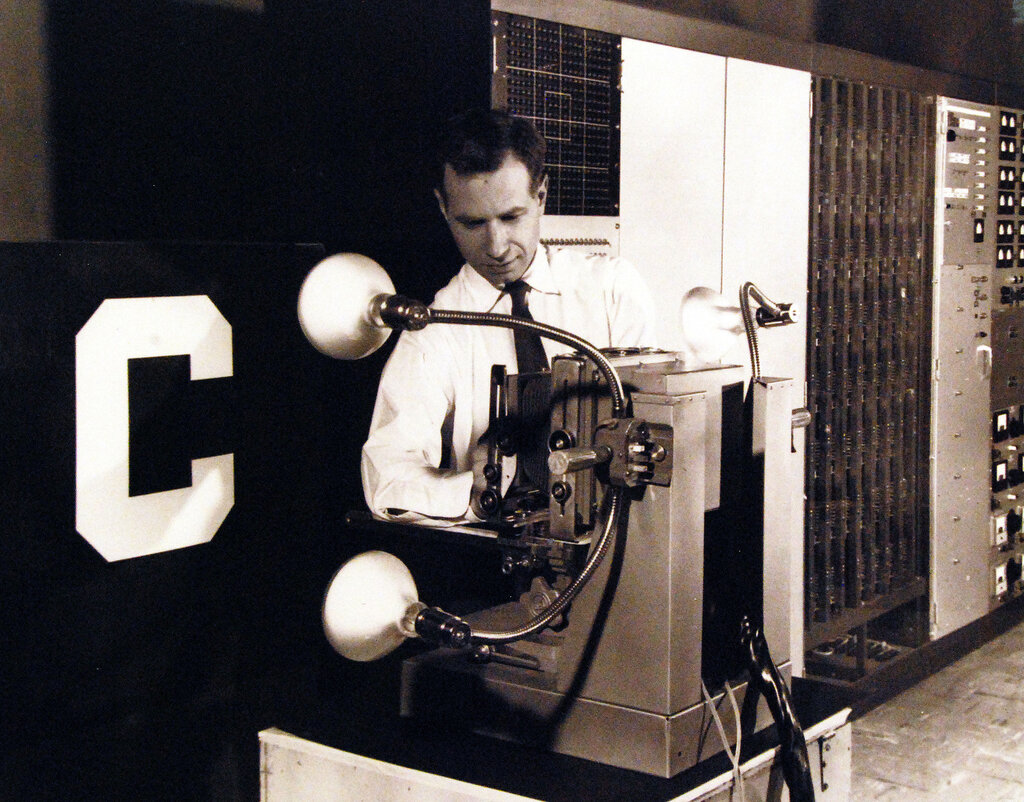
What made the Perceptron special was its ability to learn. Like the MCP neuron, it took inputs, but each input was assigned a 'weight,' a number representing its importance. The Perceptron would multiply each input by its weight, sum the results, and check if the total passed a threshold. The magic was in the learning rule: if the Perceptron made a mistake, it would automatically adjust the weights to improve its accuracy for the next time. This process of trial and error was a breakthrough.
For the first time, a machine could learn from its mistakes without being explicitly reprogrammed for every single step.
Early Success and Limits
The Perceptron caused a wave of excitement. It could be trained to perform simple visual recognition tasks. For example, it could learn to distinguish between different letters of the alphabet projected onto a grid of light sensors. For its time, this was remarkable. It seemed like the dawn of true artificial intelligence.
However, the initial optimism soon met a hard reality. In 1969, a book titled Perceptrons by Marvin Minsky and Seymour Papert proved that a single-layer Perceptron like Rosenblatt's had severe limitations. It could only solve problems that were 'linearly separable'—problems where you could separate the different categories with a single straight line. It couldn't handle a simple logical function like XOR (exclusive OR), which requires more complexity. This discovery cast a shadow over the field, leading to a period of reduced funding and interest in neural networks.
Despite these limitations, the foundational ideas of the MCP neuron and the Perceptron were essential. They planted the seeds for the more complex, multi-layered neural networks that would emerge decades later, paving the way for the deep learning revolution we see today.