The Fundamentals of Visual Perception
Introduction to Visual Perception
The Journey of Light
Seeing feels instantaneous. You open your eyes, and the world is just there, full of color, shape, and motion. But this effortless experience is the result of an intricate process that turns light into meaning. It’s a journey that starts in your eyes but ends in your brain.
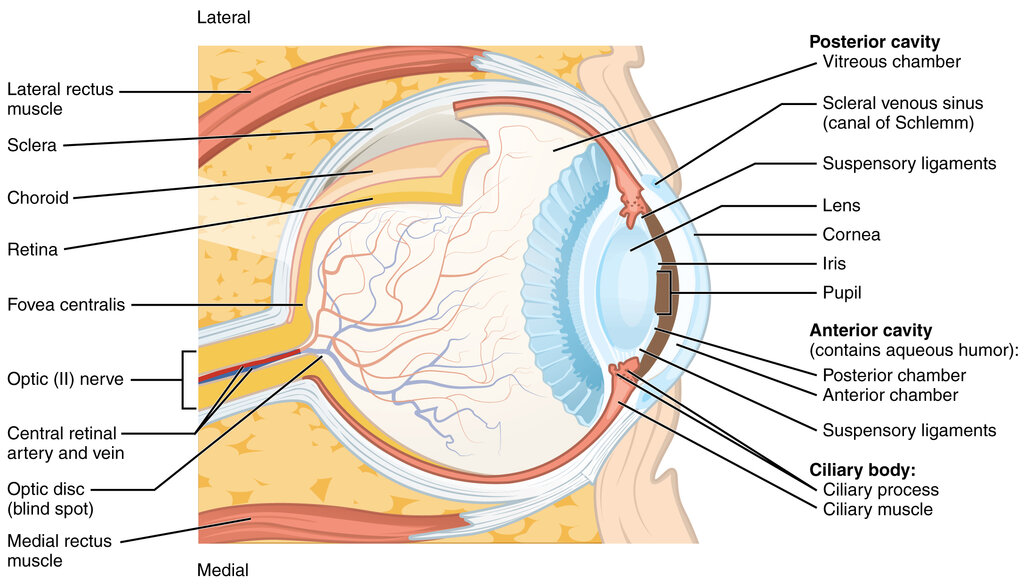
Your eye works much like a camera. Its main job is to focus incoming light onto a light-sensitive layer at the back. This process begins the moment light passes through the cornea, the transparent outer layer that covers the front of your eye. The cornea does most of the initial focusing.
The iris, the colored part of your eye, controls the amount of light that enters by adjusting the size of the pupil, the black opening in the center.
After passing through the pupil, light hits the lens. Unlike a camera's rigid lens, the lens in your eye is flexible. Tiny muscles change its shape to fine-tune the focus, allowing you to see objects clearly whether they're near or far. This focused light then travels through the vitreous humor, a gel-like substance filling the eyeball, to land on the retina at the very back.
| Part | Function |
|---|---|
| Cornea | Transparent outer layer that does most of the light focusing. |
| Iris | The colored muscle that controls the size of the pupil. |
| Pupil | The opening that lets light into the eye. |
| Lens | The flexible structure that fine-tunes the focus of light. |
| Retina | The light-sensitive layer at the back of the eye. |
From Light to Signal
The retina is where the magic really happens. It’s a thin layer of tissue packed with millions of specialized nerve cells called photoreceptors. These cells are responsible for converting light into electrical signals that your brain can understand. This process is called transduction.
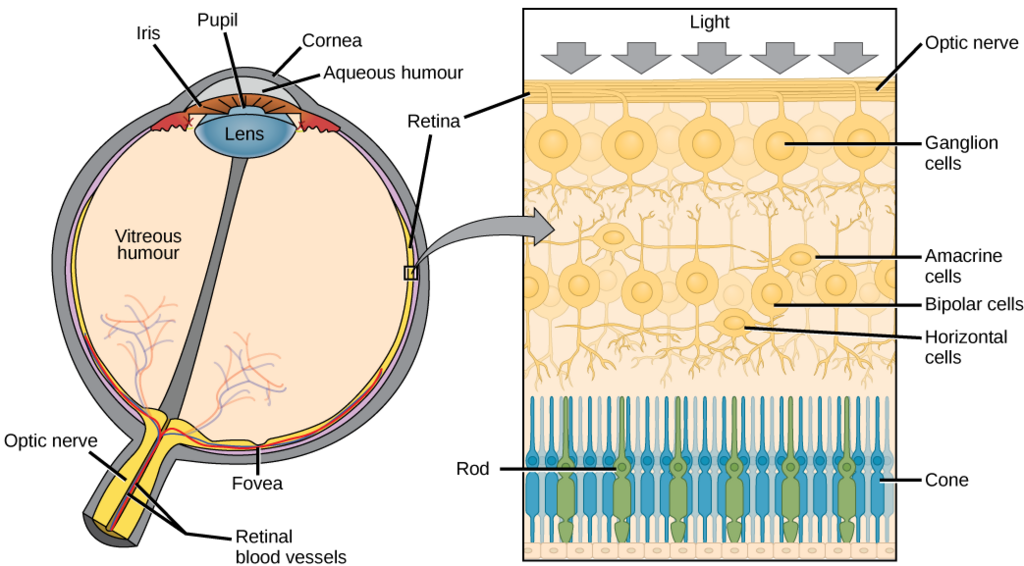
There are two main types of photoreceptors in your retina: rods and cones.
Rods are highly sensitive to light and are responsible for vision in dim conditions. They don't detect color, which is why it's hard to see colors in the dark. Cones, on the other hand, operate best in bright light and are responsible for color vision and fine detail.
When light hits the rods and cones, it triggers a chemical reaction that creates an electrical impulse. This impulse travels through a network of other neurons in the retina before being sent to the brain.
The Pathway to Perception
The electrical signals from the retina don't stay in the eye. They are gathered together and exit through the back of the eye via the optic nerve, which acts like a data cable connecting the eye to the brain.
A crucial event happens shortly after the optic nerves leave the eyes. They meet at a point called the optic chiasm. Here, signals from the inner half of each retina cross over to the opposite side of the brain. Signals from the outer half of each retina stay on the same side. This crossover ensures that information from the right visual field (what you see to your right) is processed by the left hemisphere of your brain, and information from the left visual field is processed by the right hemisphere.
The key neuroscientific insight is that visual information processing is hierarchical and proceeds in stages: The earlier stages process low-level features in the visual field (such as edges, contours, colors and shapes), whereas complex representations, such as whole objects and faces, emerge only later in the inferior temporal cortex.
After the optic chiasm, the signals travel to a relay station deep in the brain called the thalamus. From there, they are sent to their final destination: the visual cortex, located in the occipital lobe at the very back of your head. It is here in the visual cortex that the brain begins the complex task of interpreting these electrical signals, assembling them into the cohesive, meaningful images we perceive as sight.
Which part of the eye is responsible for the initial and most significant focusing of incoming light?
The process of converting light energy into electrical signals that the brain can understand is called: