The Fundamentals of Physics
Classical Mechanics
The Rules of Motion
At its heart, classical mechanics is the study of how things move. From a planet orbiting the sun to a baseball flying through the air, the principles are the same. These rules were famously laid out by Isaac Newton in the 17th century, and they form the foundation of physics.
Newton’s First Law of Motion is about inertia. It states that an object at rest will stay at rest, and an object in motion will stay in motion with the same speed and in the same direction, unless acted upon by an external force. It’s a simple but profound idea. If you slide a book across a table, it eventually stops because of friction, which is an external force. In the vacuum of space, if you push a satellite, it will keep moving in a straight line forever, because there's no friction to slow it down.
An object won't change its motion unless a force makes it.
This leads directly to the Second Law, which is where things get mathematical. This law connects force, mass, and acceleration. It tells us that the acceleration of an object is directly proportional to the net force acting on it and inversely proportional to its mass.
Let’s break that down:
- Force () is a push or a pull. It's what causes a change in motion.
- Mass () is a measure of how much matter is in an object. It’s also a measure of inertia—how resistant an object is to changing its motion.
- Acceleration () is the rate of change of velocity. It’s how quickly an object speeds up, slows down, or changes direction.
The formula is powerful. If you know any two of the variables, you can find the third. If you apply the same force to a bowling ball and a tennis ball, the tennis ball (with less mass) will accelerate much more quickly.
Newton’s Third Law is often summarized as: for every action, there is an equal and opposite reaction. This means that forces always come in pairs. When you push on a wall, the wall pushes back on you with an equal amount of force. When a rocket expels gas downwards, the gas pushes the rocket upwards. The forces are equal in magnitude but opposite in direction.
Conservation Laws
Beyond Newton's laws, two other fundamental principles govern classical mechanics: the conservation of momentum and the conservation of energy. These are deep concepts that provide a different lens for looking at motion.
momentum
noun
A measure of the quantity of motion of an object, calculated as the product of its mass and velocity.
Momentum () is simply mass times velocity.
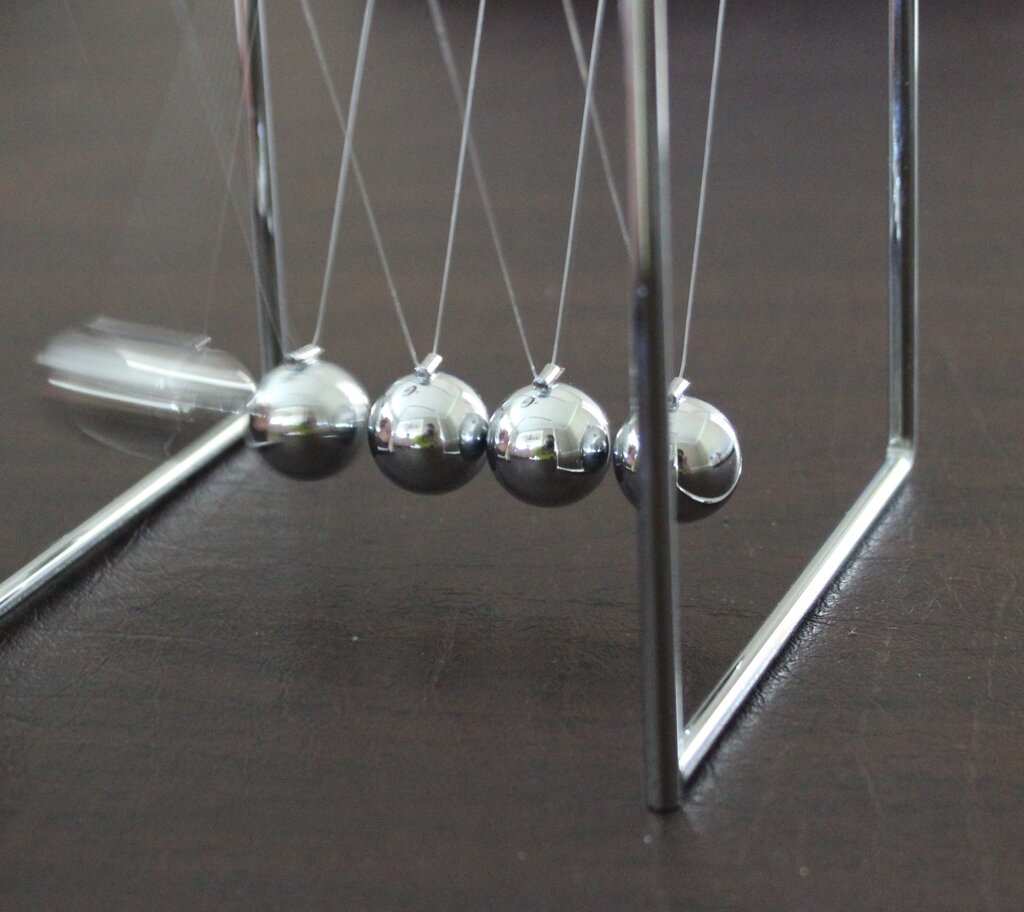
The law of conservation of momentum states that the total momentum of a closed system—one with no external forces acting on it—remains constant. Think of a game of pool. Before the break, the balls are still, so the total momentum is zero. After the cue ball hits the rack, balls fly in every direction. But if you were to add up the momentum of every single ball (remembering that momentum is a vector and has direction), the total would still be zero.
In any interaction, the total momentum before is the same as the total momentum after.
Finally, we have the conservation of energy. Energy comes in many forms, but in mechanics, we're mainly concerned with two: kinetic energy (the energy of motion) and potential energy (stored energy).
Kinetic energy () depends on an object's mass and the square of its velocity.
Gravitational potential energy () depends on an object's mass, the acceleration due to gravity (), and its height () above a reference point.
The principle of conservation of energy states that energy cannot be created or destroyed, only transformed from one form to another. When you hold a ball in the air, it has potential energy. As it falls, that potential energy is converted into kinetic energy. Just before it hits the ground, almost all its energy is kinetic. The total mechanical energy () at any point during its fall is constant, assuming we ignore air resistance.
Time to check your understanding of these core principles.
An astronaut in deep space throws a wrench. With no significant external forces like gravity or air resistance acting on it, what will happen to the wrench?
According to Newton's Second Law, if you apply the exact same net force to a 5 kg object and a 10 kg object, what will be the result?
These laws of motion and conservation are the essential toolkit for understanding the physical world on a human scale. They describe the graceful arc of a thrown ball and the majestic orbits of the planets with the same elegant logic.