The Fundamentals of Physics
Introduction to Mechanics
The Rules of Motion
Mechanics is the part of physics that explains how and why things move. From a planet orbiting the sun to a car driving down the road, the same basic principles apply. These principles were first laid out clearly by Isaac Newton, and they form the foundation of what we call classical mechanics.
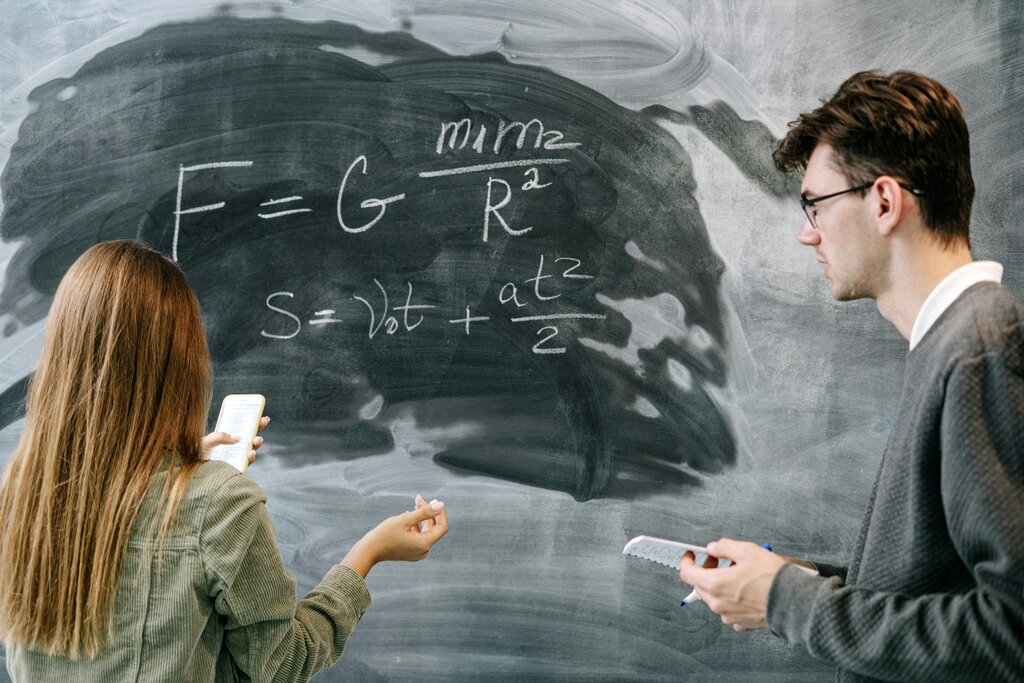
Let's explore Newton's three laws of motion. They are simple but powerful ideas that describe the relationship between an object, the forces acting on it, and how it moves in response.
Newton's Laws
The first law is about inertia. It states that an object will keep doing whatever it's doing unless a force makes it change. If it's sitting still, it will stay still. If it's moving, it will continue moving in a straight line at a constant speed.
Think about a hockey puck gliding across the ice. It keeps moving smoothly until it hits the wall or the friction from the ice slows it down. The wall and friction are the outside forces that change its motion.
The second law is the most famous. It connects force, mass, and acceleration with a simple equation. It tells us that the more force you apply to an object, the more it accelerates. It also says that for the same amount of force, a heavier object (one with more mass) will accelerate less than a lighter one.
Here, is the net force on an object, is its mass, and is its acceleration. This formula is a cornerstone of physics. It's how we calculate the force needed to launch a rocket or the acceleration of a car.
The third law is about action and reaction. It says that for every action, there is an equal and opposite reaction. This means forces always come in pairs. When you push on a wall, the wall pushes back on you with the same amount of force. A rocket pushes hot gas downward (action), and the gas pushes the rocket upward (reaction), lifting it into the sky.
Energy and Its Conservation
Next up is energy, which is the ability to do work or cause change. In mechanics, we often deal with two main types of energy: kinetic and potential.
Kinetic Energy
adjective
The energy an object possesses due to its motion.
Anything that's moving has kinetic energy. The faster it moves and the more mass it has, the more kinetic energy it has. The formula is:
Potential energy, on the other hand, is stored energy. A common type is gravitational potential energy, which an object has because of its position in a gravitational field. The higher up you lift something, the more potential energy it gains.
In this formula, is mass, is the acceleration due to gravity, and is the height. A roller coaster at the top of a hill is a great example. It has a lot of potential energy, ready to be converted.
This leads to a fundamental rule: the principle of conservation of energy. Energy cannot be created or destroyed; it only changes from one form to another. As the roller coaster speeds down the hill, its potential energy is converted into kinetic energy. When it goes up the next hill, that kinetic energy is converted back into potential energy. The total amount of energy in the system stays the same (ignoring friction for now).
Momentum
Momentum is another key concept in mechanics. You can think of it as "mass in motion." It's a measure of how much oomph an object has when it's moving. The more mass an object has and the faster it's going, the greater its momentum.
Here, represents momentum. Like energy, momentum is also conserved. The principle of conservation of momentum states that the total momentum of a closed system (one with no external forces) remains constant. This is especially useful for understanding collisions.
Imagine two billiard balls hitting each other. The momentum of each ball changes during the collision, but the total momentum of both balls combined, right before and right after they hit, is exactly the same.
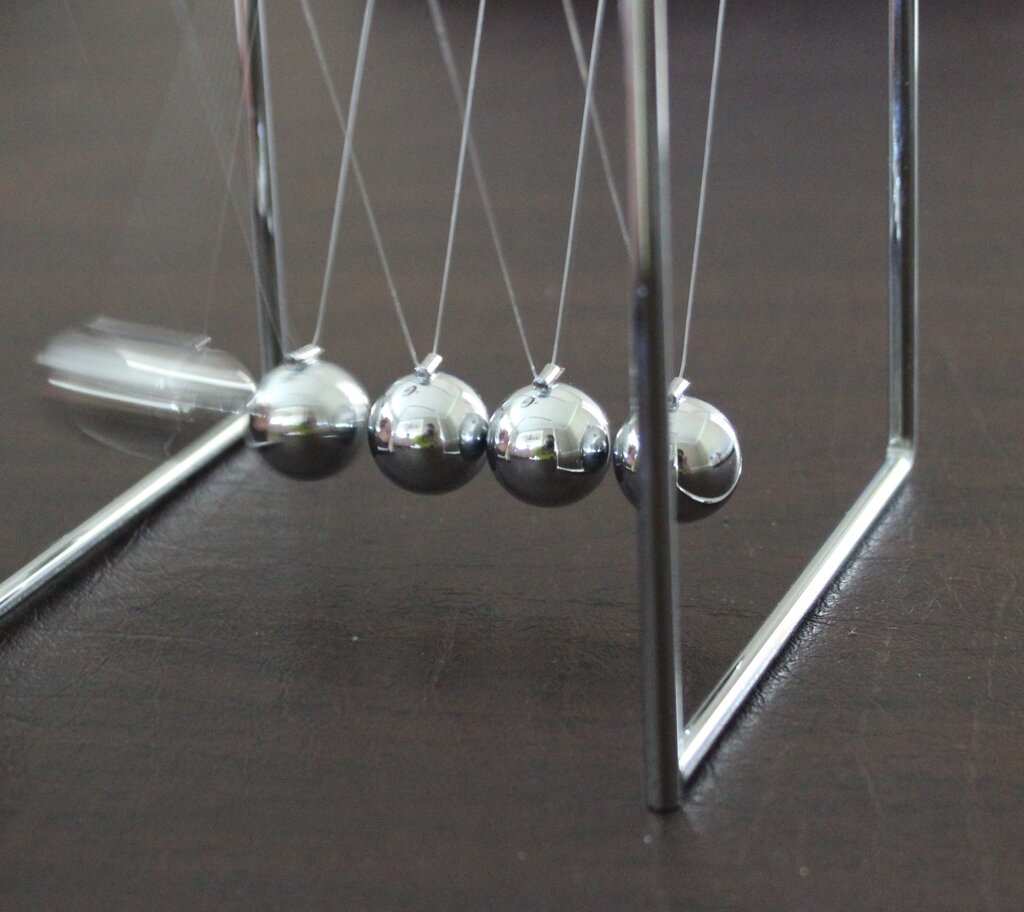
These ideas—Newton's laws, energy, and momentum—are the building blocks for understanding almost all motion in the everyday world. They allow us to predict the paths of baseballs, design safer cars, and send probes to other planets.
Ready to test your understanding? Let's see how well you've grasped these fundamental concepts.
An object is moving through the vacuum of deep space, far from any significant gravitational influence. According to Newton's First Law of Motion, what will happen to the object's motion?
True or False: A rocket can accelerate in the vacuum of space because its engines push against the air.
With these core principles, you have a solid foundation for exploring the physics of motion.