The Free-Energy Principle Explained
Introduction to the Free-Energy Principle
The Brain's Main Job
What is the fundamental purpose of the brain? A compelling answer comes from the free-energy principle, a theory developed by neuroscientist Karl Friston. It suggests that all biological systems, from a single cell to a complex human brain, share a common goal: to keep existing in a world full of surprises.
The core idea is that living things must maintain a state of order, separate from the chaos of their environment. To do this, they have to minimize something called 'free energy'. In this context, free energy isn't about physics or power plants. It's a way of measuring how much the world surprises us. It's the gap between what we expect to happen and what actually happens.
Essentially, the brain is a prediction machine. It constantly builds and updates a model of the world to anticipate sensory information. The better its predictions, the lower the free energy, and the more likely the organism is to survive.
Think about catching a ball. You don't consciously calculate its trajectory. Instead, your brain uses its internal model of physics to predict where the ball will be. You then move your hand to that predicted location. If your prediction is accurate, you catch the ball. No surprise. If you misjudge the speed, that's a surprise—a prediction error. The free-energy principle says your brain will then update its model to make better predictions next time.
By acting on the environment to minimize the free energy of their sensory samples, biological systems would avoid surprising sensory states.
Perception and Action
According to the FEP, there are two ways to minimize surprise. You can either change your model of the world (this is perception) or you can change the world itself to match your model (this is action).
Let's go back to the ball. If you thought the ball was coming slowly but it's actually coming fast, you can update your internal model. You perceive the ball's actual speed and adjust your expectations. That's changing the model.
Alternatively, you could move your hand faster to intercept the ball where you initially predicted it would be. By moving, you change the sensory input to better match your original prediction. That's changing the world through action. Most of the time, we do both simultaneously, constantly refining our predictions and actions to navigate the world smoothly.
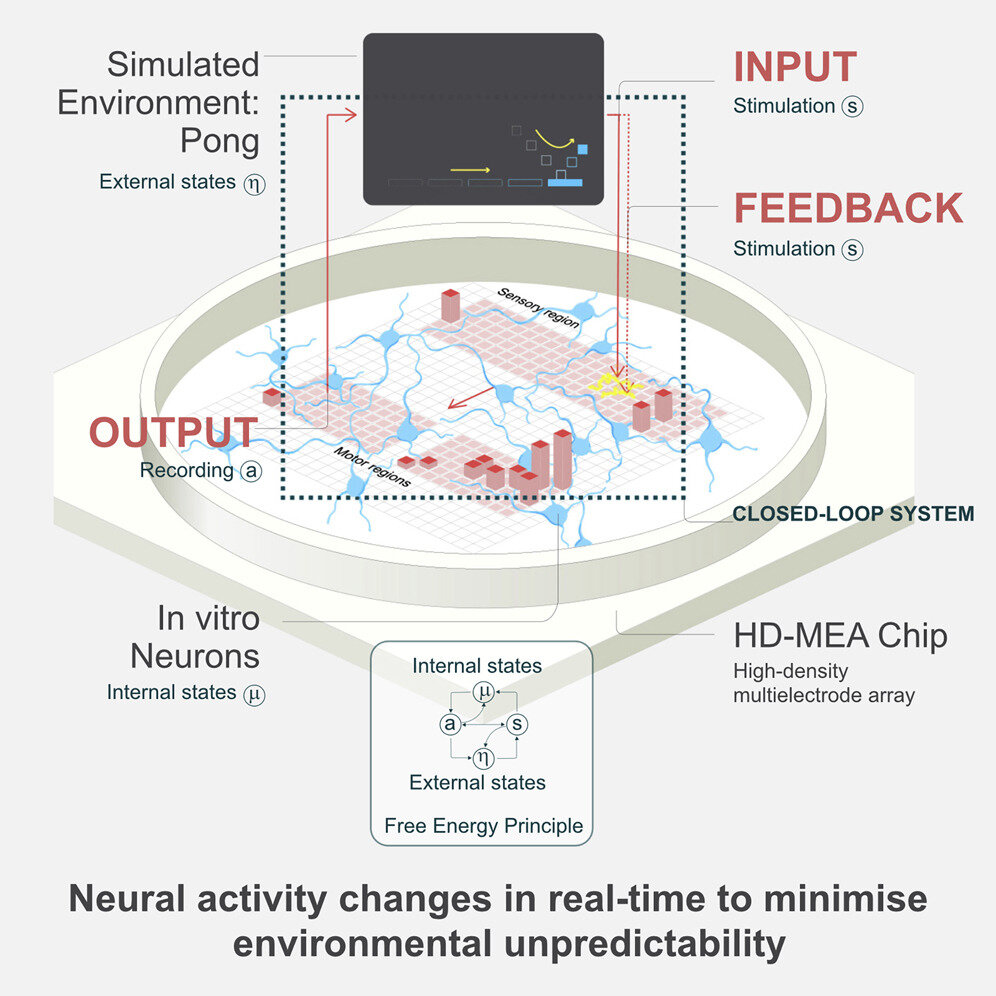
This single principle provides a unified framework for understanding many different brain functions. Perception, learning, attention, and motor control can all be seen as different facets of the same underlying process: minimizing prediction error.
A Unifying Theory
The free-energy principle is ambitious. It seeks to explain not just brain function but the very nature of life and intelligence. Its broad scope makes it relevant to many fields.
In neuroscience, it helps explain how different brain regions communicate and how we perceive the world. In artificial intelligence, engineers are using its concepts to design more flexible and adaptive learning algorithms. For cognitive scientists, it offers a mathematical framework for understanding complex mental phenomena like belief, consciousness, and decision-making.
The theory connects the biological workings of the brain to the abstract nature of the mind. It suggests that the intricate dance of neurons and chemicals is all in service of one simple imperative: resist surprise and maintain order.
According to the free-energy principle, what is the fundamental goal of all biological systems, including the brain?
In the context of the free-energy principle, 'surprise' is best defined as: