The Force of Gravity
Introduction to Gravity
The Invisible Pull
Gravity is the invisible force that pulls objects toward each other. It’s what keeps your feet on the ground and what holds the Moon in orbit around the Earth. But our understanding of this fundamental force hasn't always been the same. It took centuries of observation and debate to get from simple ideas to a powerful mathematical law.
Early Ideas About Falling
For nearly 2,000 years, the ancient Greek philosopher Aristotle had the final word on why things fall. He believed that every object had a natural place. For earthy objects, like rocks, that place was the center of the Earth. He argued that heavier objects fall faster than lighter ones because they have a stronger desire to reach their natural place. It seemed to make sense; a big rock certainly falls faster than a feather.
In the 16th century, the Italian scientist Galileo Galilei challenged this idea. He reasoned that the only reason a feather falls slower than a rock is because of air resistance. In a vacuum, with no air to push against, they should fall at the exact same rate. While the technology didn't exist to create a perfect vacuum, Galileo performed experiments by rolling balls down inclined planes, which allowed him to slow down the effect of gravity and measure it more accurately.
Galileo's conclusion was revolutionary: neglecting air resistance, all objects accelerate toward the Earth at the same rate, regardless of their mass.
Newton's Universal Law
A generation later, Isaac Newton took the next giant leap. The famous story of an apple falling from a tree prompted him to wonder: if gravity pulls an apple to the ground, could the same force reach all the way to the Moon, keeping it in its orbit around the Earth? He concluded that gravity wasn't just an earthly phenomenon; it was universal.
Newton proposed that every object in the universe attracts every other object. The strength of this attraction depends on two things: the mass of the objects and the distance between them. The more massive the objects, the stronger the pull. The farther apart they are, the weaker the pull becomes.
He described this relationship with a precise mathematical formula, now known as Newton's Law of Universal Gravitation. The force () is equal to the gravitational constant () multiplied by the masses of the two objects ( and ), divided by the square of the distance () between their centers.
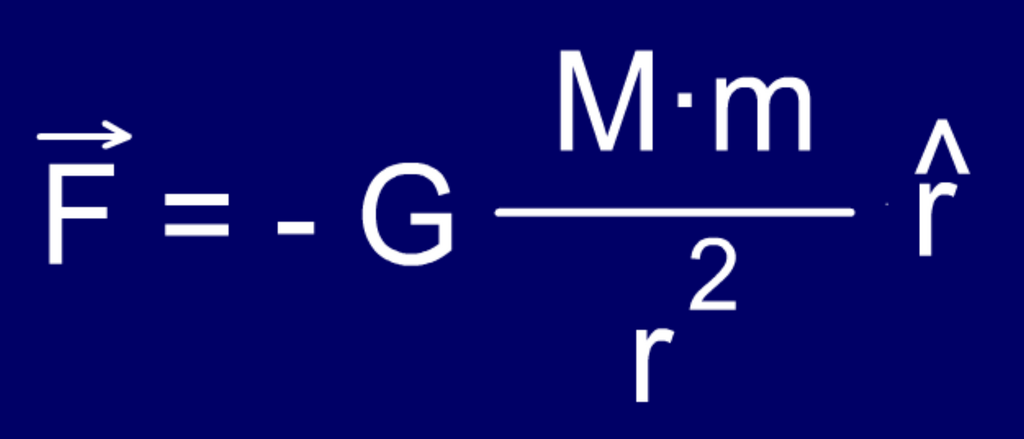
The gravitational constant, , is an extremely small number. This explains why you don't feel a gravitational pull toward your desk or your chair. The force is there, but because their masses are so small, the force is negligible. It only becomes significant when you're dealing with massive objects, like planets, moons, and stars.
The Architect of the Cosmos
Newton's law was a triumph. It explained why things fall to Earth and also why planets orbit the Sun. Gravity is the master architect of the universe. It's the force that pulled together dust and gas to form stars and planets in the first place.
It dictates the orbits of planets, the paths of comets, and the clustering of galaxies. The same simple rule that governs a falling apple also governs the majestic dance of celestial bodies across the cosmos.
This understanding of gravity allowed us to predict the motions of planets with incredible accuracy, discover new planets based on their gravitational effects on others, and eventually, send spacecraft to explore our solar system. Though our understanding of gravity would continue to evolve, Newton's law remains a powerful and essential tool for understanding the universe.
Time to check your understanding of these foundational ideas about gravity.