The Fate of International Law
Introduction to International Law
The Rules of the World Stage
Imagine a world without rules for how countries should interact. Trade, travel, and even mail delivery would be chaotic. International law is the system of rules that brings order to the global stage. It’s a set of agreements and principles that govern how nations deal with one another.
Unlike the laws within a country, there isn't a single world government to create and enforce them. Instead, international law is a collective effort. Its main purpose is to promote peace, manage shared resources like the oceans and outer space, and protect fundamental human rights. It provides a framework for cooperation, turning a world of separate states into an interconnected global community.
Where Does It Come From?
International law isn't written in a single book. It develops from several sources, which legal experts generally agree on. The most important ones are treaties, customs, and general principles.
Think of it this way: some rules are written down and signed, some are followed because 'it's always been done that way,' and some are based on fundamental ideas of fairness that nearly everyone accepts.
Here’s a breakdown of the primary sources:
| Source | Description | Example |
|---|---|---|
| Treaties | Formal, written agreements between two or more states. They are like contracts on an international scale and are legally binding on the countries that sign and ratify them. | The Geneva Conventions, which set the standards for humanitarian treatment in war. |
| Customary Law | Unwritten rules that come from a general practice accepted as law. For a custom to become law, states must act in a certain way consistently, and they must believe they are legally required to do so. | The principle that diplomats are immune from prosecution in their host country. |
| General Principles | Fundamental legal ideas that are recognized by most legal systems around the world. These principles fill in gaps where treaties or customs don't provide a clear answer. | The concept of res judicata, meaning a matter that has been finally decided cannot be raised again. |
Foundational Principles
The entire system of international law rests on a few core principles that ensure a level playing field. These ideas are the bedrock of relations between countries.
Sovereignty
noun
The principle that each state has complete authority and control over its own territory and internal affairs, free from external control by other states.
Closely linked to sovereignty are two other key principles:
-
Non-Intervention: This is the idea that states should not interfere in the domestic affairs of other states. It reinforces the independence that sovereignty guarantees.
-
Equality of States: In the eyes of international law, all states are equal. This means that a small country has the same legal rights and obligations as a large, powerful one. Each state gets one vote in the United Nations General Assembly, for example.
Key Players
While states are the main actors, certain international organizations play a huge role in creating, interpreting, and upholding international law. Two of the most important are the United Nations and the International Court of Justice.
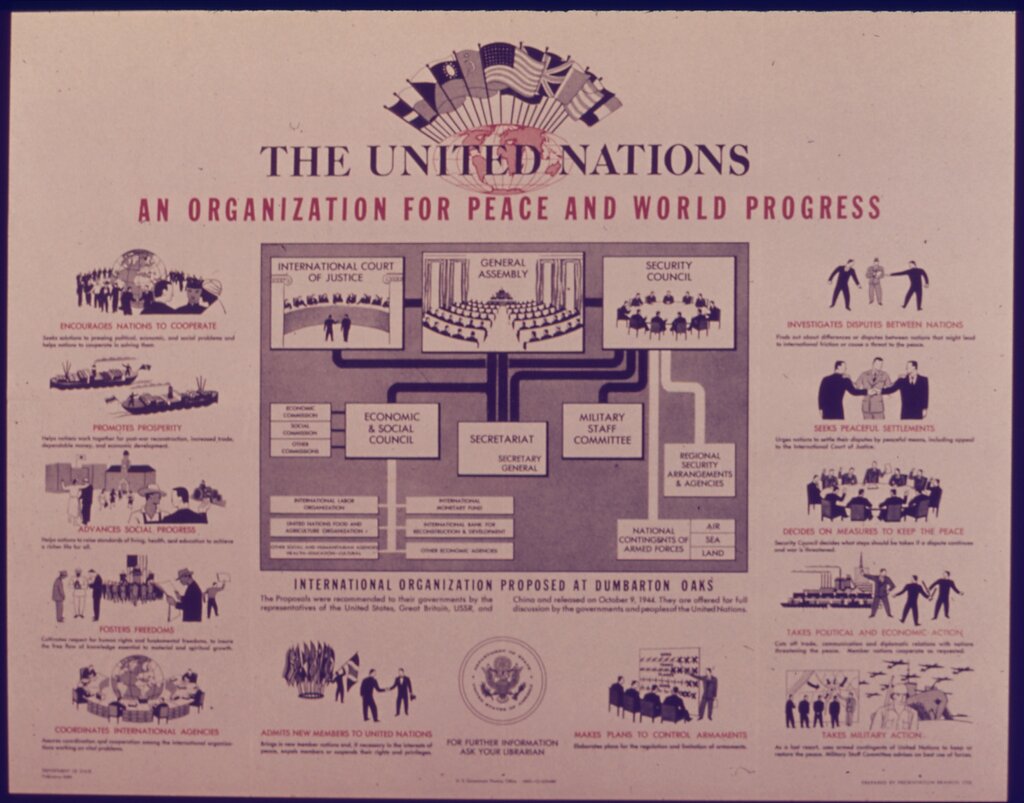
The United Nations (UN), founded in 1945, is the world's most prominent international organization. It serves as a forum where countries can discuss issues, negotiate treaties, and work together on global problems like poverty and climate change. Its General Assembly and Security Council are central to international diplomacy.
The International Court of Justice (ICJ) is the principal judicial organ of the UN. Often called the "World Court," it is located in The Hague, Netherlands. Its main job is to settle legal disputes submitted to it by states and to give advisory opinions on legal questions. A key thing to remember is that the ICJ can only hear a case if both states involved agree to its jurisdiction.

Now that we've covered the basics, let's review these key ideas.
Ready to check your understanding?
What is the main purpose of international law?
Which of the following is considered a primary source of international law?
This foundation in international law—its sources, principles, and institutions—is the starting point for understanding how the global legal system functions and the challenges it faces.