The Fascinating World of Physics
Classical Mechanics
The Rules of Motion
Everything in the universe that moves, from a thrown baseball to a planet orbiting a star, follows a predictable set of rules. These rules are the foundation of classical mechanics, a branch of physics that describes how objects behave when forces act on them. The key to understanding this world lies in three laws formulated by Isaac Newton centuries ago.
An object at rest stays at rest and an object in motion stays in motion with the same speed and in the same direction unless acted upon by an unbalanced force.
This is Newton's First Law, also known as the law of inertia. Inertia is an object's resistance to a change in its state of motion. A book on a table won't spontaneously fly into the air. A satellite coasting through empty space will continue on its path forever unless something, like a planet's gravity, pulls on it. The more mass an object has, the more inertia it has, meaning it's harder to get it moving or to stop it once it is.
Newton's Second Law connects force, mass, and acceleration. It tells us that the acceleration of an object is directly proportional to the net force acting on it and inversely proportional to its mass. In simpler terms, to make something accelerate (change its velocity), you need to apply a force. A stronger force produces more acceleration, while a heavier object will accelerate less under the same force.
Here, is the net force, is the mass, and is the acceleration. This simple equation is one of the most powerful in all of physics. It's how we calculate the force needed to launch a rocket or the path a ball will take when kicked.
Finally, Newton's Third Law states that for every action, there is an equal and opposite reaction. This means forces always come in pairs. When you push on a wall, the wall pushes back on you with the same force. A rocket pushes hot gas downward (action), and the gas pushes the rocket upward (reaction), propelling it into space. The two forces in a pair act on different objects, so they don't cancel each other out.
Energy and Work
In physics, force isn't just about pushing and pulling. It's also about doing work. Work is done when a force causes an object to move a certain distance. If you push a heavy box across the floor, you are doing work. If you push on a wall and it doesn't move, you've done no work, no matter how tired you feel.
Work is directly related to energy, which is the capacity to do work. Energy comes in many forms, but in mechanics, we often focus on two: kinetic and potential.
Energy
noun
The capacity of a physical system to perform work. Energy exists in several forms such as kinetic, potential, thermal, and chemical.
Kinetic energy is the energy of motion. Anything that moves has kinetic energy. The faster an object moves and the more mass it has, the more kinetic energy it possesses. Potential energy is stored energy. A book held above the ground has gravitational potential energy because of its position. If you let it go, that potential energy converts into kinetic energy as it falls.
Here, is kinetic energy and is gravitational potential energy, where is velocity, is the acceleration due to gravity, and is the height.
One of the most fundamental principles in all of science is the law of conservation of energy. It states that energy cannot be created or destroyed, only transformed from one form to another. When a pendulum swings, its energy constantly shifts between potential (at the top of its arc) and kinetic (at the bottom), but the total mechanical energy remains the same, assuming no friction.
Momentum
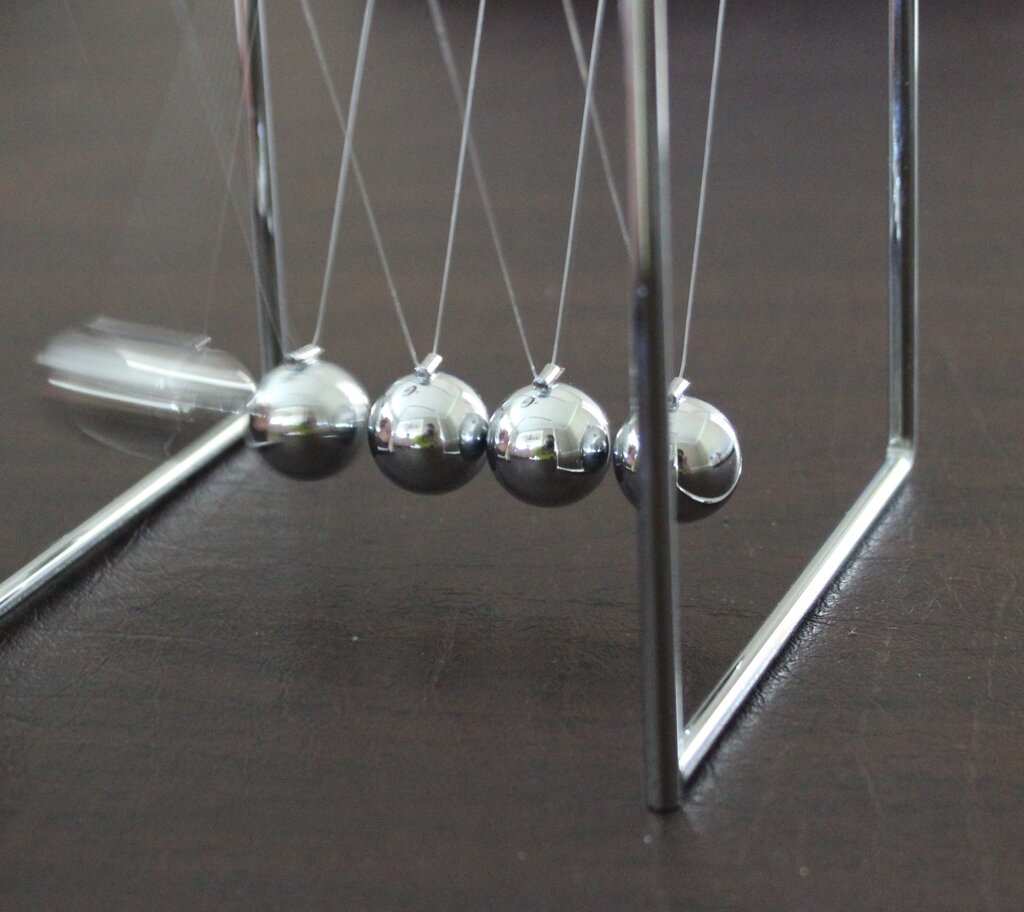
Momentum is another crucial concept, often described as "mass in motion." It's a measure of how hard it is to stop a moving object. A bowling ball and a tennis ball moving at the same speed have very different effects upon impact. The bowling ball is much harder to stop because it has more mass, and therefore more momentum.
In this equation, represents momentum. Like energy, momentum is a conserved quantity in a closed system. This means the total momentum before a collision is equal to the total momentum after the collision. This is the principle of conservation of momentum.
Think of a game of pool. When the cue ball hits a stationary ball, the momentum from the cue ball is transferred. Some of it stays with the cue ball, and some is given to the other ball, but the total momentum of both balls combined remains constant.
Changing an object's momentum requires applying a force over a period of time. This combination of force and time is called impulse. A small force applied for a long time can produce the same change in momentum as a large force applied for a short time. This is why airbags in cars are so effective. They increase the time over which the force of the impact is applied to your body, reducing the peak force and minimizing injury.
These principles of motion, energy, and momentum form the operating system for the physical world we experience every day.
Ready to test your understanding? Let's see how well you've grasped these foundational ideas.
A satellite is moving through the vacuum of space far from any planets or stars. If no external forces act on it, the satellite will:
If the same net force is applied to a bowling ball and a tennis ball, which one will have the greater acceleration?