The Fabric of Spacetime General Relativity
Special Relativity
Breaking the Speed Limit
For centuries, Isaac Newton's laws of motion were the final word on how things move. They work perfectly for everyday objects like baseballs, cars, and even planets. But in the late 19th century, physicists noticed something strange about light. According to Newtonian physics, if you're on a train moving at 50 mph and you throw a ball forward at 10 mph, someone standing on the ground sees the ball moving at 60 mph. Simple enough.
But light refused to play by these rules. No matter how fast you move towards or away from a light source, its speed always measures out to be the same value: about 299,792,458 meters per second. This was a huge puzzle. It seemed to break the classical rules of adding velocities. This is where Albert Einstein stepped in with a radical new idea.
Einstein's Special Theory of Relativity, published in 1905, is built on two simple but powerful ideas, or postulates.
| Postulate | Description |
|---|---|
| 1. The Principle of Relativity | The laws of physics are the same for everyone moving at a constant speed in a straight line. If you're in a windowless room on a perfectly smooth train, you can't perform any experiment to tell if you're moving or standing still. |
| 2. The Constancy of the Speed of Light | The speed of light in a vacuum is constant for all observers, regardless of their own motion or the motion of the light source. |
The first postulate makes sense. It's the second one that leads to some mind-bending consequences. If the speed of light is always the same for everyone, then something else must be changing. That something else is space and time itself.
Time and Space Get Flexible
One of the first casualties of Einstein's theory was the idea of 'now'. We tend to think of simultaneity—events happening at the same time—as absolute. But it turns out to be relative. Imagine standing on a train platform exactly halfway between two trees. At the exact same moment, lightning strikes both trees. Since you're in the middle, the light from both strikes reaches your eyes at the same time, and you correctly conclude the strikes were simultaneous.
Now, imagine a friend on a high-speed train moving past the platform. From their perspective, they are moving towards the light from one strike and away from the other. Because the speed of light is constant, the light from the tree they are approaching will reach them first. To your friend on the train, the two lightning strikes did not happen at the same time. Who is right? You both are. Simultaneity depends on your frame of reference.
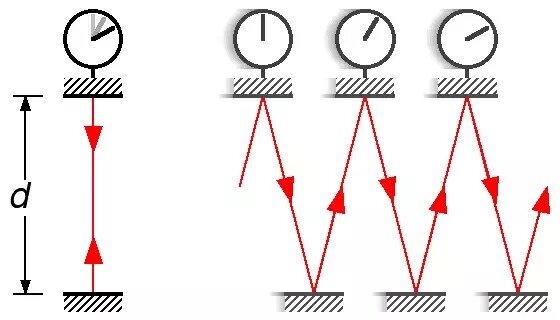
This leads directly to another strange effect: time dilation. To a stationary observer, a clock that is moving appears to tick more slowly. Imagine a clock made of two mirrors with a beam of light bouncing between them. Each bounce is one 'tick'. If this clock is at rest, the light travels a straight path up and down. But if the clock is moving, the light has to travel a longer, diagonal path to catch up to the moving mirrors. Since the speed of light is constant, covering this longer distance takes more time. The result? The moving clock ticks slower.
In this formula, is the time measured by a stationary clock, and is the time measured for the moving clock. The term (gamma) is the Lorentz factor, which is always greater than or equal to 1.
Space is also affected. An object moving at a relativistic speed appears shorter in its direction of motion to a stationary observer. This is known as length contraction. Just like time, the length you measure depends on your relative motion.
Here, is the length of the object when it's at rest (its 'proper length'), and is the shorter length measured by an observer watching it move.
The Math of Spacetime
These effects aren't just optical illusions; they are real properties of spacetime. To describe them mathematically, physicists use a set of equations called the Lorentz transformations. They are the relativistic replacement for the simple velocity-addition rules of Newtonian physics.
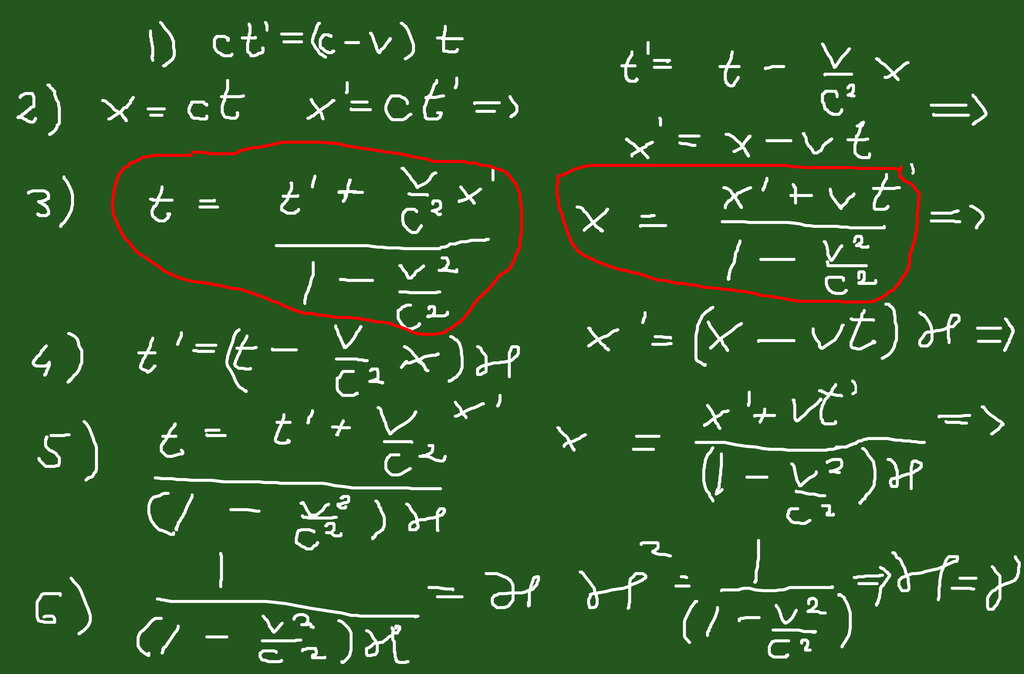
These equations provide a way to translate the coordinates of an event (a specific point in space at a specific moment in time) from one observer's reference frame to another's. Let's say one frame is at rest () and another is moving at a velocity along the x-axis (). The transformations are:
Notice how time and space are mixed together. In the equation for the new time coordinate, , there's a space term, . This is the mathematical heart of relativity: space and time are not separate and absolute. They are interwoven into a single four-dimensional fabric called spacetime. Special relativity gives us the rules for navigating this fabric when gravity isn't a major factor.
Let's test your understanding of these new ideas.
What was the central puzzle about the speed of light that contradicted classical Newtonian physics?
Imagine you are on a high-speed train. An observer on a platform sees two lightning bolts strike the front and back of the train at the exact same time. From your perspective on the train, which event happens first?
Special relativity reshaped our understanding of the universe, setting the stage for even bigger revelations about the nature of gravity.