The Evolution of Sound Recording
Early Sound Recording
Capturing Sound
For most of human history, sound was fleeting. A word spoken or a note played vanished the moment it was created, living on only in memory. That changed in the mid-19th century, thanks to a French inventor named Édouard-Léon Scott de Martinville.
In 1857, Scott de Martinville created a device called the phonautograph. Its goal wasn't to play back sound, but to see it. The machine used a horn to collect sound waves, which vibrated a stiff membrane. Attached to the membrane was a bristle from a pig, which traced a line onto a hand-cranked cylinder coated in soot. As sound entered the horn, the bristle etched a visual representation of the sound waves into the black soot.
Scott de Martinville had created the first known sound recordings, which he called "phonautograms." But there was a catch: you could look at them, but you couldn't listen to them. The machine had no way to reverse the process. It was like having a photograph of a song.
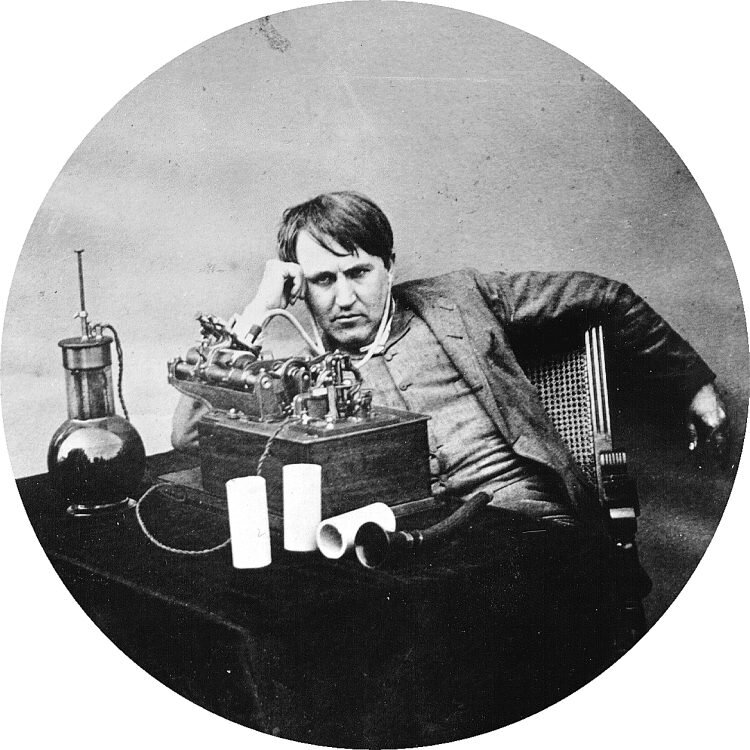
The breakthrough came twenty years later. In 1877, American inventor Thomas Edison was working on a device to record telegraph messages. He sketched a machine similar in concept to the phonautograph, but with a crucial difference. His invention, the phonograph, was designed for playback from the start.
From Marks to Music
Edison's first phonograph worked by wrapping a sheet of tinfoil around a grooved metal cylinder. The user would turn a crank and shout into a horn. The sound vibrations moved a diaphragm and a connected stylus, which indented the tinfoil into the groove. To play it back, a second stylus was traced back through the newly created groove. The indentations vibrated the stylus and diaphragm, reproducing the original sound, albeit faintly.
The first words Edison recorded and played back were from the nursery rhyme "Mary Had a Little Lamb." He was reportedly astonished that it actually worked.
These early devices were marvels, but they had serious limitations. The tinfoil recordings were extremely fragile and could only be played a few times before being destroyed. The sound quality was poor and distorted, like a faint, scratchy ghost of the original. Furthermore, a single cylinder could only hold a couple of minutes of audio.
Edison and others, like Alexander Graham Bell, soon replaced the tinfoil with hollow wax cylinders. Wax offered better sound quality and was more durable, allowing for more playbacks. This small change helped turn the phonograph from a curiosity into a viable commercial product.
A New Era for Sound
The invention of the phonograph was a monumental shift. For the first time, a moment in sound could be preserved and replayed. It allowed for the preservation of voices, music, and history in a way that had never been possible. The idea of capturing an event wasn't new, but capturing the sound of it was revolutionary.
This new technology sparked competition and innovation. While Edison focused on cylinders, other inventors developed flat discs for recording. Discs were easier to mass-produce and store, and they eventually won the market.
The Victor Victrola, a hornless cabinet machine, however, had caused an abrupt cultural change in the talking machine world and in the culture of the cylinder market, causing both Columbia and Edison to react to a change rather than produce new wares to advance cylinder technology.
The phonautograph and phonograph laid the groundwork for all subsequent audio technology. They introduced the fundamental principle of converting sound waves into a physical medium and back again. Without these noisy, fragile, and mechanically simple devices, the entire world of recorded audio, from vinyl records to digital streaming, would not exist.
Ready to test your knowledge?
What was the primary purpose of the first sound recording device, the phonautograph?
What key feature did Thomas Edison's phonograph have that the phonautograph lacked?
These early inventions marked the beginning of our ability to record and preserve the sounds of our world.