The Evolution of Mathematics
Ancient Mathematics
The Dawn of Numbers
Mathematics wasn't born in a classroom. It started with practical problems. Ancient societies needed ways to count livestock, measure land for farming, track the seasons for planting, and build structures that wouldn't fall down. The earliest math was a tool for survival and organization, developed independently in different parts of the world to solve everyday challenges.
Mesopotamia's Base 60
In Mesopotamia, the land between the Tigris and Euphrates rivers, the Babylonians created a sophisticated mathematical system around 4,000 years ago. Their most notable innovation was a base-60, or sexagesimal, number system. We still see echoes of it today in how we measure time (60 seconds in a minute, 60 minutes in an hour) and angles (360 degrees in a circle).
Why base 60? The number 60 is highly divisible. It can be evenly divided by 1, 2, 3, 4, 5, 6, 10, 12, 15, 20, and 30. This made calculations with fractions much simpler than in a base-10 system. They etched their calculations in cuneiform script onto clay tablets, thousands of which have survived.
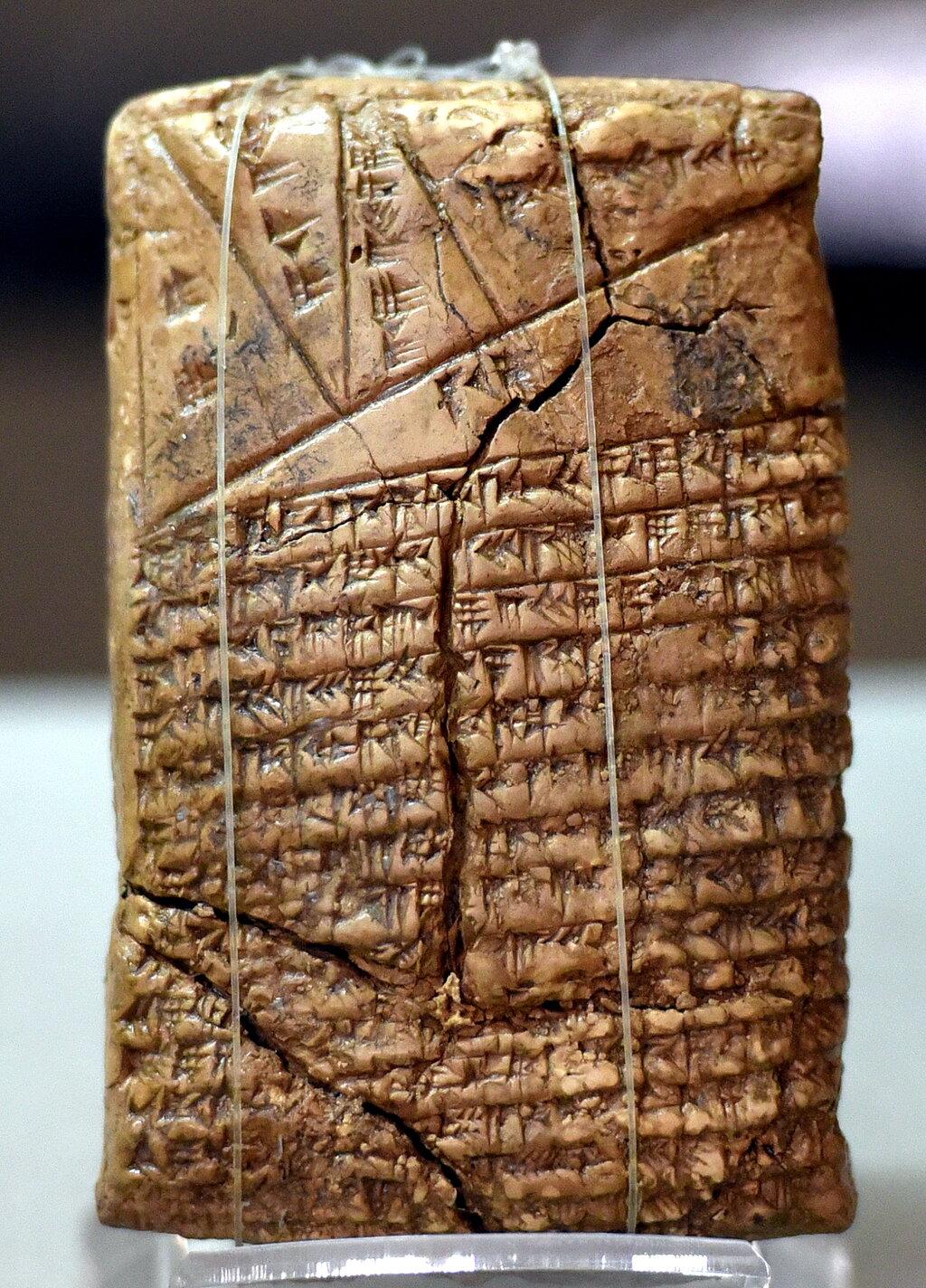
Babylonian scribes were skilled problem-solvers. They could solve systems of linear equations and even quadratic equations, which are equations that involve a variable squared, like . They used algebraic procedures to solve problems that we might write today as:
Their methods were recipe-like, providing step-by-step instructions to find the unknown quantity without explaining the underlying theory. They also knew about the relationship between the sides of a right triangle—what we call the Pythagorean theorem—long before Pythagoras was born.
Egypt's Practical Geometry
Ancient Egyptian mathematics was also driven by practical needs, especially geometry, or "earth-measuring." Each year, the Nile River flooded its banks, washing away property boundaries. The Egyptians developed geometric methods to accurately resurvey the land and re-establish plots for farming and taxation.
Their monumental construction projects, like the pyramids and temples, also required precise calculations. They could calculate the area of triangles, rectangles, and circles (using a surprisingly accurate approximation of ), as well as the volumes of cylinders and pyramids.
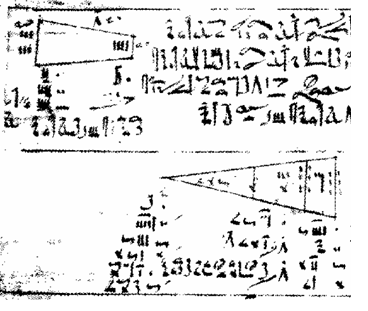
The Egyptians used a base-10 number system, similar to ours, but it was not positional. They had distinct hieroglyphs for 1, 10, 100, 1,000, and so on. To write the number 23, they would simply write the symbol for 10 twice and the symbol for 1 three times.
Their method for multiplication was clever, relying only on doubling and adding. To multiply 13 by 21, they would create two columns. In the first, they would start with 1 and keep doubling. In the second, they'd start with 21 and do the same. They would then find the numbers in the first column that add up to 13 (1, 4, and 8) and add the corresponding numbers from the second column to get the answer.
| Powers of 2 | 21 | Check |
|---|---|---|
| 1 | 21 | ✓ |
| 2 | 42 | |
| 4 | 84 | ✓ |
| 8 | 168 | ✓ |
Sum of checked rows in column 2: . So, .
The Greek Leap to Logic
The ancient Greeks inherited mathematical knowledge from the Egyptians and Babylonians, but they introduced a revolutionary idea. Instead of just knowing how to perform a calculation, the Greeks wanted to know why it worked. They were interested in abstract principles and logical certainty.
This shift led to the development of deductive reasoning, where conclusions are reached from a set of agreed-upon starting points, or axioms. This is the foundation of modern mathematics.
The seminal achievement of Euclid and the Greek geometers was to take geometric thinking and recast it as a deductive science, in which the known geometric results of the time were organized to follow from a few simple assumptions.
The most famous example of this approach is Euclid's Elements, written around 300 BCE. This textbook compiled and organized centuries of Greek geometric knowledge into a single, logical framework. Starting with just a few simple definitions, postulates, and axioms, Euclid rigorously proved hundreds of theorems.
For example, one of Euclid's postulates states that a straight line can be drawn between any two points. From such basic assumptions, he built a system that allowed him to prove complex results, like the Pythagorean theorem, from first principles.
This insistence on proof transformed mathematics from a collection of practical techniques into a structured, logical discipline. It laid the groundwork for all subsequent mathematical and scientific thought, showing that we can build vast systems of knowledge from a few simple, certain truths.
What was the primary advantage of the Babylonian base-60 (sexagesimal) number system for practical calculations?
The development of geometry in ancient Egypt was primarily driven by the practical need to:
These early civilizations set the stage for centuries of mathematical discovery, moving from practical calculations to the abstract beauty of logical proof.