The Evolution of Embeddings in AI
Introduction to Embeddings
Making Sense of Data
Computers don't understand words, images, or sounds the way we do. For a machine, a photo is just a grid of pixel values, and a word is just a sequence of characters. To perform tasks like recommending a movie or translating a sentence, a computer needs to understand the meaning and relationships behind this raw data. This is where embeddings come in.
What Are Embeddings?
At its core, an embedding is a way of representing complex, real-world objects as a list of numbers. This list of numbers is called a vector. Think about how we represent a location on Earth. We don't just describe it with words; we use two numbers: latitude and longitude. These two numbers are a simple vector that embeds a physical location into a mathematical space, a map.
vector
noun
An object that has both magnitude and direction. In machine learning, it's often represented as an array of numbers.
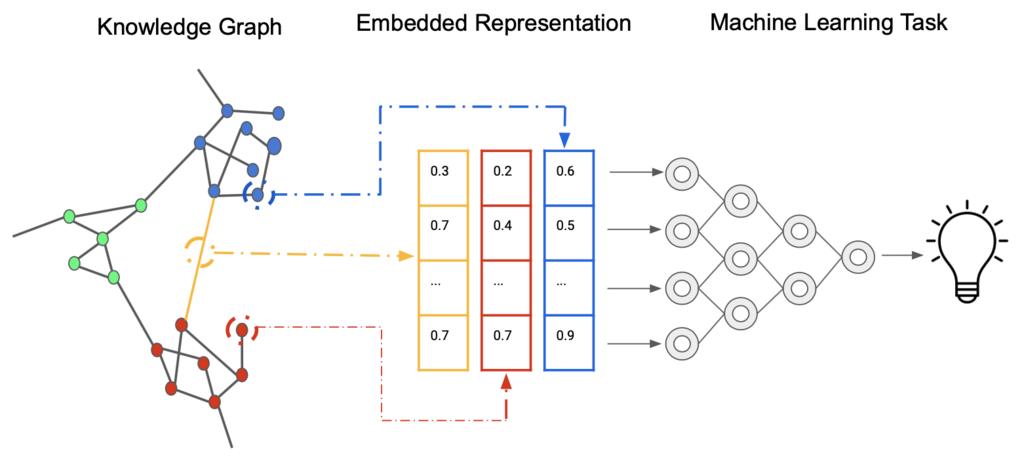
Embeddings do the same for more abstract concepts. A machine learning model learns to create a vector for a word, a product, or even a song. The key is that this isn't just a random list of numbers. The vector is carefully constructed so that it captures the essential qualities and relationships of the original item.
Embeddings translate complex data into a numerical language that machines can understand and work with.
For instance, in a well-trained model, the vector for the word "cat" will be mathematically close to the vector for "kitten." The vector for "king" might have a similar relationship to "queen" as "man" does to "woman." The machine doesn't know what a king or a queen is, but it can learn from the data that their vector representations are related in a specific way. This process turns abstract relationships into simple math.
Why Lower Dimensions Matter
One of the most powerful aspects of embeddings is dimensionality reduction. Many types of data are incredibly high-dimensional. A 1000x1000 pixel color image has a million pixels, and each pixel has three color values (red, green, blue). That's 3 million dimensions! Trying to find patterns in such a vast space is computationally expensive and often ineffective. It's like trying to find a friend in a megacity by checking every single address one by one.
Embeddings solve this by compressing the data into a much lower-dimensional space while preserving the most important information. Instead of 3 million dimensions for an image, a model might create a vector with just 512 dimensions. This makes calculations faster and helps the model focus on the meaningful patterns rather than getting lost in the noise.
Dimensionality reduction is like creating a summary of a very long book. You keep the main plot points and characters but leave out the less important details.
Embeddings in Action
Because they are so versatile at capturing meaning, embeddings are used in countless machine learning applications.
-
Recommendation Engines: When a service like Netflix or Spotify recommends something new, it's often using embeddings. It creates vectors for you and for every item (movie, song). It then finds items whose vectors are closest to yours, suggesting you'll probably like them.
-
Natural Language Processing (NLP): Search engines use embeddings to understand the intent behind your query, not just the keywords. They find documents whose embedded meaning is close to your query's embedded meaning. This is also crucial for machine translation and sentiment analysis.
-
Image Recognition: Computers can find visually similar images by comparing their embeddings. This powers features like reverse image search.
In each case, the principle is the same: complex objects are turned into meaningful vectors, and then simple mathematical operations on those vectors can yield powerful results.
What is the primary function of an embedding in machine learning?
In a well-trained model, the vector for "king" is mathematically related to the vector for "queen" in a similar way that the vector for "uncle" is related to the vector for ______.