The Evolution of Data Centers
Early Computing Facilities
The Age of Mainframes
Long before computers sat on our desks, they filled entire rooms. These weren't just powerful machines; they were destinations. The earliest computers, born in the 1940s, were giants of metal, wire, and vacuum tubes, and they required specialized facilities to house them. These buildings were the very first data centers.
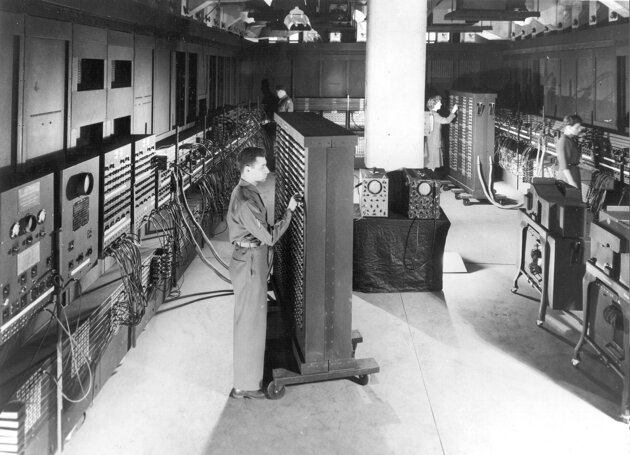
A prime example was the ENIAC, or Electronic Numerical Integrator and Computer. Completed in 1945, ENIAC weighed 30 tons and occupied 1,800 square feet. It wasn't programmed with code as we know it today. Instead, operators physically rewired it for each new task, a painstaking process that could take days. It contained over 17,000 vacuum tubes, which generated immense heat and failed frequently.
Rooms Built for Machines
Housing a machine like ENIAC wasn't a simple matter of finding a big enough room. These early computing facilities had demanding operational requirements. They needed massive amounts of electricity, comparable to that of a small town, just to power up. All that energy produced a tremendous amount of heat, making robust air conditioning systems essential to prevent the components from melting down.
Floors had to be reinforced to support the immense weight of the mainframes. Often, they were raised to create a space underneath for the thick bundles of cables connecting the different parts of the system. A full-time staff of engineers was also required, not just to operate the machine, but to constantly replace failing vacuum tubes and other components.
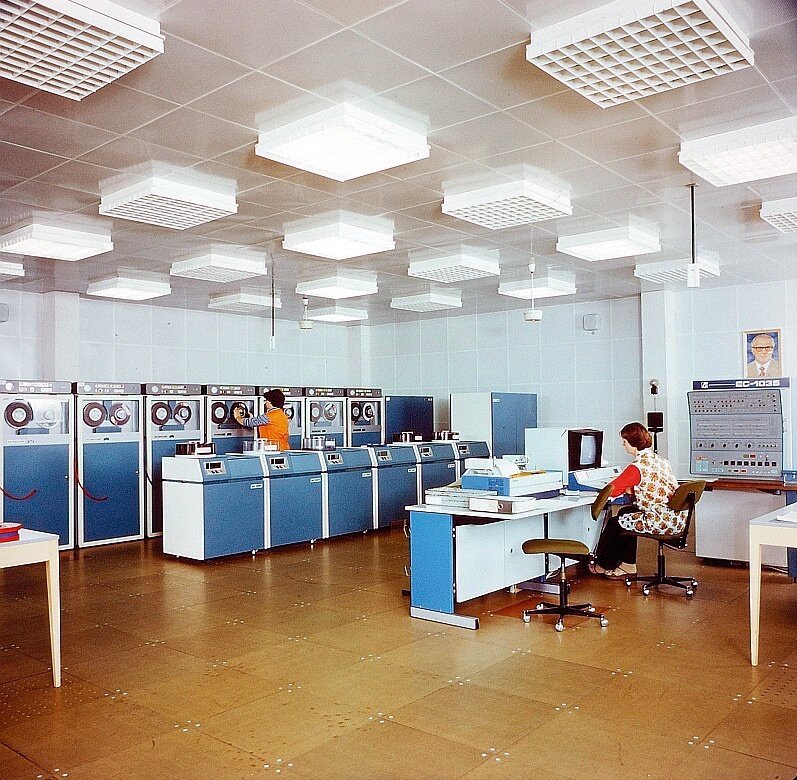
These enormous costs and complex requirements gave rise to the idea of centralized computing. An organization would have one single, colossal computer, and anyone who needed to run a calculation had to bring their problem to it. Users submitted their programs, often on punch cards, to a team of operators who would then run them on the machine. This model, where computing power is concentrated in one location, is the direct ancestor of the modern data center.
The first computing facilities were less like offices and more like industrial plants, built to serve the needs of a single, massive machine.
From the UNIVAC to the IBM System/360, these mainframes dominated computing for decades. They established the fundamental principles of housing, powering, and cooling large-scale computer systems—principles that, while vastly evolved, still underpin the data centers of today.