The Essence of Mathematics
Arithmetic
The Building Blocks
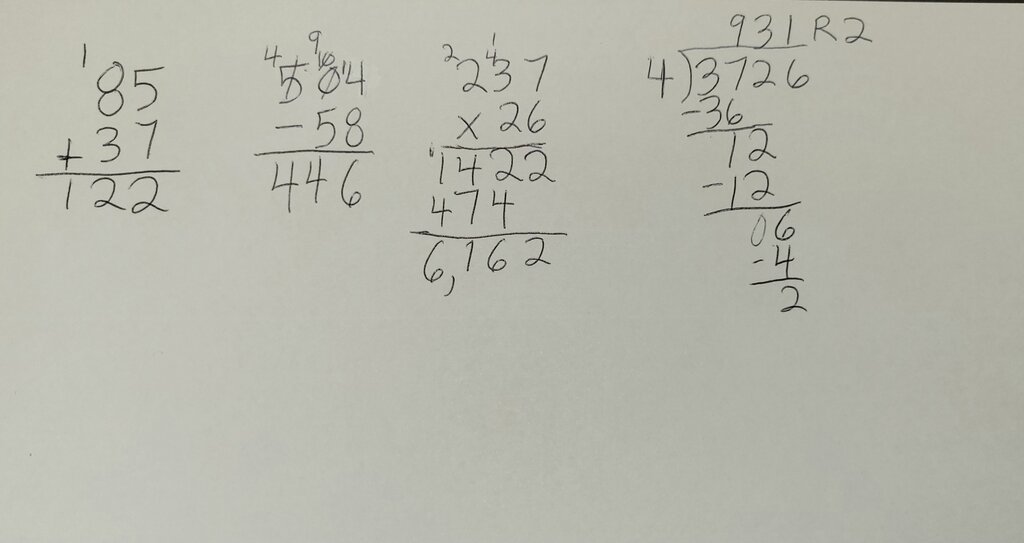
Everything in math starts with numbers. The simplest are whole numbers: 0, 1, 2, 3, and so on. These are the numbers we use for counting. With them, we can perform four basic operations.
Addition
noun
Combining values to find their total sum.
Think of addition as simply putting things together. If you have 3 apples and you get 2 more, you have 5 apples in total.
Subtraction
noun
Finding the difference between two values.
Subtraction is taking things away. If you have 8 slices of pizza and eat 3, you are left with 5.
Multiplication
noun
Repeated addition of a number to itself a certain number of times.
Multiplication is a shortcut for adding the same number over and over. Instead of writing , we can just write . Both equal 12. It's useful for when you have multiple groups of the same size.
Division
noun
Splitting a number into equal parts or groups.
Division is the opposite of multiplication. It’s about sharing or splitting. If you have 15 cookies to share among 3 friends, each friend gets 5 cookies. Sometimes, division doesn't work out perfectly, and you have a remainder—the amount left over.
Parts of a Whole
Not everything can be described with whole numbers. Sometimes we need to talk about parts of something, like half a pizza or a quarter of an hour. For this, we use fractions.
A fraction has two parts. The top number is the numerator, which tells us how many parts we have. The bottom number is the denominator, which tells us how many equal parts the whole is divided into.
Adding and subtracting fractions is straightforward when their denominators are the same. You just add or subtract the numerators and keep the denominator.
Decimals are another way to write fractions. Specifically, they represent fractions whose denominator is a power of 10 (like 10, 100, 1000). The decimal point separates the whole number part from the fractional part.
For example, the fraction is the same as the decimal 0.5. And is the same as 0.75. You can convert any fraction to a decimal by dividing the numerator by the denominator. To convert a decimal to a fraction, you use the place value of the last digit as the denominator. For example, 0.75 is 75 hundredths, or , which simplifies to .
Numbers in the Real World
Percentages are a special type of fraction where the denominator is always 100. The word "percent" literally means "per hundred." So, 25% means 25 out of 100, which can be written as the fraction or the decimal 0.25.
Percentages are everywhere in daily life. They're used for discounts at stores, interest rates on loans, tips at restaurants, and statistics in the news.
To find a percentage of a number, convert the percentage to a decimal and then multiply. For example, to find 20% of 💲50, you calculate .
Let's say a shirt originally costs $40 and is on sale for 25% off. The discount is . So, the sale price is . Understanding percentages helps you make smart decisions with your money.
Keeping Things in Order
When you have a calculation with multiple operations, the order you do them in matters. For example, what is the answer to ? If you add first, you get . If you multiply first, you get . Which one is correct?
To avoid confusion, mathematicians agreed on a standard order of operations. A common way to remember it is with the acronym PEMDAS.
| Letter | Stands For | What to do |
|---|---|---|
| P | Parentheses | First, solve anything inside parentheses. |
| E | Exponents | Next, calculate any exponents. |
| M/D | Multiplication and Division | Then, do all multiplication and division from left to right. |
| A/S | Addition and Subtraction | Finally, do all addition and subtraction from left to right. |
Following PEMDAS for , we do the multiplication first () and then the addition (). The correct answer is 14.
Let's try a more complex one: .
- Parentheses: . The expression becomes .
- Exponents: There are none.
- Multiplication/Division: From left to right, we do and . The expression is now .
- Addition/Subtraction: . The final answer is 14.
What about numbers less than zero? These are called negative numbers. You see them when talking about cold temperatures (–10 degrees), being in debt (having –$50 in your account), or elevation below sea level.
A number line can help visualize them. Zero is in the middle. Positive numbers go to the right, and negative numbers go to the left. Subtracting a number is the same as adding its negative counterpart. For instance, $10 - 4$ is the same as $10 + (-4)$. Both equal 6.
Ready to test your knowledge?
What is the result of the calculation ?
In the fraction , the number 7 is called the __________.
These concepts are the bedrock of mathematics. Mastering them opens the door to understanding more complex ideas down the road.