The Essence of Mathematics
Numbers and Quantity
The Building Blocks of Math
Numbers start with the simple act of counting. When you count objects—apples, books, cars—you're using natural numbers. They are the positive, whole numbers we first learn as kids: 1, 2, 3, 4, and so on, stretching out to infinity.
Natural Numbers: {1, 2, 3, ...}
What happens when you have no apples to count? That's where the number zero comes in. When we add zero to the set of natural numbers, we get the whole numbers. It's a small change, but adding zero was a huge leap in mathematics, allowing us to represent the concept of "nothing."
Whole Numbers: {0, 1, 2, 3, ...}
Expanding the Number Line
The world isn't just about having things; sometimes we owe things or experience temperatures below freezing. To represent these ideas, we need negative numbers. By including the negative counterparts of the natural numbers, we get the integers.
Integers: {..., -3, -2, -1, 0, 1, 2, 3, ...}
Integers can be visualized on a number line, with zero in the middle, positive numbers stretching to the right, and negative numbers to the left.
But what about the spaces between the integers? That's where rational numbers live. A rational number is any number that can be written as a fraction, or a ratio of two integers (as long as the bottom number isn't zero). This includes simple fractions like and , as well as all the integers, since any integer can be written as a fraction over 1 (for example, ).
When written as decimals, rational numbers either terminate (like ) or repeat a pattern forever (like ).
Some numbers, however, can't be written as a simple fraction. Their decimal representations go on forever without ever repeating. These are the irrational numbers. Famous examples include (the ratio of a circle's circumference to its diameter, approximately 3.14159...) and the square root of 2 (, approximately 1.41421...).
Putting Numbers to Work
The most basic use of numbers is counting. The fundamental idea behind it is the one-to-one correspondence principle: you assign exactly one number word to each object you're counting. If you have three pens, you count them "one, two, three." The last number you say is the total quantity.
Once we can count, we can perform operations. Arithmetic gives us the tools to combine or change quantities. The four basic operations are the foundation of almost all mathematics.
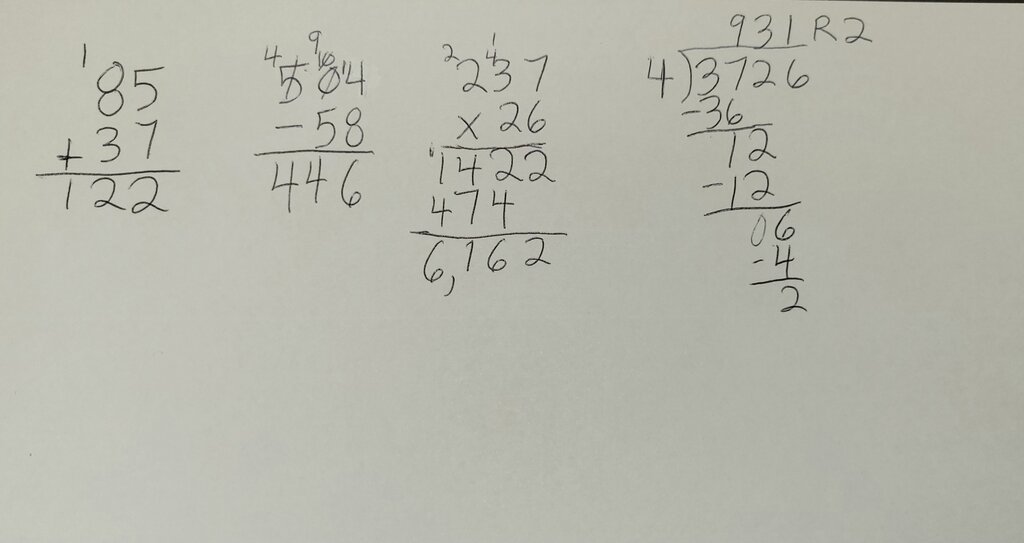
| Operation | Symbol | What it does |
|---|---|---|
| Addition | + | Combines values (sum) |
| Subtraction | - | Finds the difference between values |
| Multiplication | × | Adds a number to itself a certain number of times (product) |
| Division | ÷ | Splits a value into equal parts (quotient) |
These number types and operations are the essential toolkit for solving problems, from simple everyday calculations to complex scientific discoveries.
Which set of numbers includes all positive whole numbers, their negative counterparts, and zero?
The number 0.75 can be classified as a rational number.