The English Language Unpacked
Origins of English
The Family Tree of English
The story of English begins long before England existed. It starts with a language we can't read or hear, because it was never written down. Scholars call it Proto-Indo-European, or PIE. It was spoken thousands of years ago, likely in the steppes of what is now southern Russia and Ukraine.
Think of PIE as the great-great-grandparent of hundreds of modern languages, from Hindi and Persian to Spanish and English. We know it existed by comparing its descendants. Linguists act like detectives, finding related words across different languages and tracing them back to a common source. For example, the words for "father" in Sanskrit (pitṛ), Latin (pater), and Gothic (fadar) are too similar for coincidence. They all point back to a single PIE word, reconstructed as *pǝtḗr.
This diagram shows just a sliver of the vast PIE family. Our focus is on the branch that became English.
A Germanic Branch
Over millennia, as people migrated, PIE split into different dialects. One of these, spoken in Northern Europe, became Proto-Germanic. This was the ancestor of German, Dutch, Swedish, and English. The people who spoke it were not a single unified nation but a collection of tribes with related cultures and languages.
Proto-Germanic developed its own distinct sounds. One major change is known as Grimm's Law, named after Jacob Grimm (one of the Brothers Grimm). It describes a chain reaction where certain consonant sounds from PIE shifted. For instance, the PIE sound 'p' became 'f' in Proto-Germanic. That's why we have father in English and Vater in German, but pater in Latin.
| PIE Sound | Proto-Germanic Sound | Example (PIE > Latin > English) |
|---|---|---|
| p | f | **p*od- > pedis > foot |
| t | th (þ) | **t*reyes > tres > three |
| k | h | **k*erd- > cordis > heart |
These sound shifts are like a genetic marker, helping us identify which languages belong to the Germanic family. Words like water, mother, and ship are all part of this ancient inheritance.
Arrival in Britain
For centuries, the island of Britain was a Roman province, inhabited by Celtic-speaking Britons. But as the Roman Empire crumbled in the 5th century, its legions withdrew, leaving the island vulnerable. Soon after, new groups began crossing the North Sea.
These were the Angles, Saxons, and Jutes, Germanic tribes from what is now Denmark and northern Germany. They came first as mercenaries, then as settlers, pushing the native Britons west into what we now call Wales, Cornwall, and Scotland. The newcomers brought their dialects of West Germanic with them.
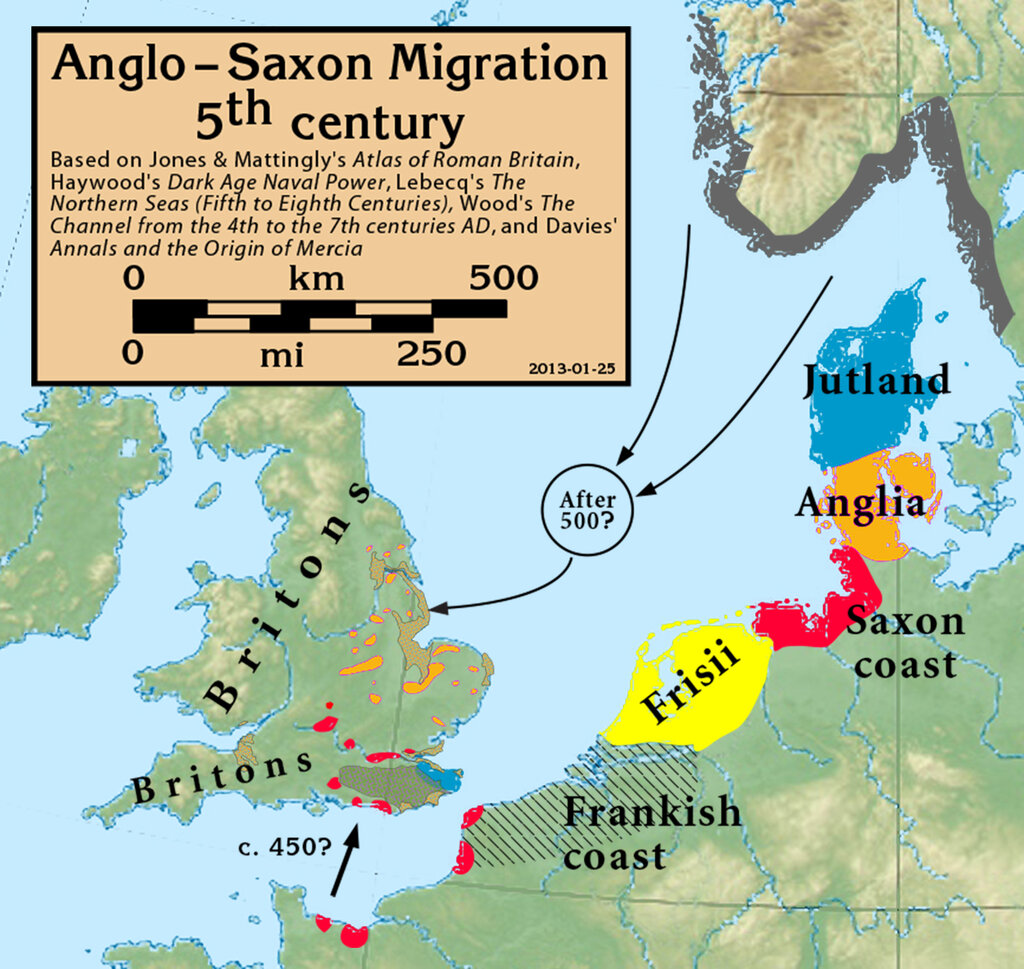
Over time, these closely related dialects began to merge in their new home. The land became known as Englaland (the land of the Angles), and their speech came to be called Englisc. This was the birth of Old English.
Englisc
noun
The Old English name for the English language.
Old English sounded very different from the English we speak today. It was a heavily inflected language, meaning word endings changed to show grammatical function, similar to modern German or Latin. The core of our everyday vocabulary comes from this period: simple, essential words like mann (man), wīf (woman, wife), cild (child), hūs (house), etan (eat), and drincan (drink).
This Germanic foundation provided the structure and basic vocabulary of English. Words for family, the body, farming, and the weather are overwhelmingly from Old English.
Although the Norman Conquest in 1066 would later introduce a massive amount of French vocabulary, the language's fundamental grammar and core words remained firmly Germanic.
The blending of Norman French with Anglo-Saxon English led to the emergence of Middle English, a language that integrated elements of both linguistic traditions.
But that's a story for another time. The key takeaway is that the skeleton of modern English was formed during this early period, built from the linguistic bones of Proto-Germanic and its ancestor, PIE. Everything that came after was layered on top of this strong foundation.
What is the name of the prehistoric language that is considered the ancestor of English and hundreds of other languages like Spanish, Hindi, and Russian?
The development of the English word 'father' from the reconstructed Proto-Indo-European word '*pǝtḗr' is a classic example of what linguistic principle?
From its deep roots to its arrival in Britain, the journey of the English language is a story of migration and transformation.