The Enduring Power of Latin
Origins of Latin
The Language of Latium
Long before Rome was an empire, the Italian peninsula was a patchwork of different tribes and languages. In a small region on the west coast called Latium, people spoke a dialect that would one day be known as Latin. It was just one of many Italic languages, and for a long time, it wasn't particularly special.
These early speakers were farmers and herders living in small communities. Their language was practical, suited for discussing crops, family, and local affairs. It existed alongside other tongues like Oscan, Umbrian, and Faliscan. The rise of Latin wasn't inevitable; it was a direct result of the political and military growth of one of Latium's cities: Rome.
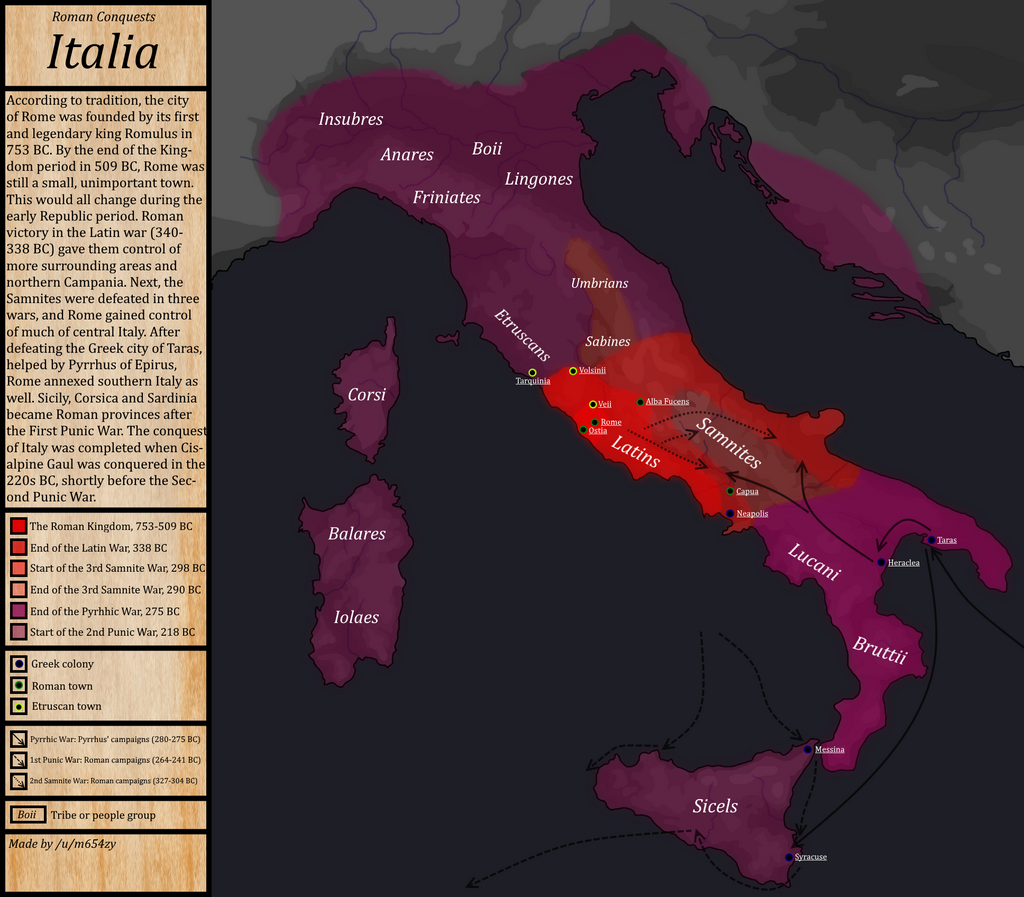
As Rome expanded its influence through treaties and conquest, it brought its language along. Latin became the language of administration, law, and the military in the territories Rome controlled. Over centuries, it slowly displaced the other local languages, unifying the peninsula under a single tongue.
Borrowing an Alphabet
The early Latins could speak their language, but they couldn't write it. For that, they looked to their more established neighbors. To the north were the Etruscans, a mysterious and advanced civilization with their own unique language and a writing system. To the south, Greek colonies dotted the coast, bringing with them Greek culture, philosophy, and, importantly, their alphabet.
The Romans adapted what they needed from both. The Greek alphabet itself was an adaptation of the Phoenician script. The Etruscans had borrowed this Greek script and modified it for their own language. The Romans, in turn, borrowed the Etruscan version and tweaked it to fit the sounds of Latin.
Greek Alphabet → Etruscan Alphabet → Latin Alphabet
This process of borrowing and adapting explains some of the quirks of the Latin alphabet. For instance, the Etruscan language didn't distinguish between the sounds for 'k' and 'g'. They used the Greek letter gamma (Γ) for their 'k' sound. Early Latin did the same, using the letter C (derived from gamma) for both sounds. This is why the names Gaius and Gnaeus were often abbreviated as C. and Cn.
Forging the Alphabet
The early Latin alphabet was not identical to the one we know. It was a work in progress. For example, to solve the C/G confusion, a new letter was invented: G. It was created by simply adding a small bar to the letter C. Problem solved.
Other letters were dropped or added over time. The letter Z was borrowed from Greek early on, then fell out of use because Latin didn't have a 'z' sound. It was later reintroduced to help write Greek loanwords. The letters Y was also added for the same reason. The distinction between I and J, and between U and V, came much, much later, during the Renaissance.
| Greek | Etruscan | Early Latin | Classical Latin |
|---|---|---|---|
| Α (Alpha) | A | A | A |
| Β (Beta) | 𐌁 | B | B |
| Γ (Gamma) | 𐌂 | C (for G & K) | C, G |
| Δ (Delta) | D | D | D |
| Ε (Epsilon) | E | E | E |
| Ζ (Zeta) | 𐌆 (Z) | (dropped) | Z (re-added later) |
This table shows just a few examples of the alphabet's evolution. Through a series of practical adjustments, a script borrowed from neighbors was refined into the powerful tool that would record the literature, laws, and history of Rome. It was a slow, organic process, driven by the need to make writing match the spoken word as accurately as possible.