The Element Carbon
Atomic Structure
The Carbon Atom
Every element is defined by the number of protons in its atoms. For carbon, that number is six. This is its atomic number, and it's what makes carbon, well, carbon. If an atom doesn't have six protons, it isn't carbon.
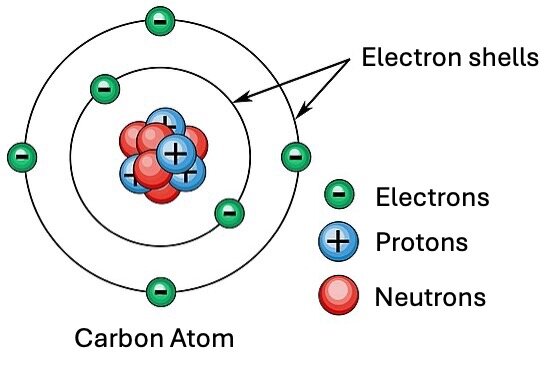
Along with protons, the nucleus also contains neutrons. The most common form of carbon has six neutrons. Since protons and neutrons each have a mass of about one atomic mass unit (amu), this version of carbon has an atomic mass of 12 amu. The electrons are so light that their mass is usually ignored in this calculation.
Electron Configuration
An atom's electrons orbit the nucleus in shells, or energy levels. A neutral carbon atom has six electrons to balance its six protons. They are arranged in a specific way. The first, innermost shell can only hold two electrons. Once that shell is full, the remaining four electrons go into the second shell, which is also carbon's outermost or valence shell.
This arrangement can be written as . This notation tells us there are two electrons in the first energy level (the '' orbital) and four electrons in the second energy level (the '' and '' orbitals). These four outer electrons are what allow carbon to form a vast number of different compounds, a topic for another time.
Carbon's Isotopes
While the number of protons in a carbon atom is always six, the number of neutrons can change. Atoms of the same element with different numbers of neutrons are called isotopes.
| Isotope | Protons | Neutrons | Mass Number | Natural Abundance |
|---|---|---|---|---|
| Carbon-12 | 6 | 6 | 12 | ~99% |
| Carbon-13 | 6 | 7 | 13 | ~1% |
| Carbon-14 | 6 | 8 | 14 | Trace amounts |
Carbon-12 is the most common isotope and is used as the standard by which the mass of all other atoms is measured. Carbon-13 is stable, like Carbon-12, but much rarer.
Carbon-14 is the most interesting of the three. With eight neutrons, its nucleus is unstable and radioactive. It decays over time at a predictable rate, which makes it incredibly useful for archaeologists and geologists. By measuring the amount of Carbon-14 left in an organic artifact, they can determine its age in a process called radiocarbon dating.
Let's test your understanding of carbon's atomic structure.
What fundamentally determines that an atom is a carbon atom?
A neutral carbon atom has six electrons. How are its four valence electrons arranged?
Understanding carbon's atomic number, electron shells, and isotopes is the first step to appreciating its unique role in chemistry and life.