The Electron Explained
Introduction to Electrons
The First Piece of the Puzzle
For a long time, atoms were thought to be the smallest, most fundamental building blocks of matter. The word atom even comes from the Greek word atomos, which means "indivisible." But in the late 19th century, experiments with cathode rays, which are streams of particles in vacuum tubes, suggested there was something smaller.
In 1897, the physicist J.J. Thomson was studying these rays. He found that they were made of particles that were incredibly small, much smaller than any known atom, and carried a negative electric charge. He had discovered the first subatomic particle: the electron.
An Electron's Identity
So what exactly is an electron? It's a fundamental particle, meaning it can't be broken down into smaller pieces. It's a member of a family of particles called leptons.
electron
noun
A stable subatomic particle with a negative electric charge, found in all atoms.
Electrons have a few key properties that define them.
Charge: An electron has a negative electric charge. This charge, denoted as , is considered the fundamental unit of electric charge. All other charges are multiples of this amount.
Mass: Electrons are incredibly light. An electron's mass is about 1/1836th the mass of a proton. To put that in perspective, if a proton were the size of a bowling ball, an electron would be about the size of a small pea.
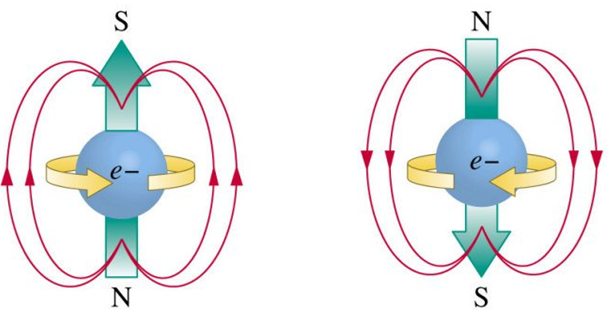
Spin: Electrons have an intrinsic property called spin. You can think of it as the particle constantly spinning, which gives it a tiny magnetic field. This property is fundamental to magnetism and how electrons arrange themselves in atoms.
The Atom's Architect
Electrons are a crucial part of an atom's structure. They move in the space surrounding the atom's dense central core, called the nucleus. The nucleus contains positively charged protons and neutral neutrons.
The negative charge of the electrons is attracted to the positive charge of the protons. This electromagnetic force is what holds the atom together, keeping the electrons bound to the nucleus.
The number and arrangement of electrons in an atom determine its chemical properties. When atoms bond to form molecules, it's the outermost electrons that do all the work, getting shared or transferred between atoms. Without electrons, there would be no chemistry.
Electrons in Action
Because they are charged particles, electrons are affected by electric and magnetic fields. An electric field will push or pull on an electron, causing it to accelerate. A magnetic field will cause a moving electron to change its direction, forcing it into a curved path.
This behavior is the basis for much of our technology. The controlled flow of electrons through a material is what we call an electric current. It's what powers our lights, computers, and everything else that plugs into a wall.
Understanding the electron was the first step into the world of particle physics, and it opened the door to understanding everything from chemical bonds to the electricity that powers our lives. It's a small particle with a huge impact.
Who is credited with discovering the electron in 1897 while studying cathode rays?
Which statement best describes a key property of an electron?