The Electoral College Explained
Origins and Purpose
A Presidential Puzzle
When the framers of the Constitution gathered in Philadelphia in 1787, they faced a monumental task: designing a new government. One of the thorniest problems was deciding how to choose a president. The delegates were wary of concentrating too much power in one place.
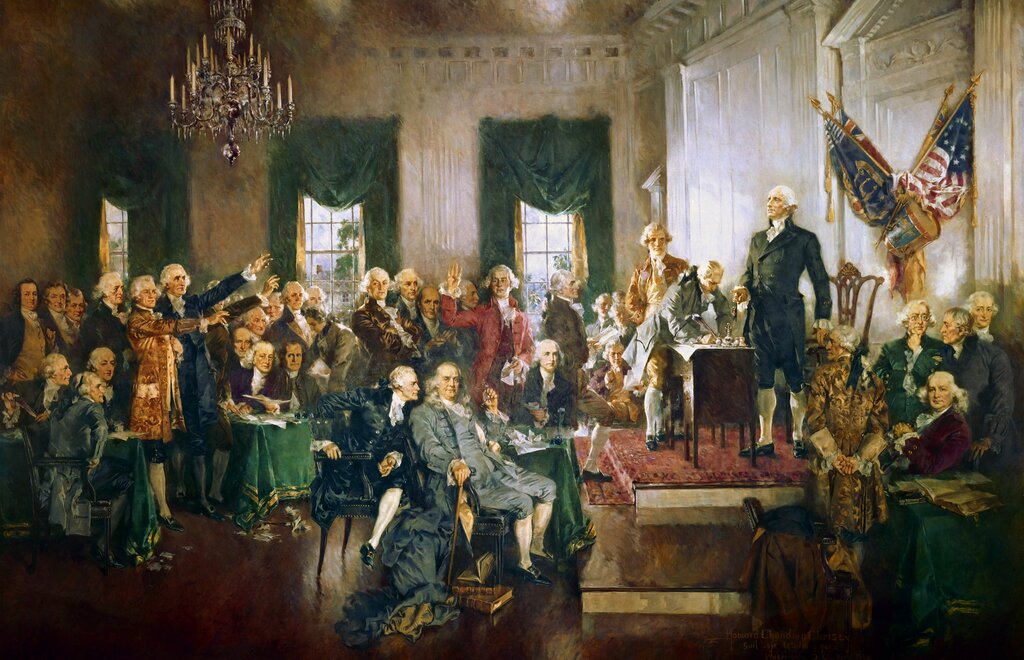
Several ideas were on the table. Some argued that Congress should elect the president. This would be simple, but it raised concerns about corruption and the separation of powers. A president chosen by the legislature might feel indebted to them, undermining the executive branch's independence.
Others, like James Madison, championed a direct popular vote. This seemed more democratic, but it also had its critics. Delegates from smaller states worried that candidates would only focus on populous states, ignoring their interests entirely. There were also practical concerns about the sheer scale of a national election in a large, sparsely populated country with slow communication.
The Constitutional Convention in 1787 settled on the Electoral College as a compromise between delegates who thought Congress should select the president and others who favored a direct nationwide popular vote.
The Electoral College emerged as a middle ground, a complex system designed to balance competing interests. It was an indirect method of election, creating a buffer between the population and the final choice.
States, Power, and Slavery
Beyond the method of election, the framers had to decide how to apportion power among the states. The number of electors for each state was set to equal its number of representatives in the House plus its two senators. This gave a slight advantage to less populous states, as every state gets two senators regardless of size.
But this calculation was deeply entangled with the issue of slavery. Southern delegates wanted to count their enslaved population to increase their political power, while Northern delegates opposed it. The dispute was settled by the infamous Three-Fifths Compromise.
The Three-Fifths Compromise dictated that for purposes of representation and taxation, three-fifths of the enslaved population would be counted. This increased the number of seats southern states had in the House of Representatives, and consequently, the number of electoral votes they controlled.
This compromise had a direct impact on presidential elections. By boosting the representation of slaveholding states, it gave them more influence in choosing the president than their free population would have warranted. For example, in 1790, Virginia had 40% of its population enslaved. The compromise gave Virginia significantly more electors than it would have had if only free citizens were counted.
The Original Design
The way the Electoral College was first designed is quite different from how it works today. Originally, state legislatures decided how to choose their electors. These electors would then meet and cast two votes for president. They could not cast both votes for the same person, and at least one of their votes had to be for a candidate from outside their home state.
The votes from all states were then sent to the president of the Senate. The candidate with the most votes, provided it was a majority, became president. The person with the second-highest number of votes became vice president.
This two-vote system was created before the existence of political parties. The framers expected electors to be independent thinkers who would choose the two most qualified individuals for the nation's highest offices.
However, the quick rise of partisan politics threw a wrench in the works. The election of 1800 resulted in a tie between Thomas Jefferson and his own running mate, Aaron Burr, creating a constitutional crisis. This flaw led to the passage of the 12th Amendment, which separated the votes for president and vice president.
Ready to check your understanding of why the framers made these choices?
What was a primary reason the framers of the Constitution created the Electoral College instead of a direct popular vote for president?
How did the Three-Fifths Compromise directly affect presidential elections?
The Electoral College wasn't a sudden invention but a carefully constructed, if flawed, compromise. It was a product of its time, designed to solve the specific political challenges of the 18th century.