The Economy Explained
Economic Fundamentals
The Heartbeat of the Market
At its core, an economy is just a collection of people making decisions. Two of the most powerful forces guiding these decisions are supply and demand. They are the two sides of every transaction, determining the price of everything from a cup of coffee to a car.
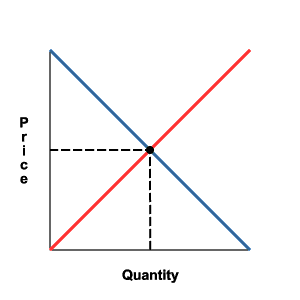
Supply and demand are the forces that make market economics work.
Let's start with demand. The Law of Demand is simple: when the price of something goes down, people will want to buy more of it. If your favorite coffee shop cuts the price of a latte from $5 to $3, you're more likely to buy one. Conversely, if the price jumps to $7, you might think twice.
Then there's supply. The Law of Supply works in the opposite direction: when the price of something goes up, producers are willing to make more of it. If coffee shops can sell lattes for $7, they have a strong incentive to brew more coffee and hire more baristas. If the price drops to $3, some shops might cut back on staff or even stop selling lattes altogether because it's less profitable.
Equilibrium
noun
The point where the quantity of a good that buyers are willing to buy is exactly equal to the quantity that sellers are willing to sell.
So, how is a price actually set? This happens when supply and demand meet. The market is constantly searching for a sweet spot called equilibrium, where the amount producers want to sell at a certain price matches the amount consumers want to buy at that price. This is the point where the supply and demand curves cross.
The Market's Playground
Supply and demand don't operate in a vacuum. They play out in different types of markets, each with its own set of rules and level of competition. These are known as market structures.
The structure of a market affects how firms behave and how prices are set.
On one end of the spectrum is perfect competition. Imagine a giant farmers' market where thousands of farmers sell identical potatoes. No single farmer can charge more than the market price, because buyers can just walk to the next stall. In this structure, prices are driven purely by supply and demand.
On the opposite end is a monopoly. This is a market with only one seller. Think of your local water company. If you want running water, you have only one choice. This gives the monopolist significant power to set prices, since there's no competition.
Most real-world markets fall somewhere in between these two extremes. Here’s a quick breakdown of the main types:
| Structure | Number of Firms | Type of Product | Price Control |
|---|---|---|---|
| Perfect Competition | Many | Identical | None |
| Monopolistic Competition | Many | Differentiated | Some |
| Oligopoly | A Few | Identical or Differentiated | Significant |
| Monopoly | One | Unique | Total |
Monopolistic competition involves many sellers offering similar but not identical products, like restaurants or hair salons. They compete on price, but also on quality, branding, and location. An oligopoly is dominated by a few large firms, such as the airline or mobile phone industries. The actions of one firm can have a big impact on the others.
Setting the Rules
Sometimes, governments step into the market to influence outcomes. They might do this to correct a perceived unfairness, provide a public good, or manage the economy. These actions are called government interventions.
One common intervention is a price control. A price ceiling sets a maximum price for a good or service. Rent control in some cities is a classic example. The goal is to make housing more affordable. However, if the ceiling is set below the equilibrium price, it can lead to a shortage, because landlords have less incentive to offer apartments while more people are looking for cheap rent.
A price floor does the opposite, setting a minimum price. The minimum wage is a type of price floor for labor. It's intended to ensure workers earn a living wage. If the minimum wage is set above the market equilibrium wage, it can cause a surplus of labor—also known as unemployment—because more people want to work at that wage than businesses are willing to hire.
Other interventions include taxes (which can decrease supply or demand) and subsidies (which can increase them). Each tool has its own set of goals and potential side effects.
Ready to check your understanding? Let's see what you've learned.
According to the Law of Supply, if the market price for coffee beans increases, what are coffee growers most likely to do?
What is the economic term for the point where the quantity of a product that consumers want to buy is equal to the quantity that producers are willing to sell?
Understanding these basic building blocks—supply and demand, market structures, and the role of government—is the first step to thinking like an economist. They provide a powerful framework for analyzing everything from your personal finances to global economic trends.