The Double-Slit Experiment Explained
Introduction to Wave-Particle Duality
Particles vs. Waves
In our everyday world, the difference between a particle and a wave seems obvious. A particle is a tiny, localized object, like a grain of sand or a baseball. It has a definite position at any given moment. A wave, on the other hand, is a spread-out disturbance, like a ripple in a pond or a sound traveling through the air. It doesn't have a single, precise location; it occupies a region of space.
For centuries, physicists believed everything in the universe fit neatly into one of these two categories. Light was considered a wave, and matter, like electrons, was made of particles. This clean distinction worked perfectly well for explaining the large-scale world. But as scientists began to probe the strange realm of the very small, this classical view started to fall apart.
Light's Identity Crisis
For a long time, light was the textbook example of a wave. Experiments showed it could bend around corners (diffraction) and create interference patterns, just like water waves. But at the turn of the 20th century, a puzzling phenomenon called the photoelectric effect challenged this idea.
Scientists observed that when light shines on a metal surface, it can knock electrons loose. According to classical wave theory, a brighter light (higher intensity) should carry more energy and therefore knock out electrons with more force. But this isn't what happened. Instead, the energy of the ejected electrons depended only on the light's frequency (its color), not its brightness. A dim, high-frequency violet light could eject electrons, while a very bright, low-frequency red light did nothing at all.
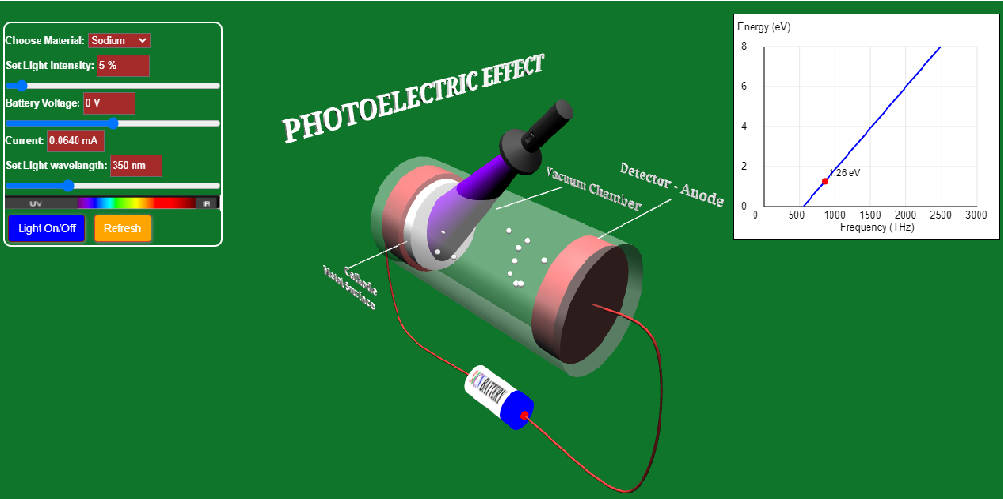
In 1905, Albert Einstein proposed a revolutionary solution. He suggested that light isn't a continuous wave but is instead made of discrete packets of energy he called "photons." Each photon has an energy directly proportional to its frequency. This explained the photoelectric effect perfectly: a single photon had to have enough energy on its own to knock an electron free. Turning up the brightness just meant sending more photons, but if each one was too weak (low frequency), nothing would happen.
This formula states that the energy () of a photon is equal to its frequency () multiplied by a constant () known as Planck's constant. Suddenly, light started to look a lot like a particle.
Further experiments, like the Compton effect in 1923, solidified this idea. When a photon collides with an electron, they bounce off each other just like two billiard balls, conserving energy and momentum. This was clear particle-like behavior.
Matter Acts Like Waves
So light, which everyone thought was a wave, sometimes acts like a particle. The story gets even stranger. In 1924, physicist Louis de Broglie made a bold suggestion: if waves can act like particles, maybe particles can act like waves. He proposed that all matter, including electrons, has a wavelength associated with it.
De Broglie's hypothesis predicted that the wavelength () of any object is equal to Planck's constant () divided by its momentum (). For large objects like a baseball, the momentum is so huge that the wavelength is absurdly small, far too tiny to ever notice. But for a tiny particle like an electron, the wavelength is significant enough to be detected.
A few years later, experiments confirmed de Broglie's idea. Scientists found that a beam of electrons could be diffracted, just like a beam of light. They were behaving like waves.
The wave-particle duality has indicated that a quantum object may exhibit the behaviours of both wave and particle, depending upon the circumstances of the experiment.
This is the core of wave-particle duality. Tiny objects like photons and electrons don't commit to being either a particle or a wave. Instead, they exhibit properties of both. Which property you observe depends entirely on how you measure it. If you set up an experiment to detect a particle's position, you'll find a particle. If you set up an experiment to detect a wave's interference, you'll find a wave.
This concept shatters our classical intuition. In the quantum world, an object's nature isn't fixed; it's a blend of possibilities that only resolves into a single reality when we interact with it.
Ready to check your understanding of this strange new reality?
The photoelectric effect demonstrated that the energy of electrons ejected from a metal surface depends on what property of the light?
Who proposed that particles like electrons could also exhibit wave-like properties?
This dual nature is a fundamental pillar of quantum mechanics, forcing us to abandon our simple, everyday pictures of reality and embrace a much more subtle and interconnected view of the universe.