The Double-Slit Experiment Explained
Introduction to Quantum Mechanics
A Different Kind of Reality
In our everyday world, things are predictable. A thrown baseball follows a clear path. A car is either in the garage or it's not. This is the realm of classical physics, the rules of which have governed our understanding for centuries. But when we zoom in to the scale of atoms and electrons, these familiar rules break down. Welcome to the world of quantum mechanics, where objects can be in multiple places at once and behave as both particles and waves.
This isn't just a quirky theory; it's the foundation of modern technology, from smartphones to medical imaging. Understanding its core principles means rethinking what it means for something to be somewhere or be something.
Wave or Particle?
One of the first quantum puzzles was the nature of light. Sometimes, it acts like a wave, spreading out and creating interference patterns, much like ripples in a pond. At other times, it acts like a stream of tiny, discrete packets of energy called photons, knocking electrons off a metal surface. This strange behavior is called wave-particle duality.
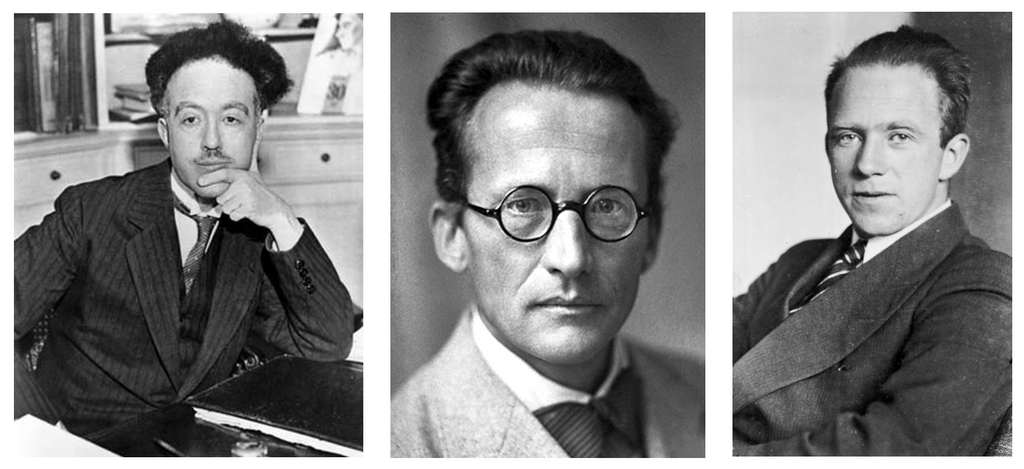
In the 1920s, physicist Louis de Broglie made a bold proposal: if waves like light can act like particles, then maybe particles like electrons can act like waves. He suggested that all matter has a wavelength, connecting its momentum to its wave-like nature.
So, why don't you see a baseball diffracting like a wave when you throw it? Its momentum is so large that its wavelength is incredibly tiny, far too small to ever be detected. But for a subatomic particle like an electron, the wavelength is significant enough to affect its behavior dramatically. It's not that the electron is either a wave or a particle; it's that it is a quantum object that can reveal either of these properties depending on how we interact with it.
Many States at Once
Another core concept of quantum mechanics is superposition. It states that a quantum system can exist in multiple states or locations at the same time. Think of a spinning coin. Before it lands, it's not definitively heads or tails—it's a blur of both possibilities. Superposition is the quantum version of this.
An electron, for example, isn't orbiting a nucleus in a neat, clean path like a planet around the sun. Instead, it exists in a cloud of probability, a superposition of many possible locations. It's only when we perform a measurement—when we "look" for the electron—that this cloud collapses and it settles into a single, definite position. The act of observation forces the quantum system to "choose" a state.
In the quantum world, an object exists as a wave of possibilities until it is measured. Measurement collapses the wave, forcing a single outcome.
This idea was revolutionary because it introduced probability directly into the laws of physics. Before quantum mechanics, physicists believed that if you knew all the conditions of a system, you could predict its future with certainty. Quantum mechanics showed that at the most fundamental level, the universe is governed by chance. We can only calculate the probability of finding a particle in a certain state or place.
Ready to check your understanding of these strange new rules?
What is the core idea of wave-particle duality?
According to the principle of superposition, what can be said about a quantum particle before it is measured?
These concepts—wave-particle duality and superposition—are the building blocks for understanding even more fascinating quantum phenomena.