The Dollar's Reign Global Currency
Origins of Dollar Dominance
A World Rebuilt
The end of World War II in 1945 left much of the world in ruins. The economies of Europe and Asia were shattered, their industries destroyed and their finances in chaos. In this landscape of devastation, one country stood out as a beacon of economic strength: the United States.
Unlike the other major powers, the U.S. mainland was untouched by the war. Its industrial base had not only survived but had grown massively to support the war effort. By 1945, the U.S. accounted for about half of the world's manufacturing output. Critically, it also held around two-thirds of the world's gold reserves, the traditional bedrock of economic value.
This immense economic power gave the United States a unique position to shape the postwar world.
The Bretton Woods Agreement
Even before the war ended, leaders of the Allied nations knew they needed a plan to prevent a repeat of the economic turmoil that had plagued the 1930s. Competitive currency devaluations and trade barriers had worsened the Great Depression and fueled the rise of nationalism. To create a more stable system, representatives from 44 nations gathered in Bretton Woods, New Hampshire, in July 1944.
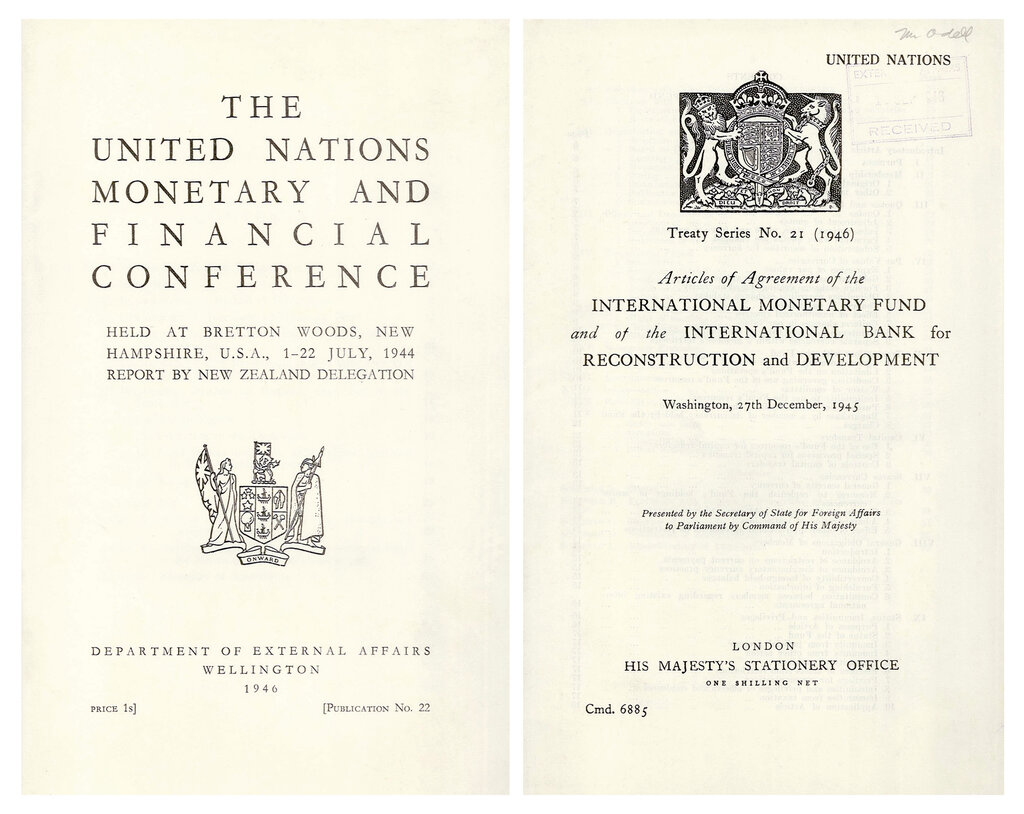
The goal was to create a framework for international economic cooperation. The outcome was a new monetary system, famously known as the Bretton Woods system. The agreement also established two crucial new institutions: the International Monetary Fund (IMF) and the World Bank.
The IMF was designed to promote international monetary cooperation and provide temporary financial assistance to countries with balance of payments problems. The World Bank was created to provide loans for the reconstruction of war-torn countries and to support development in poorer nations.
A Dollar-Centered System
The core of the Bretton Woods system was a new method for setting exchange rates. Before the war, many countries followed the gold standard, where a currency's value was directly linked to a specific amount of gold. The new system was different. Instead of every country tying its currency to gold, they would tie it to the U.S. dollar.
From 1944 to 1971, the dollar was pegged to gold at 1/35th of a gold ounce and the world’s currencies were largely pegged to the dollar.
This setup, often called a "gold-exchange standard," put the dollar at the center of the global financial universe. The U.S. government guaranteed that it would exchange dollars for gold at a fixed rate of $35 per ounce for foreign central banks. Other currencies had a fixed exchange rate to the dollar, which they were responsible for maintaining. For example, the British pound might be fixed at $2.80.
This system worked because everyone trusted the dollar. The U.S. economy was powerful, and its massive gold reserves backed the currency's value. As a result, central banks around the world began holding U.S. dollars as their primary reserve asset, using them to settle international transactions. This was the beginning of the dollar's reign as the world's dominant reserve currency.
What was the primary goal of the 1944 Bretton Woods conference?
Why was the U.S. dollar chosen as the central currency in the Bretton Woods system?