The Discovery of Penicillin
Fleming's Serendipitous Discovery
A Fortunate Accident
In September 1928, bacteriologist Alexander Fleming returned to his laboratory at St Mary's Hospital in London after a holiday. His bench was notoriously untidy, cluttered with old experiments. As he sorted through a stack of Petri dishes containing cultures of Staphylococcus aureus, a common bacterium responsible for boils and sore throats, he noticed something odd in one of them.
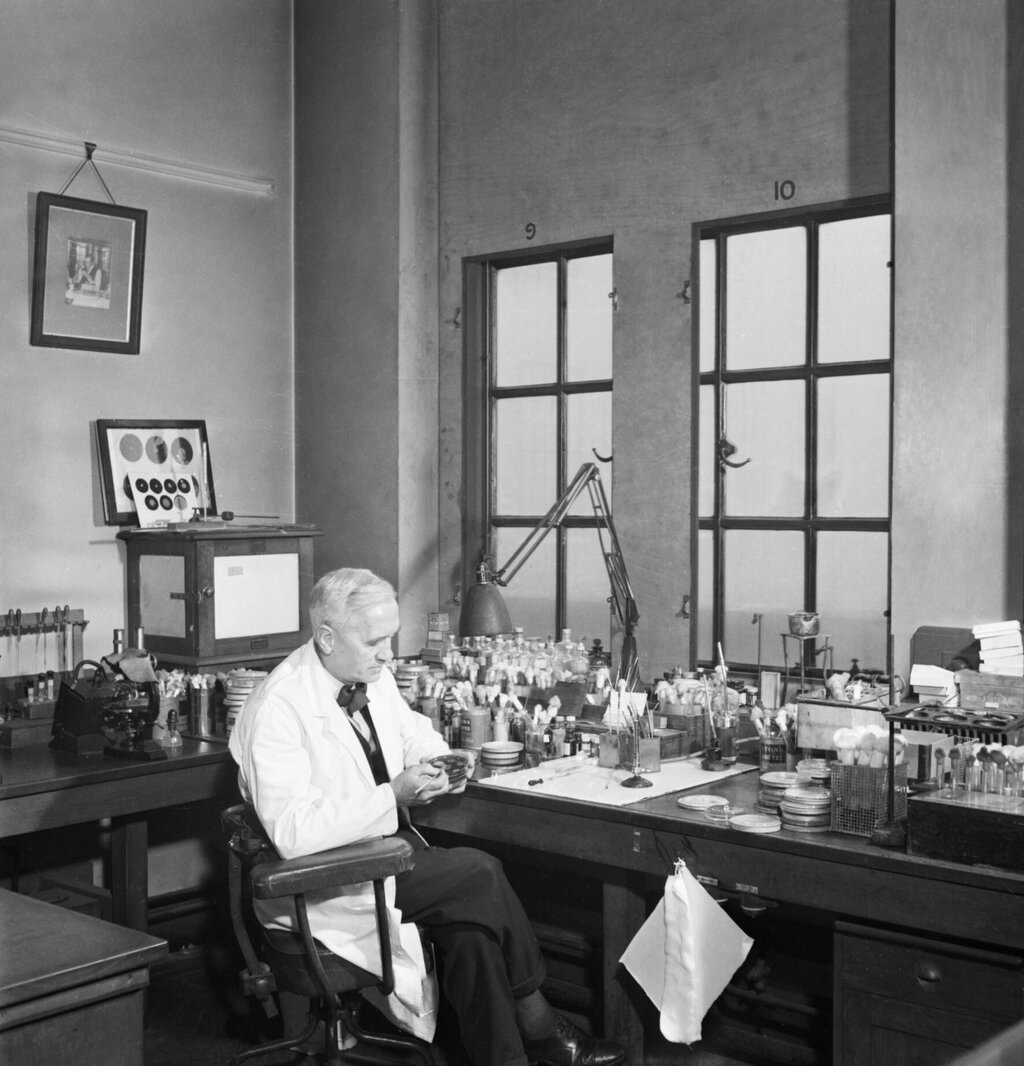
A spot of mould had contaminated the dish. This was a common annoyance for bacteriologists. But instead of throwing the dish away, Fleming looked closer. Surrounding the fuzzy, blue-green mould was a perfectly clear ring, a sort of 'halo' where the bacterial colonies had been destroyed. Elsewhere on the plate, the staphylococci grew in their usual opaque clusters. The mould was clearly secreting something that inhibited bacterial growth.
Fleming identified the intruder as a member of the Penicillium genus. The specific conditions in his lab were crucial. A spore of the mould, likely from a mycology lab on the floor below, must have drifted into his dish. Unusually cool weather in London that August had allowed the mould to grow before a subsequent warm spell encouraged the bacteria to flourish everywhere except near the mould. Fleming had captured a chemical arms race on an agar plate.
From Mould Juice to Medicine
Intrigued, Fleming cultivated the mould in a liquid broth and found that this 'mould juice' was remarkably potent. Even when diluted up to 800 times, it could prevent the growth of staphylococci. He began a series of experiments, applying the crude extract to other types of bacteria. It was effective against many of the pathogens that caused diseases like pneumonia, scarlet fever, and diphtheria. Crucially, it had no toxic effect on human white blood cells.
He discerned that it was not the mould itself but some ‘juice’ it had produced that had killed the bacteria.
Despite these promising results, Fleming hit a wall. He was a bacteriologist, not a chemist. He found it immensely difficult to isolate the active antibacterial compound from the broth. The substance, which he named after the mould that produced it, was unstable and his team could only produce it in small, diluted quantities. This made it impossible to test as a systemic drug injected into the body. Fleming concluded its main use might be as a topical antiseptic for surface wounds.
He published his findings in the 1929 edition of the , but the paper received little attention. The scientific community was not yet ready for the idea of 'magic bullets' that could target bacteria inside the body. For nearly a decade, the most important medical discovery of the 20th century remained a laboratory curiosity.
Although Fleming published the discovery of penicillin in the British Journal of Experimental Pathology in 1929, the scientific community greeted his work with little initial enthusiasm.
The challenge was immense. Producing enough pure penicillin to treat even a single patient required processing thousands of litres of mould culture. It would take another decade and the pressure of a world war for a team of scientists at Oxford to overcome these hurdles and turn Fleming's accidental observation into a true miracle drug.