The Dengue Virus Explained
Dengue Virus Basics
Meet the Dengue Virus
Dengue is a single virus with four different personalities. Known as serotypes, these four distinct variations are called DENV-1, DENV-2, DENV-3, and DENV-4. While they are all technically the same virus, each one is different enough that your immune system has to learn to fight them individually. Gaining immunity to one doesn't protect you from the others.
This tiny agent of disease belongs to the Flavivirus genus, a family of viruses that includes West Nile and Yellow Fever. Dengue is found throughout the world's tropical and subtropical regions, making it a global health concern.
The Viral Blueprint
At its core, the Dengue virus is a simple package of genetic information. Its genome is a single strand of RNA, which is like a software program containing all the instructions needed to create more viruses. This RNA blueprint is about 11,000 nucleotides long and codes for just ten proteins.
Imagine the viral RNA as a single, long sentence that a host cell reads to produce a single, large protein. This protein then gets chopped up into smaller, functional pieces.
These ten proteins fall into two categories: structural and non-structural.
Structural proteins are the physical building blocks of the virus particle, or virion. There are three types:
- Capsid (C): This protein forms a protective shell around the RNA genome.
- Membrane (M): An intermediate protein that helps the virus mature.
- Envelope (E): This protein covers the outer surface of the virus. It's crucial because it's what the virus uses to attach to and enter host cells.
Non-structural (NS) proteins don't become part of the final virus particle. Instead, they act like factory workers, hijacking the host cell's machinery to replicate the viral RNA and build new virions. The seven NS proteins are NS1, NS2A, NS2B, NS3, NS4A, NS4B, and NS5.
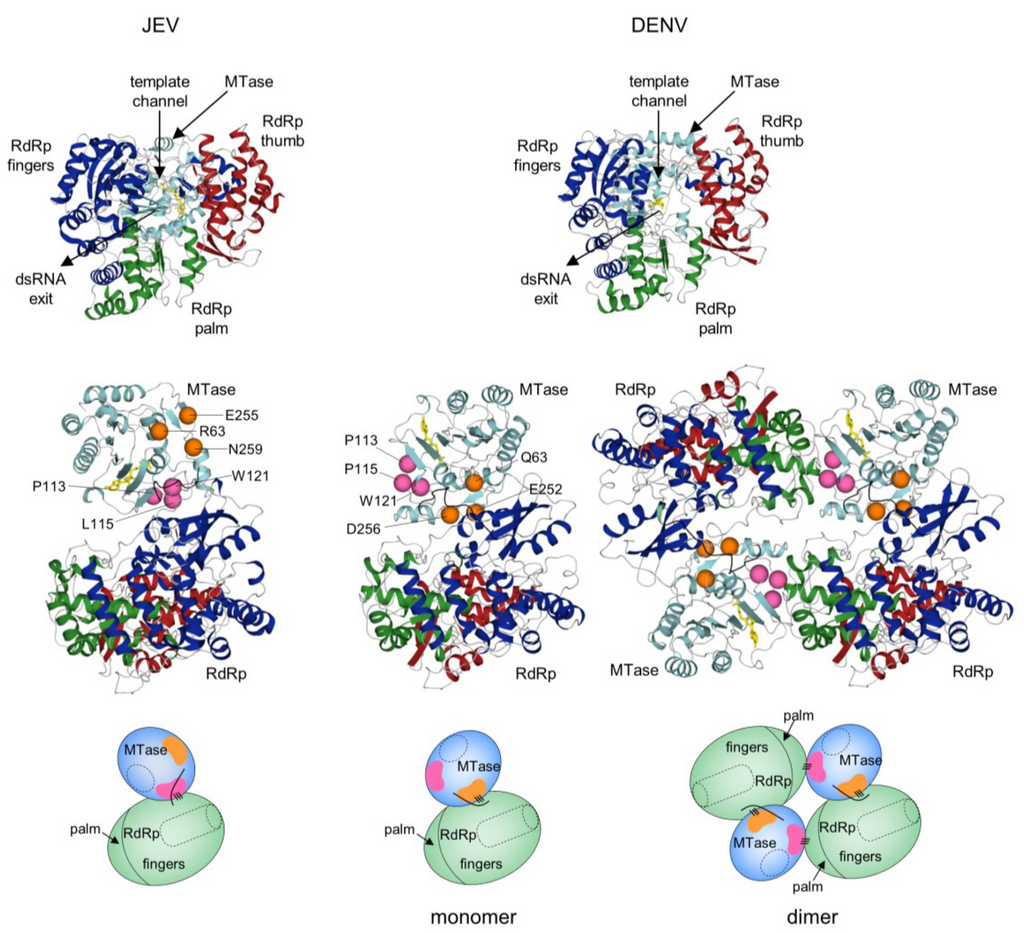
Each NS protein has a specific job. NS3, for example, is a multi-tool protein that cuts the long protein chain into individual pieces and helps unwind RNA. NS5 is another key player, functioning as the polymerase—the machine that copies the virus's RNA genome.
The Replication Cycle
Once a Dengue virus gets inside a host cell, it immediately gets to work. The process is a hostile takeover on a microscopic scale.
The cycle starts when a virus particle attaches to the surface of a host cell using its Envelope (E) proteins. The cell is tricked into engulfing the virus.
Once inside, the virus sheds its outer layers, releasing its RNA genome into the cell's cytoplasm. The cell's own machinery, called ribosomes, starts reading the viral RNA and translating it into one long protein. This polyprotein is then cut into the ten individual structural and non-structural proteins by both viral and host enzymes.
The newly made non-structural proteins create replication factories within the cell. Here, they make thousands of copies of the viral RNA. These new RNA strands are then packaged inside new sets of structural proteins (C, M, and E), forming immature virus particles. These particles travel through the cell's internal pathways, where they mature. Finally, the newly minted viruses are released from the host cell, ready to infect others.
An Evolving Threat
Viruses like Dengue are not static. As the virus replicates, its polymerase (NS5) is prone to making small errors, or mutations, when copying the RNA genome. This is a common feature of RNA viruses.
Most of these mutations are harmless or even detrimental to the virus. But occasionally, a mutation can give the virus an advantage, perhaps allowing it to replicate faster or evade the immune system more effectively. Over time, these small changes lead to the evolution of new genetic variants and strains within each of the four serotypes.
This constant evolution is a major challenge for vaccine development. A vaccine must be effective against all four serotypes, and it needs to keep up with the new variants that emerge.
The genetic diversity of Dengue also has direct implications for disease severity. Certain genetic lineages within a serotype are sometimes associated with more severe outbreaks. Understanding how the virus evolves is crucial for predicting its behavior and designing better ways to control it.
Let's check your understanding of the Dengue virus.
What is the primary function of the Envelope (E) protein in the Dengue virus?
A person who recovers from an infection with the DENV-2 serotype travels to a region where DENV-4 is prevalent. What is the status of their immunity to Dengue?
Understanding the fundamental biology of the Dengue virus—from its genetic makeup to its replication strategy—is the first step in combating the disease it causes.