The Deep Roots of Palestine and Israel
Ancient Civilizations
The Age of City-States
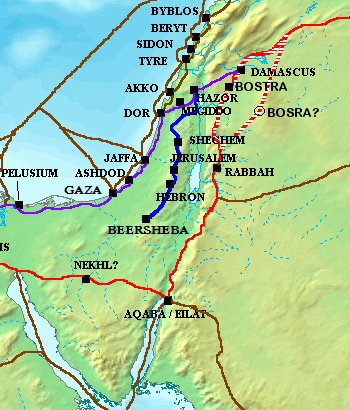
Long before the rise of kingdoms, the land known as Canaan was a patchwork of independent city-states. This region, strategically located between the great powers of Mesopotamia and Egypt, thrived on trade. Each city, such as Megiddo, Hazor, and Gezer, was a self-governing entity, ruled by its own king who controlled the city and its surrounding agricultural lands.
Canaanite
noun
A term for the Semitic-speaking peoples who inhabited the Levant region (modern-day Israel, Palestine, Lebanon, Syria, and Jordan) during the Bronze Age.
The Canaanites were skilled artisans and merchants. Their location made them a crucial crossroads for caravans carrying goods like timber, wine, olive oil, and textiles. This constant flow of trade brought not only wealth but also a rich exchange of ideas and technologies. Their culture was a blend of local traditions and influences from their powerful neighbors.
Shadow of the Empires
Canaan rarely enjoyed true independence. For much of the Late Bronze Age (c. 1550–1200 BCE), it was under the firm control of the New Kingdom of Egypt. The pharaohs viewed the region as a vital buffer zone and a source of valuable resources. They maintained control through a series of garrisons and by demanding tribute from the local Canaanite rulers, who were effectively vassals.
Egyptian dominance meant that Egyptian culture, religion, and administrative practices heavily influenced the Canaanite city-states. Local rulers often adopted Egyptian titles and artistic styles to demonstrate their loyalty.
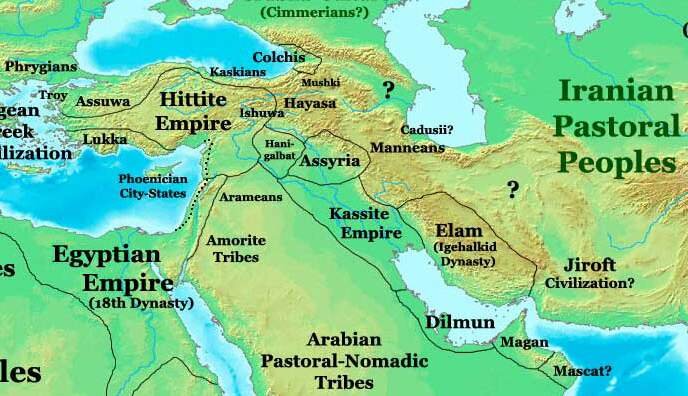
To the north, another great power emerged: the Hittite Empire, centered in Anatolia (modern-day Turkey). The Hittites and Egyptians were rivals for control of the Levant, and their struggle often played out on Canaanite soil. This competition culminated in the famous Battle of Kadesh in 1274 BCE, after which the two empires agreed to a treaty that roughly divided the region into spheres of influence.
Newcomers on the Coast and in the Hills
Around 1200 BCE, the established order of the Bronze Age collapsed. The Hittite Empire disintegrated, and Egypt's power waned, creating a power vacuum in Canaan. During this period of upheaval, two new groups emerged and established themselves in the region: the Philistines and the Israelites.
The Philistines settled along the southern coastal plain, establishing a powerful confederation of five cities known as the Pentapolis: Ashdod, Ashkelon, Ekron, Gath, and Gaza. They brought with them advanced military technology, including iron weapons and chariots, which gave them a distinct advantage over their neighbors. Their organized city-states controlled fertile agricultural land and key trade routes.
Meanwhile, in the central hill country, a loosely organized confederation of Israelite tribes began to coalesce. Unlike the urbanized Canaanites and Philistines, the early Israelites were primarily pastoralists and farmers living in small villages. Their social structure was based on kinship and tribal alliances, rather than the monarchical system of the city-states. The rugged, less fertile highlands provided a natural defense and allowed their distinct culture to develop in relative isolation.
This set the stage for a new dynamic in the region. The declining influence of Egypt and the Hittites allowed these local powers—the remaining Canaanite cities, the powerful Philistine Pentapolis, and the emerging Israelite tribes—to interact, compete for resources, and ultimately shape the next chapter of history in this land.
Before the rise of larger kingdoms, what was the primary political structure in Canaan?
During the Late Bronze Age, the rulers of Canaanite city-states were effectively vassals who paid tribute to which major power?