The Dawn of Writing Cuneiform
Origins of Writing
The Need to Remember
As ancient Mesopotamian cities like Uruk grew, so did their complexity. Imagine managing a temple's grain stores, tracking trade caravans, or recording tax payments. Relying on memory alone became impossible. A system was needed to keep track of who owned what, who owed what, and how much was available.
The first solution wasn't what we would call writing today. It was a system of proto-writing, using simple pictures to represent objects. These pictures, or pictographs, were etched onto wet clay tablets. A drawing of a stalk of barley stood for barley. A picture of a jar meant a jar of oil. It was a straightforward accounting tool, born from economic necessity.
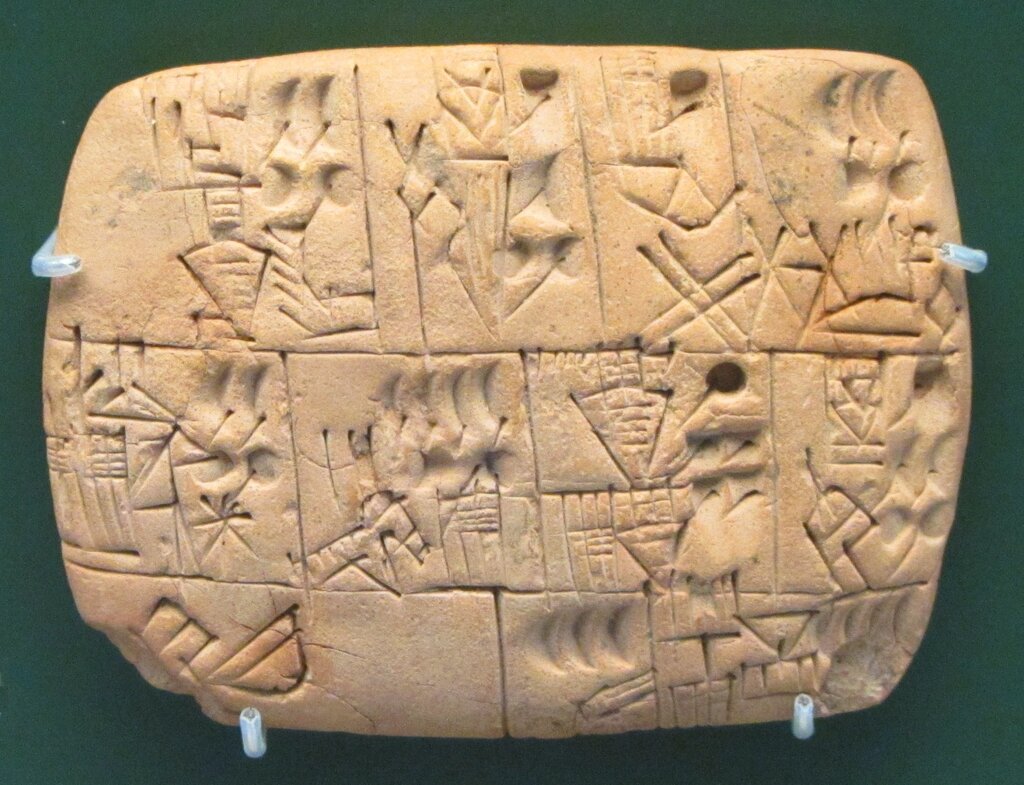
These early tablets were essentially ledgers. They didn't tell stories or record laws; they counted goods. This simple, practical need for record-keeping was the driving force behind one of humanity's greatest inventions.
From Pictures to Wedges
Pictographs worked, but they were slow to draw and limited. How do you draw "a delivery is late" or "payment received"? To speed things up and express more complex ideas, the system had to evolve.
Scribes began simplifying the pictographs, abstracting them over time. Instead of drawing a detailed picture, they used a reed stylus to press wedge-shaped marks into the clay. This new script is called cuneiform, from the Latin cuneus, meaning “wedge.”
The biggest breakthrough was when these symbols started representing sounds in addition to objects. For instance, the Sumerian word for “barley” was še (pronounced 'sheh'). Scribes could use the cuneiform sign for barley to represent the še sound in any word. This shift from representing things to representing sounds—the phonetic principle—was revolutionary. It allowed for the writing of abstract concepts, names, and complete sentences.
Writing moved from a simple accounting tool to a versatile system for communication. Scribes could now record not just how many jars of beer were paid, but who paid them, why, and when.
This powerful new tool spread throughout Mesopotamia and was adapted by other civilizations, like the Akkadians, Babylonians, and Assyrians, to write their own languages. The simple need to track grain had blossomed into a full-fledged writing system, changing the course of human history.
What was the primary motivation for the development of the earliest form of writing in Mesopotamia?
The script that evolved from pictographs and used wedge-shaped marks is called...