The Dawn of Digital Play
Early Computer Games
The First Dogfight
Long before arcades and home consoles, the first true video games were born in university labs on massive, room-sized computers. One of the most influential was Spacewar!, created in 1962 by a group of students at MIT. They had a new toy to play with: the DEC PDP-1, a computer that came with its own monitor.
This was a huge leap. Instead of just printing out numbers, the PDP-1 could draw points of light on a screen. The students, led by Steve Russell, decided to make a game to show off its power. The result was a two-player space combat game.
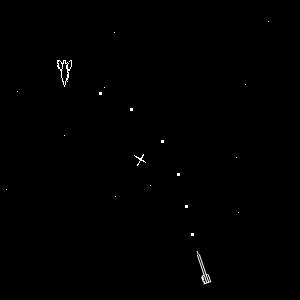
The game's concept was simple but addictive. Each player controlled a spaceship, one wedge-shaped and one needle-shaped. The goal was to destroy the other ship by firing torpedoes. A star in the center of the screen created a gravitational pull, forcing players to constantly adjust their trajectory or risk getting sucked in. Ships could also jump into hyperspace to escape danger, but it was a risky move that could send them to a random, potentially disastrous, new location.
Spacewar! was never sold. It was an open-source project, shared freely among the small community of programmers who had access to PDP-1 computers. Its code was copied, modified, and ported to other systems, becoming a staple in computer labs across the country. It laid the foundation for countless future games, from Asteroids to modern space simulators.
Ruling an Ancient City
While Spacewar! was about fast-paced action, another early game focused on strategy and education. In 1964, Mabel Addis, a teacher, and William McKay, a programmer at IBM, created The Sumerian Game. It was one of the first text-based strategy games, designed to teach sixth-graders about economics in the ancient Sumerian city of Lagash.
The game was played on an IBM 7090 mainframe. There were no graphics; the entire experience was delivered through text printed on paper or displayed on a screen. Players took on the role of the city's ruler and made decisions over a series of rounds.
You are the ruler of Lagash. Each round, you must decide how much grain to plant, how much to store, and how much to feed your people.
The game responded to the player's choices. A good harvest might lead to a population boom. Planting too little could cause a famine. The game also threw random events at the player, like a pest infestation or a breakthrough in farming technology, forcing them to adapt their strategy. It was a complex simulation for its time, with the goal of balancing resources to help your kingdom prosper.
A Lasting Legacy
These two games, though vastly different, were pioneers. Spacewar! proved that computers could be used for interactive entertainment and real-time action. It established core elements of arcade games: two players, direct control, and a clear objective of destroying the opponent.
The Sumerian Game introduced the world to resource management and strategy gameplay. Its text-based format and focus on decision-making became the blueprint for countless educational, simulation, and strategy games that followed. Together, they demonstrated the potential of computers for both fun and learning, setting the stage for the entire video game industry.
Let's see what you've learned about these foundational games.
What computer was the original version of Spacewar! developed on in 1962?
What was the primary educational goal of The Sumerian Game?
These early experiments were just the beginning. They showed what was possible when programming and play came together.