The Dawn of Digital Play
Early Video Game Concepts
Before the Arcade
Long before anyone plugged in a home console, the first video games flickered to life in research labs and at technology exhibitions. These weren't games made for fun or profit. They were experiments, designed to showcase the power of new electronic technology and maybe, just maybe, make a complicated machine seem a little more human.
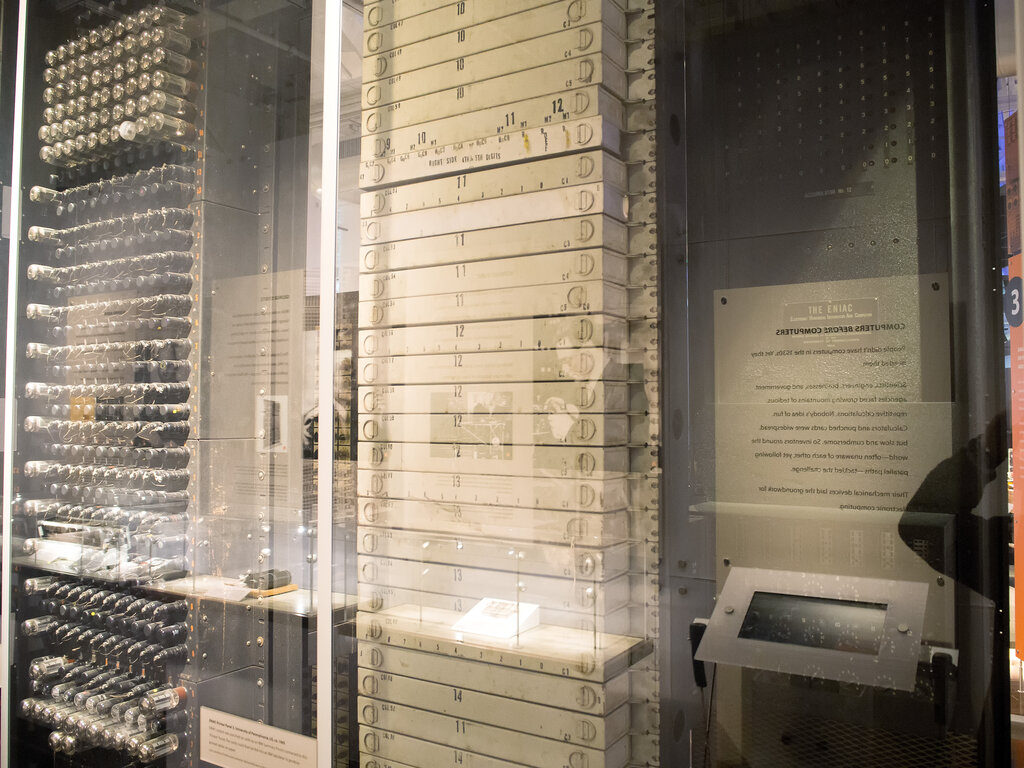
These early creations were built on massive, room-sized computers that bore little resemblance to the sleek devices we use today. They were one-of-a-kind machines, programmed for a single purpose and seen by only a handful of people. Yet, they planted the seeds for the entire video game industry.
The First Interactive Display
The earliest known interactive electronic game wasn't even digital. Patented in 1948, the "Cathode-Ray Tube Amusement Device" was an analog missile simulator inspired by radar displays from World War II. Players would twist knobs and flick switches to guide a dot across a screen, trying to "shoot down" paper targets taped to the display. If the dot lined up with a target, you'd hit a button to simulate a blast.
There was no computer processing the action. The device used circuits of vacuum tubes to control the beam on the cathode-ray tube, or CRT. It was a clever piece of electronic engineering, but it was never manufactured or sold. Only a single handmade prototype was ever built, making it a true relic from the dawn of gaming.
This device was a game in its purest sense: an interactive experience with a goal, controls, and a visual display.
A Computer Learns to Play
A few years later, computers entered the picture. In 1951, the Nimrod computer was unveiled at the Festival of Britain. It was designed for one purpose: to play the ancient mathematical strategy game of Nim.
In Nim, there are several piles of objects. Players take turns removing any number of objects from a single pile. Depending on the rules, the player who takes the last object either wins or loses. Nimrod was programmed to be a perfect opponent, using a system of lights to display the game state.
Nimrod wasn't intended as entertainment. Its creators wanted to demystify computers and demonstrate that they could perform complex logical tasks. But for the public, the experience was mesmerizing. People lined up for the chance to challenge the giant electronic brain, making it one of the first instances of a computer being used for recreation.
Noughts and Crosses
The next major step came in 1952 from a PhD student at the University of Cambridge named A. S. Douglas. For his thesis on human-computer interaction, he created a program to play tic-tac-toe, or "noughts and crosses" as it's known in Britain.
The game, called OXO, ran on the university's EDSAC computer. The EDSAC was one of the first computers to store its programs in memory, and it used a 35x16 dot CRT screen as its output. Players would input their moves using a rotary telephone dial, and the computer would respond by displaying its move on the screen. Like Nimrod, the EDSAC was programmed to play a perfect game.
OXO is often considered the first video game to use a graphical display that updated in real time.
While these early creations were isolated experiments, they shared a common thread. They explored how humans could interact with machines in a playful, engaging way. They were the first sparks of an idea that would eventually grow into one of the world's biggest entertainment industries.
What was the primary motivation behind the creation of the earliest video games like Nimrod and OXO?
Which of these early games was an analog device that did not use a digital computer?