The Cynefin Framework for Complexity
Introduction to Complexity Theory
The World Isn't Always Simple
We often try to solve problems by breaking them down into smaller pieces. This works well when the cause of a problem is clear. If a lightbulb burns out, you replace it. The relationship between cause (a dead filament) and effect (no light) is direct and obvious. This is a simple system.
But what about problems like traffic jams, financial markets, or climate change? These aren't just bigger versions of the lightbulb problem. They belong to a different class of systems entirely. Understanding how these systems work is the first step to making better decisions within them.
Four Kinds of Systems
Problems and situations can generally be sorted into one of four types of systems: simple, complicated, complex, and chaotic. Let's start with the two most familiar.
Simple systems are predictable and orderly. There are clear rules, and the link between cause and effect is obvious to everyone. Following a recipe to bake a cake is a simple system. If you follow the steps correctly, you get a cake every time.
Complicated systems are also predictable, but require expertise to understand. Think of a jumbo jet. It has millions of parts, but engineers designed it. With the right knowledge, you can take it apart and put it back together. The relationship between cause and effect exists, but it's not obvious to the untrained eye. For both simple and complicated systems, best practices and expert analysis are effective.
In complicated systems, the whole is the sum of its parts. In complex systems, the whole is greater than the sum of its parts.
Complex systems are fundamentally different. They consist of many independent agents interacting with one another. These interactions create patterns that aren't centrally controlled or predictable. The behavior of the system as a whole emerges from the local interactions of the agents. A flock of birds is a classic example. No single bird is in charge, yet the flock moves as a coherent, adaptive unit. Cause and effect can only be understood in hindsight, not predicted in advance.
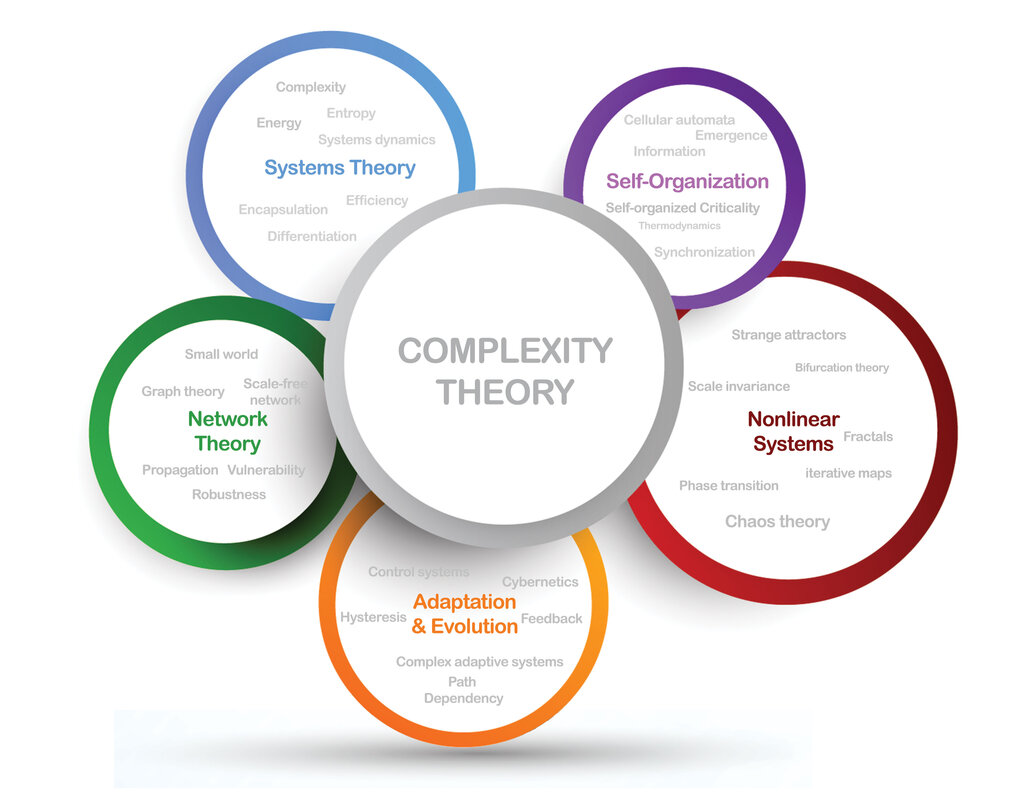
Emergence
noun
The arising of novel and coherent structures, patterns, and properties during the process of self-organization in complex systems.
Finally, we have chaotic systems. In a chaotic system, there is no discernible relationship between cause and effect. The environment is turbulent and unpredictable. Think of the immediate aftermath of a major earthquake. There are no manageable patterns, only constant flux. The priority here isn't analysis, but immediate action to establish some form of order.
| System Type | Characteristics | Decision-Making Approach |
|---|---|---|
| Simple | Stable, clear cause-and-effect | Follow best practices, sense and respond |
| Complicated | Knowable, requires expertise | Analyze, consult experts, plan |
| Complex | Unpredictable, emergent patterns | Probe, sense, respond, adapt |
| Chaotic | Turbulent, no clear patterns | Act immediately to create stability |
Matching Your Approach to the Problem
Recognizing which type of system you're dealing with is critical. You can't solve a complex problem using methods designed for a simple one. Trying to create a five-year plan for a startup in a rapidly changing market (a complex system) is as pointless as hiring a team of engineers to figure out why a lightbulb won't turn on (a simple system).
When faced with a complicated problem, like fixing a car engine, you gather data, analyze the situation, and develop a plan. But in a complex situation, like raising a child or managing a corporate culture, there is no one right answer. The best approach is to run small experiments, see what happens, and adapt your strategy based on the feedback. You have to interact with the system to understand it.
In a complex system, you can't predict the outcome. Instead, you create the conditions for favorable outcomes to emerge.
Before you try to solve a problem, take a moment to ask: what kind of system am I in? Is it predictable or unpredictable? Is expertise enough, or do I need to experiment and adapt? Answering these questions helps you choose the right tools for the job.
What is the primary difference between a simple system and a complicated system?
The behavior of a system as a whole emerging from the local interactions of many independent agents is a hallmark of which type of system?