The Crusades Explained
Origins of the Crusades
A World Divided
By the 11th century, the world around the Mediterranean was a fractured place. In Europe, the old Roman Empire was a distant memory. The continent was a patchwork of kingdoms and feudal states, often at war with one another. A warrior class of knights, bound by codes of honor and service to their lords, had little to do besides fight each other. The one great unifying force was the Catholic Church, led by the Pope in Rome.
To the east, the situation was different. The Byzantine Empire, a direct continuation of the Eastern Roman Empire, was a powerful Christian state, but it was under immense pressure. A new force had emerged: the Seljuk Turks. Originally from the steppes of Central Asia, they had converted to Islam and carved out a vast empire in the Middle East, conquering Persia, Iraq, and much of Anatolia—the heartland of the Byzantine Empire.
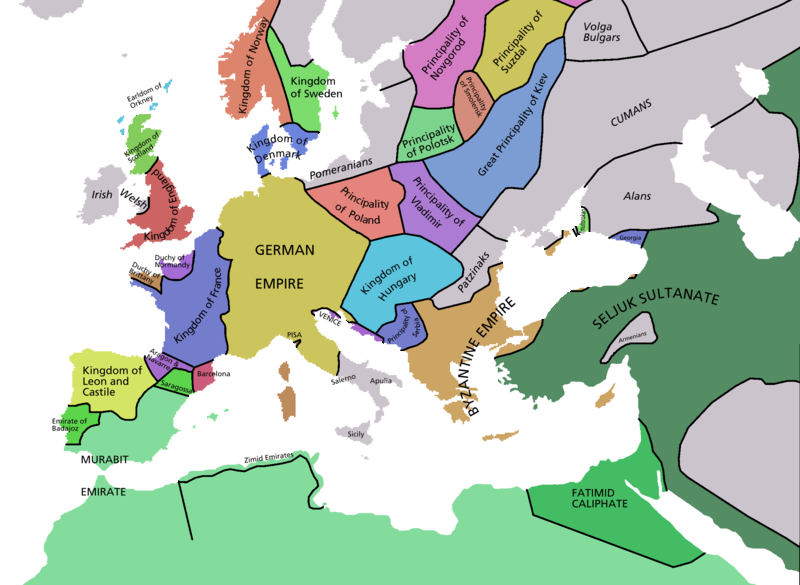
The Seljuk advance was alarming for the Byzantines. But it also created a new problem for European Christians. The Seljuks now controlled Palestine, the land Christians called the Holy Land.
The Holy City
Jerusalem was, and is, a city of immense religious importance. For Christians, it was the site of Jesus Christ's crucifixion and resurrection, the most sacred place on Earth. For centuries, they had undertaken long, difficult journeys called pilgrimages to pray at its holy sites.
For Muslims, Jerusalem was also profoundly holy. It was the site of the Prophet Muhammad's Night Journey, where he was said to have ascended to heaven. The city was home to the Al-Aqsa Mosque and the Dome of the Rock, two of Islam's most important shrines. Under previous Islamic rulers, Christian pilgrims had generally been allowed to visit the city. But the Seljuks were less tolerant, and travel became much more dangerous. Stories of pilgrims being harassed, robbed, or even killed began to spread throughout Europe.
For both faiths, Jerusalem was a physical connection to the divine, a city worth fighting and dying for.
A Call to Arms
The situation came to a head in 1095. The Byzantine Emperor, Alexios I Komnenos, sent a desperate plea to the West. He asked Pope Urban II for military aid, hoping for a contingent of European knights to help him push back the Seljuk Turks from his territory.
Pope Urban II saw a much bigger opportunity. He could answer the Emperor's call, but also achieve several of his own goals. He could unite the quarrelsome knights of Europe under the banner of the Church, directing their violent energies outward instead of inward. He could strengthen the power of the papacy. And he could reclaim the holiest city in Christendom.
At the Council of Clermont in France in November 1095, Pope Urban II delivered one of the most influential speeches in history. He described the suffering of Eastern Christians and the defilement of the holy places. He called on the knights of Europe to stop fighting among themselves and to embark on a righteous war, an armed pilgrimage, to liberate Jerusalem. As a reward, he offered something extraordinary: a complete remission of sins for anyone who took up the cause.
The response was electric. Cries of "Deus vult!"—God wills it!—echoed through the crowd. The Pope's call had unleashed a religious fervor that would shape the next two centuries of history.
Let's check your understanding of what set the stage for this holy war.
Which of the following best describes the political and religious situation in Western Europe around the 11th century?
What was the primary reason the Byzantine Emperor Alexios I Komnenos reached out to Pope Urban II in 1095?
The Pope's call set in motion a massive movement of people, igniting the First Crusade and an era of conflict between Europe and the Middle East.