The Complete Journey of Knowledge
Introduction to Big History
A History of Everything
Most history courses focus on kingdoms, wars, and revolutions. They might cover a few thousand years. Big History is different. It tells the entire story of the universe, from the Big Bang 13.8 billion years ago all the way to the present day.
It’s a single, connected narrative that links the past across enormous scales of time and space. Instead of seeing human history as separate from natural history, it weaves them together. This approach combines insights from many different fields, including cosmology, physics, chemistry, biology, and archaeology, to create one cohesive origin story.
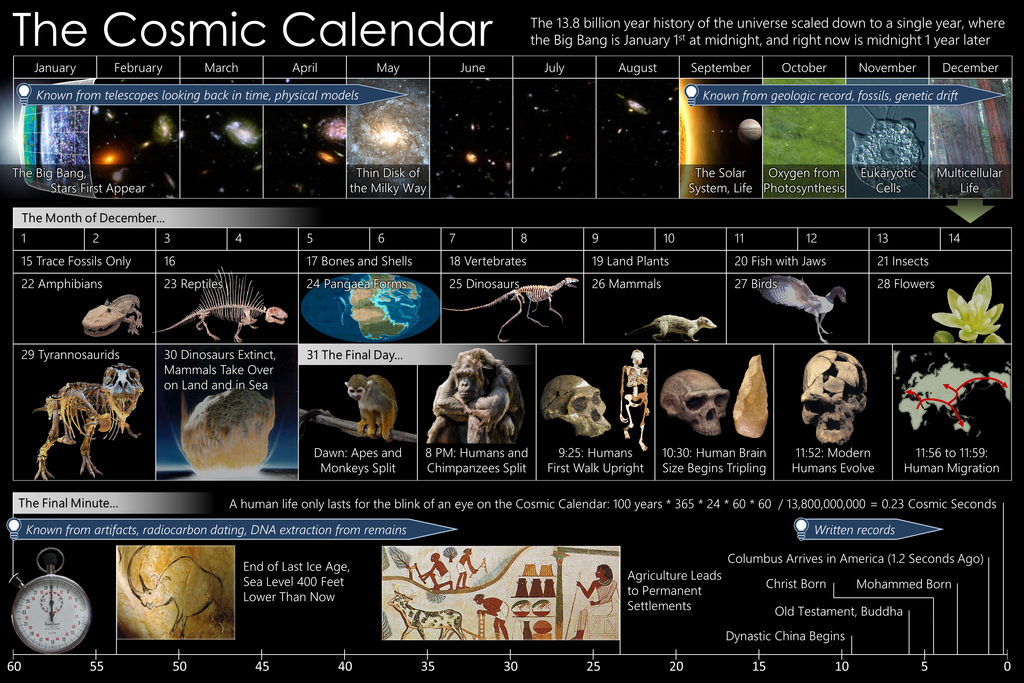
Thinking in these vast timescales helps put our own existence into perspective. If the entire history of the universe were a single calendar year, the first modern humans would not appear until 11:52 PM on December 31st. All of recorded history would flash by in the final few seconds before midnight.
Thresholds of Complexity
How can we possibly organize 13.8 billion years of history? Big History breaks down this immense timeline into a series of major turning points, or "thresholds." Each threshold marks a moment when something fundamentally new and more complex emerged in the universe.
These are moments when the right conditions—often called "Goldilocks Conditions"—came together to create a new form of complexity. For something new to appear, there must be the right ingredients and the right environment.
Each threshold is a major transformation, building upon what came before to create the next level of complexity in the universe.
This framework provides a roadmap for understanding how we got from a simple, hot, dense universe to a world filled with galaxies, stars, planets, and life. Here are the major thresholds that structure the story.
| Threshold | What Emerged |
|---|---|
| 1. The Big Bang | The Universe: time, space, energy, and matter |
| 2. The First Stars | Stars and Galaxies |
| 3. New Chemical Elements | Heavier elements forged in dying stars |
| 4. Earth and the Solar System | Planets, including our own |
| 5. Life | The first living organisms |
| 6. Collective Learning | The human species and shared knowledge |
| 7. Agriculture | Settled societies and civilizations |
| 8. The Modern Revolution | A globally interconnected human world |
Each of these steps was a critical innovation. Without stars, the heavier elements needed for planets and life would never have formed. Without life, there would be no one to learn, build civilizations, or study the history of the universe.
One Story, Many Disciplines
To tell the full story, Big History draws on the work of scientists and scholars from many fields. It's an interdisciplinary approach that breaks down the walls between different areas of knowledge.
A cosmologist explains the first few moments after the Big Bang. A chemist describes how dying stars created new elements. A biologist details the mechanisms of evolution, and an archaeologist uncovers the rise of the first cities. By combining these perspectives, we get a much richer and more complete picture of our past.
This unified view helps us see the connections between seemingly unrelated events. The carbon in our bodies was forged in a star billions of years ago. The extinction of the dinosaurs paved the way for mammals, and eventually humans, to thrive. Seeing these deep connections is the core idea of Big History.
Now, let's test your understanding of these foundational ideas.
How does the scope of Big History differ from that of traditional history?
In the Big History framework, what is a "threshold"?
By understanding the grand narrative of our universe, we can better appreciate our own small but significant part in its ongoing story.