The Cold War Explained
Origins of the Cold War
From Allies to Adversaries
World War II ended in 1945, leaving much of the world in ruins. Two countries emerged as global superpowers: the United States and the Soviet Union. They had fought on the same side to defeat Nazi Germany, but their alliance was one of convenience, not shared values. Once their common enemy was gone, deep-seated mistrust and conflicting visions for the future came to the surface.
The post-war world was a power vacuum. The old empires of Britain and France were weakened, and Germany and Japan were defeated and occupied. This left the U.S. and the USSR to fill the void, each determined to shape the new world order according to its own beliefs. This ideological clash set the stage for a new kind of conflict: the Cold War.
Two Worlds Collide
At the heart of the tension were two fundamentally different systems for organizing society: capitalism and communism. These weren't just economic theories; they were complete worldviews that touched on everything from government and personal freedom to the role of the individual.
| Feature | United States (Capitalism) | Soviet Union (Communism) |
|---|---|---|
| Economy | Private ownership of property and business. Driven by free markets and competition. | State ownership of all property and industry. Central government plans the economy. |
| Government | Multi-party democracy. Leaders elected by the people. | Single-party dictatorship. The Communist Party holds all political power. |
| Individual Rights | Emphasis on individual freedoms, such as speech, press, and religion. | The needs of the state and collective group are prioritized over individual rights. |
The United States championed democracy and a capitalist economy, believing that free markets and individual liberty were the keys to prosperity and peace. The Soviet Union, on the other hand, was guided by communist ideology. It advocated for a state-controlled economy and a single-party political system, arguing this was the only way to create a truly equal society and protect against the perceived greed of capitalism.
The Iron Curtain Descends
As World War II ended, the Soviet Red Army occupied much of Eastern and Central Europe. While the U.S. and its allies had liberated Western Europe, the Soviets remained in countries like Poland, Czechoslovakia, Hungary, Romania, and East Germany. They didn't leave.
Instead, the Soviet Union installed communist governments loyal to Moscow in these nations. Any opposition was suppressed. This created a clear line dividing the continent. In the West were democratic, capitalist countries allied with the United States. In the East were communist countries under the tight control of the Soviet Union.
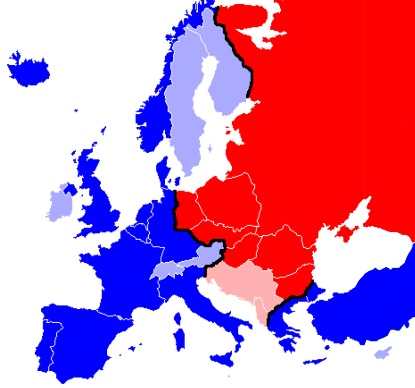
British Prime Minister Winston Churchill famously declared that an "iron curtain" had descended across Europe, separating the Soviet-dominated East from the democratic West. The name stuck.
The Two Blocs
This division solidified into two opposing camps. The Western Bloc, led by the United States, consisted of countries with democratic governments and capitalist economies. This group included nations like the United Kingdom, France, and West Germany.
The Eastern Bloc was a group of nations led by and loyal to the Soviet Union. These countries, often called satellite states, had communist political systems and centrally planned economies dictated by Moscow. This bloc included Poland, East Germany, and others behind the Iron Curtain. For nearly half a century, these two blocs would face each other in a tense standoff, each seeing the other as a threat to its very existence.
Let's review the key terms from this section.
Now, test your understanding of how the Cold War began.
Which two countries emerged as the world's primary superpowers immediately following the end of World War II?
The fundamental ideological conflict of the Cold War was between which two opposing systems?
The stage was now set. With Europe divided and two superpowers locked in an ideological struggle, the Cold War had begun. The next several decades would be defined by this global rivalry.