The Cold War Explained
Origins of the Cold War
A World Divided
World War II left much of the globe in ruins. Old empires, like those of Britain and France, were exhausted. Out of the ashes, two new superpowers rose: the United States and the Soviet Union. They had fought on the same side, but their alliance was one of convenience against a common enemy. Once that enemy was defeated, their deep-seated differences came to the forefront.
At the heart of the conflict was a clash of ideologies. The United States championed capitalism and liberal democracy, emphasizing individual freedoms and free markets. The Soviet Union, on the other hand, was built on communism. It promoted a state-controlled economy where the government owned all property and a single political party held all the power. These two systems were fundamentally incompatible. Each saw the other not just as a competitor, but as a threat to its very existence.
Imagine two neighbors who disagree on everything, from how to raise their kids to how to manage their property. Now imagine those two neighbors are the most powerful forces in the entire world. That was the situation between the US and the USSR.
The Iron Curtain Descends
As the war ended, the Soviet Red Army occupied much of Eastern and Central Europe. Instead of withdrawing, Soviet leader Joseph Stalin installed communist governments in countries like Poland, Hungary, and Czechoslovakia. These nations became Soviet satellite states, independent in name but controlled from Moscow.
This division of Europe became starkly clear. In a famous 1946 speech, former British Prime Minister Winston Churchill declared that an "iron curtain" had descended across the continent, separating the free, democratic nations of the West from the Soviet-dominated East.
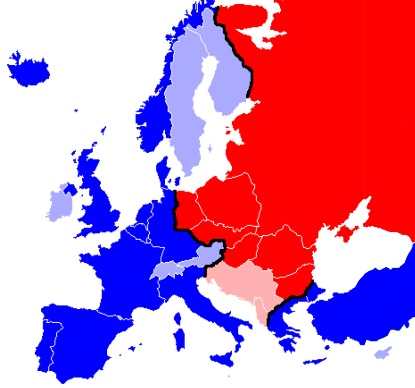
The United States watched this expansion with growing alarm. In 1947, President Harry S. Truman announced what would become known as the Truman Doctrine. He pledged that the U.S. would support any nation resisting attempted subjugation by armed minorities or outside pressures. This was a clear message to the Soviet Union: the spread of communism would be met with resistance.
The policy, known as containment, would guide American foreign policy for the next four decades. Its goal wasn't to defeat communism where it already existed, but to prevent it from spreading further.
Building Blocs
Containment wasn't just a military strategy. U.S. leaders believed that economically devastated countries were prime targets for communist takeovers. To prevent this, Secretary of State George Marshall proposed a massive aid package to rebuild Western Europe. The Marshall Plan, as it was called, poured billions of dollars into reviving European economies.
The plan was a stunning success. It helped rebuild infrastructure, restore industries, and stabilize currencies. It also strengthened ties between the United States and Western Europe, pulling them closer together both economically and politically. The Soviet Union and its satellite states rejected the aid, further deepening the continent's divide.
The final step in solidifying this division was the creation of formal military alliances. In 1949, the United States, Canada, and ten Western European nations formed the North Atlantic Treaty Organization (NATO). Its members pledged to consider an attack on one as an attack on all, creating a powerful collective defense against any potential Soviet aggression.
The Soviet Union responded in 1955 by creating its own military alliance, the Warsaw Pact. This formalized the military relationship between the USSR and its Eastern European satellite states. With the creation of NATO and the Warsaw Pact, the lines were drawn. Two armed camps now faced each other across the Iron Curtain, setting the stage for decades of suspicion, competition, and conflict known as the Cold War.
Let's review the key ideas that set the stage for this global rivalry.
Which two nations emerged as the dominant global superpowers immediately following World War II?
The core ideological conflict of the Cold War was a struggle between which two opposing systems?
With Europe divided and two superpowers locked in an ideological struggle, the post-war world entered a new and tense era. This initial period of positioning and alliance-building defined the conflict for years to come.