The Case for Generalist Early Stage VC Funds
Venture Capital Basics
What Is Venture Capital?
Venture capital, or VC, is a form of financing that investors provide to startup companies and small businesses that are believed to have long-term growth potential. Think of it as high-octane fuel for brand-new companies aiming for rapid growth.
Most startups are too risky for a traditional bank loan. They don't have years of profit history or hard assets like buildings to use as collateral. Instead, they sell a piece of their company, called equity, to venture capitalists in exchange for cash.
Venture capital refers to financing given by well-off investors or investment banks to startups and small businesses that the investors believe have big growth potential.
But VC firms offer more than just money. They also provide valuable expertise, industry connections, and strategic guidance to help their portfolio companies succeed. The VCs become partners in the venture, sharing both the risks and the potential rewards.

The Startup Funding Ladder
Startups don't receive all their funding at once. Instead, they raise money in rounds as they grow and hit specific milestones. This process is often described as climbing a funding ladder, with each step representing a new stage of development and a larger investment.
The earliest stages, Pre-Seed and Seed, are about turning an idea into a tangible product. Founders might raise money from friends, family, or angel investors to build a first version.
Series A is typically the first major round of financing from a VC firm. At this point, the startup has a working product and some early customers. The goal is to find "product-market fit" and build a repeatable business model.
Later rounds like Series B and Series C are about growth. The company has a proven model and uses this capital to scale up its operations, expand into new markets, hire more people, or even acquire other companies.
Inside a VC Firm
A venture capital firm isn't just one person with deep pockets. It's a structured partnership designed to find, fund, and grow promising startups. The two main players are General Partners (GPs) and Limited Partners (LPs).
Limited Partners (LPs) are the investors who provide the money. These are typically large institutions like pension funds, university endowments, or insurance companies, as well as wealthy individuals. They commit capital to the VC fund but are not involved in the day-to-day decisions. They are 'limited' in their liability and their role.
General Partners (GPs) are the hands-on managers of the fund. They are the experienced investors who source deals, perform due diligence on startups, make the investment decisions, and then actively work with the companies they've funded. They are responsible for the fund's success or failure.
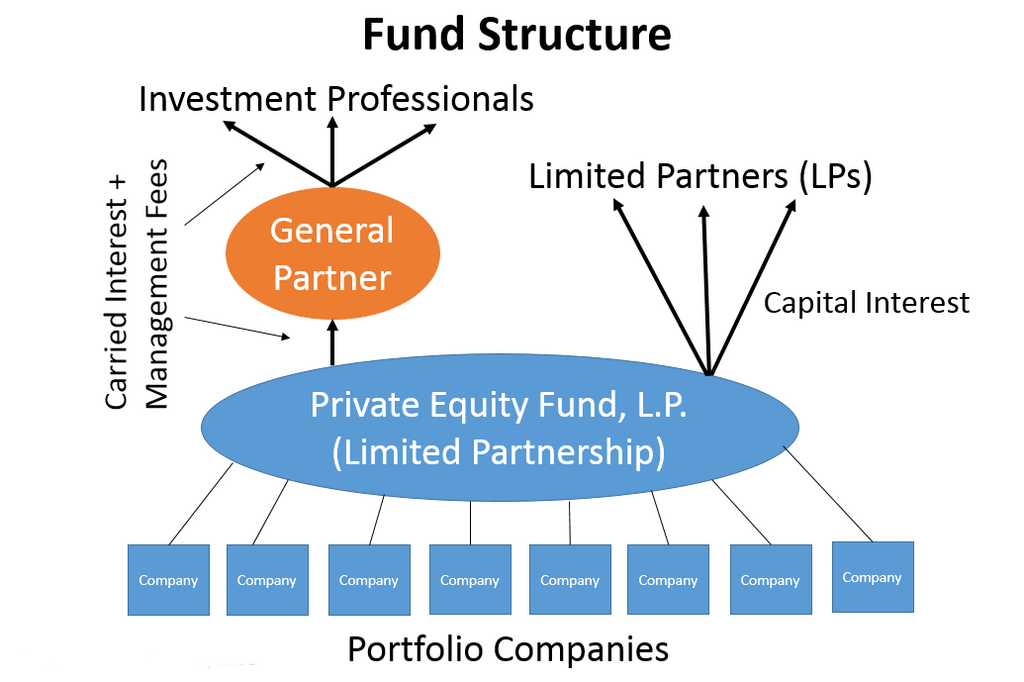
GPs earn money in two ways. First, they charge a management fee, usually around 2% of the fund's total size each year, to cover salaries and operational costs. Second, they receive a share of the profits, known as carried interest, which is typically 20% of the returns after the original capital has been returned to the LPs.
The Fund Lifecycle
A VC fund has a finite lifespan, usually around 10 years, which can be broken down into a few distinct phases.
1. Fundraising: The GPs raise money from LPs, securing commitments for a new fund.
2. Investing: Over the first few years (the "investment period"), GPs find and invest in a portfolio of startups.
3. Managing & Growing: GPs work with their portfolio companies, providing guidance and support to help them grow.
4. Exiting: The fund generates returns when its portfolio companies are acquired by larger companies or go public through an Initial Public Offering (IPO). This is the "exit."
5. Returning Capital: The proceeds from exits are distributed back to the LPs, hopefully delivering a significant return on their investment.
Venture capital is a game of patience and high risk. Many startups fail, so VCs build a portfolio of companies knowing that only a few big successes are needed to generate strong returns for the entire fund. They're not looking for small, steady wins; they're searching for the rare company that can grow to be worth billions of dollars.
This high-risk, high-reward model is what makes venture capital unique. A single successful investment can return 100x or more, covering the losses from all the other companies in the portfolio that didn't make it.
Now, let's test your understanding of these core concepts.
What is the primary purpose of venture capital financing?
In a typical VC fund structure, the ____ are the passive investors who provide the capital, while the ____ are the active managers who make the investment decisions.
Understanding these fundamentals provides a strong base for exploring the more complex strategies and decisions that drive the world of venture capital.