The Building Blocks of Matter
Introduction to Matter
What Is Matter?
Everything around you, from the phone in your hand to the air you're breathing, is made of matter. It's the physical 'stuff' that makes up the universe.
Matter is anything that has mass and occupies space.
Let's break that down. To 'occupy space' means an object has volume—it takes up a certain amount of room. A basketball has more volume than a golf ball. 'To have mass' is a way of measuring how much stuff is in an object. A bowling ball has more mass than a balloon of the same size.
matter
noun
The substance of which all physical objects are made; anything that has mass and takes up space.
While all matter shares these two properties, it doesn't all look or behave the same way. The form matter takes is called its state.
The States of Matter
You're probably familiar with the three most common states of matter on Earth: solid, liquid, and gas. The main difference between them comes down to how their particles—the tiny bits that make them up—are arranged and how they move.
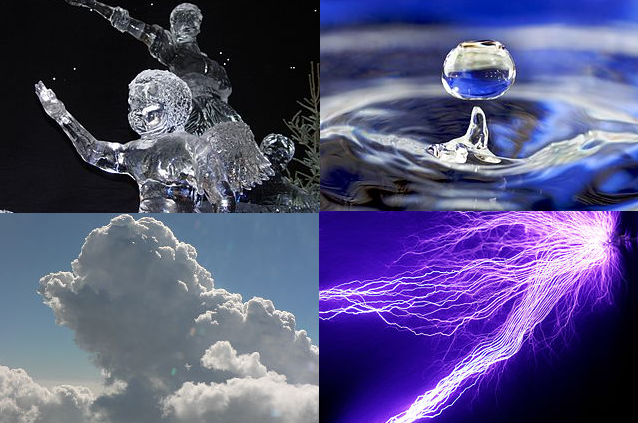
Solids, like a block of ice or a rock, have a definite shape and volume. Their particles are packed tightly together in a fixed structure, so they can only vibrate in place.
Liquids, like water or honey, have a definite volume but take the shape of their container. Their particles are close together but can slide past one another, allowing the liquid to flow.
Gases, like the air we breathe, have no definite shape or volume. Their particles are far apart and move around randomly and rapidly, filling any container they're in.
This table summarizes the key properties.
| Property | Solid | Liquid | Gas |
|---|---|---|---|
| Shape | Definite | Takes shape of container | Fills container |
| Volume | Definite | Definite | Fills container |
| Particle Arrangement | Tightly packed, orderly | Close, but random | Far apart, random |
| Particle Movement | Vibrate in place | Flow past each other | Move quickly and randomly |
But what about stars, lightning, or the aurora borealis? These are made of a fourth state of matter: plasma. Plasma is like a gas, but its particles have been energized so much that they've broken apart into charged pieces. It's actually the most abundant state of matter in the universe, even though it's less common here on Earth.
Why Study Matter?
Understanding matter is the foundation of both chemistry and physics. Chemistry is the study of matter's properties and how it changes. It helps us understand why iron rusts, how baking a cake works, and how medicines can heal us.
Physics looks at how matter and energy interact. It explains why a ball falls back to the ground when you throw it up, how a light bulb glows, and how planets orbit the sun. Every question about the physical world ultimately comes back to the behavior of matter and energy.
Ready to check your understanding? Let's see what you've learned about matter and its different forms.
What are the two defining properties of all matter?
Which state of matter is characterized by particles that are far apart and move randomly to fill their entire container?
By understanding the basics of matter, we can start to explore the rules that govern our entire universe, from the smallest particles to the largest galaxies.