The Brains Hippocampus Explained
Hippocampus Anatomy
The Brain's Memory Hub
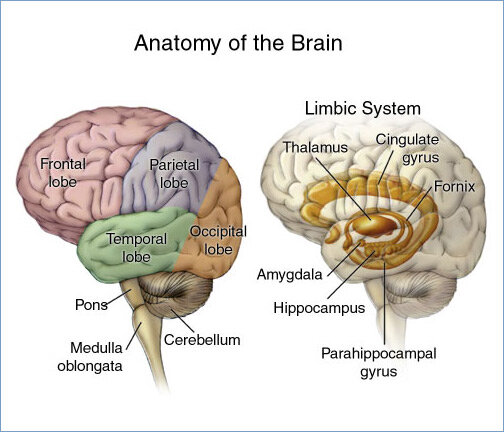
Deep within the brain, tucked into the medial temporal lobe, is a structure crucial for memory: the hippocampus. There are two hippocampi, one in each hemisphere. The name comes from the Greek word for “seahorse,” because its curved shape resembles the sea creature. This structure is a central hub for learning and memory, and understanding its layout is the first step to understanding how it works.
Imagine a jelly roll cake. The hippocampus has a similar rolled-up, layered structure. This intricate architecture allows it to process information in a very specific sequence, like an assembly line for memories.
A Tour Inside
The hippocampus isn't a single, uniform structure. It's made of several interconnected regions, each with a specific role in the memory-making process. The main pathway for information flows through these regions in a mostly one-way circuit.
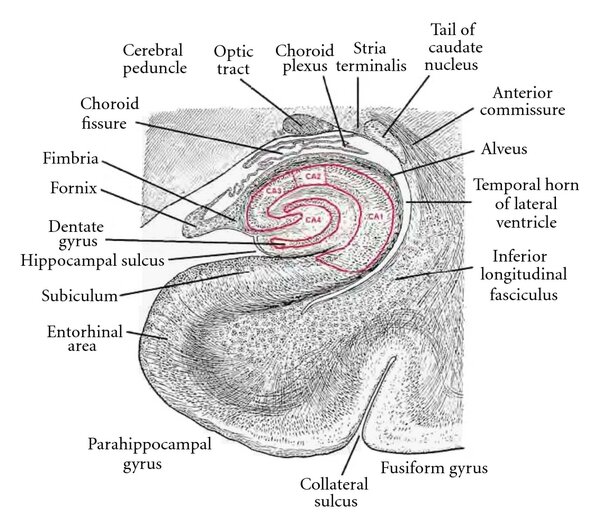
The primary components form a loop:
- Dentate Gyrus: This is the main input station. It receives information from the neocortex (the brain's outer layer) via a neighboring region called the entorhinal cortex. Think of it as the mailroom, receiving and sorting incoming data.
- Cornu Ammonis (CA): Latin for "Ammon's horn," referring to the ram horns of the Egyptian god Amun. This region is split into distinct fields. Information from the dentate gyrus flows first to CA3, a highly interconnected area. From CA3, signals travel to CA1. A smaller field, CA2, sits between them. CA1 is a major processing center.
- Subiculum: This is the main output region. After processing in CA1, information moves to the subiculum, which then sends it back out to the entorhinal cortex and other parts of the brain to be stored as long-term memories.
The primary flow of information is often summarized as: Entorhinal Cortex → Dentate Gyrus → CA3 → CA1 → Subiculum → Entorhinal Cortex.
A Connected Hub
The hippocampus doesn't work in isolation. Its location and connections are key to its function. It acts as a bridge, receiving highly processed sensory information from all over the cortex and binding it together into a single, coherent memory. The subiculum and CA1 are the main output structures, projecting widely to other brain areas.
This pathway, known as the trisynaptic circuit, is the anatomical backbone that allows the hippocampus to create new memories. Each stage performs a different kind of computational step, which we'll explore later. For now, it's enough to know the names of the parts and the order they connect.
Let's check your understanding of the hippocampus's structure.
The name "hippocampus" comes from the Greek word for what animal, due to its shape?
Information flows through the hippocampus in a specific sequence known as the trisynaptic circuit. What is the correct order?
Understanding this layout is the foundation for exploring how the hippocampus performs its remarkable feats of memory and navigation.