The Brain as a Biological Computer
Neurobiology Basics
The Brain's Building Blocks
Your brain is a network of billions of specialized cells that transmit information. These cells are the fundamental units of the nervous system, and understanding them is the first step to understanding the brain itself.
Neuron
noun
A specialized cell that transmits nerve impulses; a nerve cell.
Think of a neuron as a tiny biological wire with a processing center. It has a distinct shape that allows it to send and receive signals with incredible speed and precision. A typical neuron has three main parts.
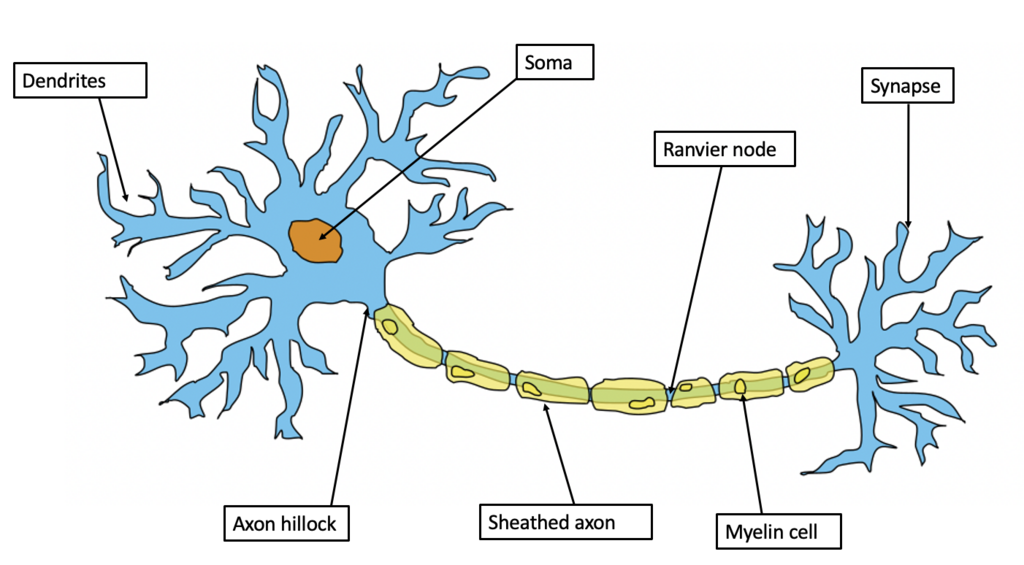
First is the soma, or cell body. This is the neuron's headquarters, containing the nucleus and other machinery needed to keep the cell alive and functioning.
Branching out from the soma are dendrites. These tree-like extensions are the neuron's receivers. They collect incoming signals from other neurons.
Finally, there's the axon, a long, cable-like projection that carries signals away from the soma. You can think of it as the transmitter. The axon sends the neuron's message onward to other cells. Many axons are wrapped in a fatty layer called the myelin sheath, which acts like insulation on an electrical wire, helping the signal travel much faster.
The Synaptic Leap
Neurons don't physically touch each other. There's a microscopic gap between the axon of one neuron and the dendrite of the next. This junction is called a synapse, and it's where the magic of communication happens.
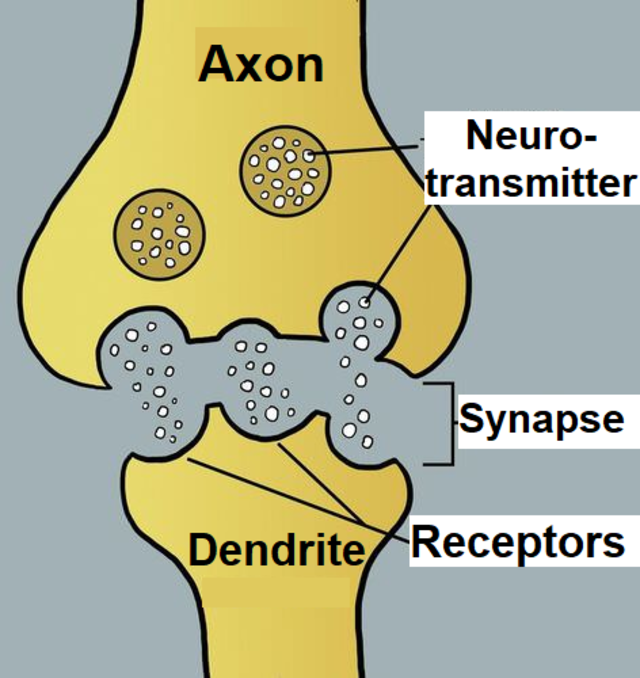
When an electrical signal, called an action potential, travels down the axon and reaches its end, it can't just jump across the gap. Instead, the signal is converted from an electrical one to a chemical one.
The axon terminal releases chemical messengers called neurotransmitters into the synapse. These molecules drift across the tiny gap and bind to specific receptors on the dendrites of the receiving neuron. This binding action opens channels on the receiving neuron, converting the chemical message back into an electrical signal and passing the message along.
This whole process—from an electrical signal to a chemical release and back to an electrical signal—happens in a fraction of a millisecond.
Organizing the Network
These billions of interconnected neurons are not just a random tangle. They are organized into a vast, complex network: the nervous system. This system is broadly divided into two main parts.
The Central Nervous System (CNS) is the command center. It consists of the brain and the spinal cord. The brain is the primary site of processing, where information is interpreted, decisions are made, and memories are stored. The spinal cord acts as a major highway, relaying messages between the brain and the rest of the body, and it also handles simple reflexes.
The Peripheral Nervous System (PNS) is everything else. It's the network of nerves that extends from the CNS to all parts of the body, including your limbs and organs. The PNS is responsible for carrying signals from your senses (like touch and sight) to the CNS, and for carrying commands from the CNS out to your muscles and glands.
The complexity of human behavior produced by the nervous system depends less on the variety of neurons than on their organization into anatomical circuits with precise functions.
Together, these components form the biological machinery that allows you to perceive, think, act, and learn. Each thought you have and every move you make is the result of these fundamental processes.
Which part of a neuron is primarily responsible for receiving signals from other neurons?
At a synapse, an electrical signal triggers the release of chemical messengers called ______.