The Bohr Mysteries and the Dawn of Quantum Reality
Historical Synthesis
The Unstable Atom
In the early 20th century, Ernest Rutherford’s model painted a picture of the atom as a miniature solar system. A dense, positively charged nucleus sat at the centre, with tiny electrons orbiting it. While a brilliant leap forward, this nuclear model had a catastrophic flaw when viewed through the lens of classical physics.
According to James Clerk Maxwell's theory of electromagnetism, any accelerating charged particle must radiate energy. An electron orbiting a nucleus is constantly changing direction, which means it's constantly accelerating. Therefore, it should be continuously losing energy as electromagnetic radiation. This energy loss would cause its orbit to decay, sending the electron spiralling into the nucleus in a fraction of a second. If this were true, atoms couldn't exist, and neither could we.
This glaring contradiction was known as the 'radiation catastrophe'. Classical physics, which worked perfectly for planets and billiard balls, failed completely at the atomic scale. A new idea was needed to explain why atoms were stable.
Bohr's Quantum Leap
Niels Bohr provided that idea in 1913. He took Rutherford's nuclear model and fused it with the quantum theory developed by Max Planck and Albert Einstein. Bohr proposed a radical set of postulates that defied classical intuition.
First, he suggested that electrons can only exist in specific, fixed orbits, which he called stationary states. While in one of these states, an electron does not radiate energy, making the atom stable.
Second, an electron can 'jump' from one stationary state to another. To move to a higher-energy orbit, it must absorb a photon of light with precisely the right amount of energy. To drop to a lower-energy orbit, it must emit a photon of a specific energy, corresponding to the energy difference between the two states.
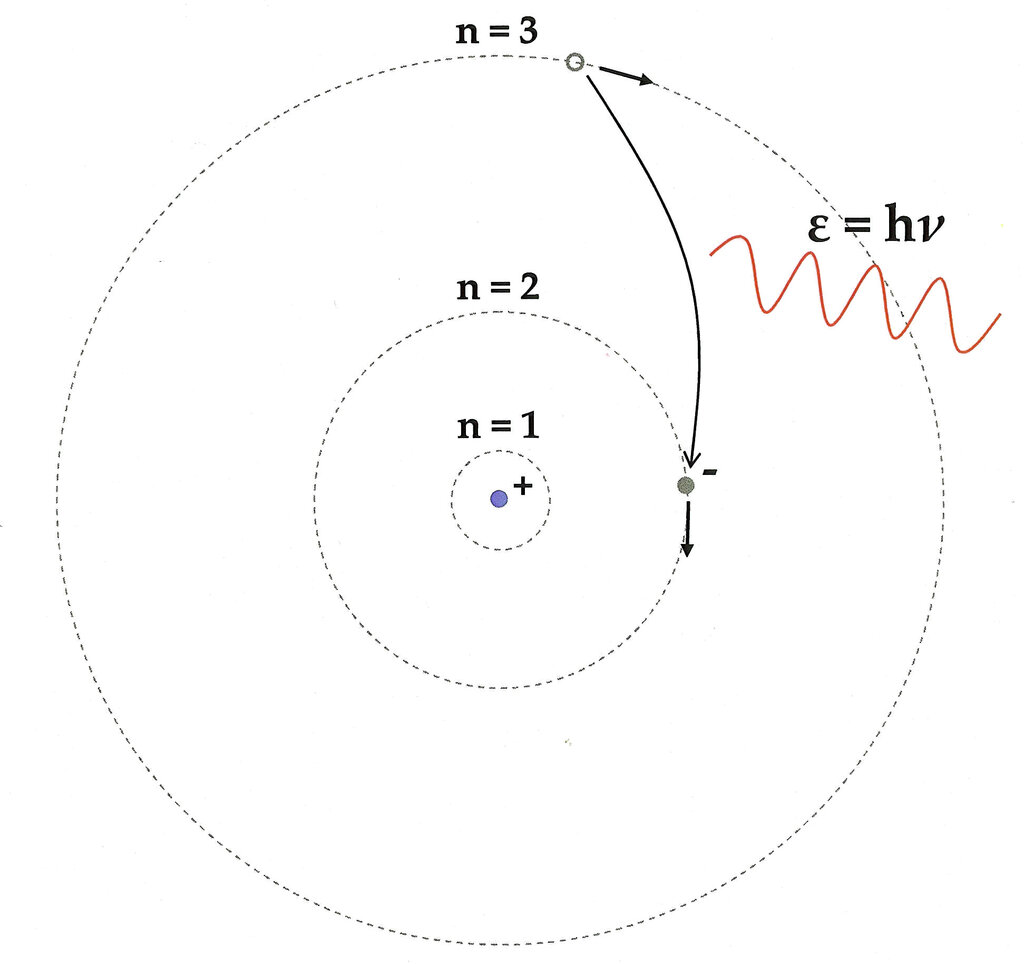
The most critical innovation was the rule that determined which orbits were allowed. Bohr postulated that the angular momentum of an electron in a stationary state was quantised, meaning it could only take on discrete values. Specifically, it had to be an integer multiple of a fundamental constant.
This condition of quantised angular momentum was the bridge between classical mechanics and the new quantum reality. By restricting electrons to specific orbits, it prevented the spiralling collapse predicted by classical theory and locked them into stable configurations.
Evidence from Hydrogen
Bohr's model wasn't just a clever idea; it made a testable prediction. If electrons could only exist at specific energy levels, then an atom like hydrogen should only be able to emit light at specific frequencies, corresponding to the energy gaps between its allowed orbits. This would produce a line spectrum, not a continuous rainbow.
This is exactly what scientists had observed for decades. When hydrogen gas is energised, it emits light at a few distinct wavelengths. Bohr's model was able to calculate these wavelengths with remarkable accuracy, providing powerful evidence that his quantum view of the atom was correct.
While it was eventually superseded by a more complete quantum mechanical model, Bohr's atomic model was a monumental achievement. It successfully explained atomic stability and the hydrogen spectrum by introducing the core idea that energy and momentum are quantised at the atomic level, setting the stage for the quantum revolution to come.
According to classical physics, what was the primary reason Ernest Rutherford's 'solar system' model of the atom was considered unstable?
What key concept did Niels Bohr introduce to explain why atoms are stable?
The introduction of quantised states marked a definitive break from the continuous world of classical physics.