The Bloch Sphere Explained
Qubit Basics
The Quantum Bit
In everyday computers, the smallest piece of information is a bit. It's a simple switch that can be either off or on, represented by a 0 or a 1. All the complex software you use, from web browsers to video games, is built on this straightforward binary foundation.
Quantum computing operates on a different fundamental unit: the qubit, short for quantum bit. A qubit can also be a 0 or a 1, just like a classical bit. But it can also be something more.
qubit
noun
The basic unit of quantum information. It is the quantum analogue of the classical binary bit.
Qubits are not abstract ideas; they are physical systems. Anything that has two distinct quantum states can work as a qubit. For example, an electron has a property called spin, which can be measured as either "spin up" or "spin down." We can assign "spin up" to represent the state 1 and "spin down" to represent 0. Another example is an atom, which can be in a low-energy "ground state" (0) or a high-energy "excited state" (1).
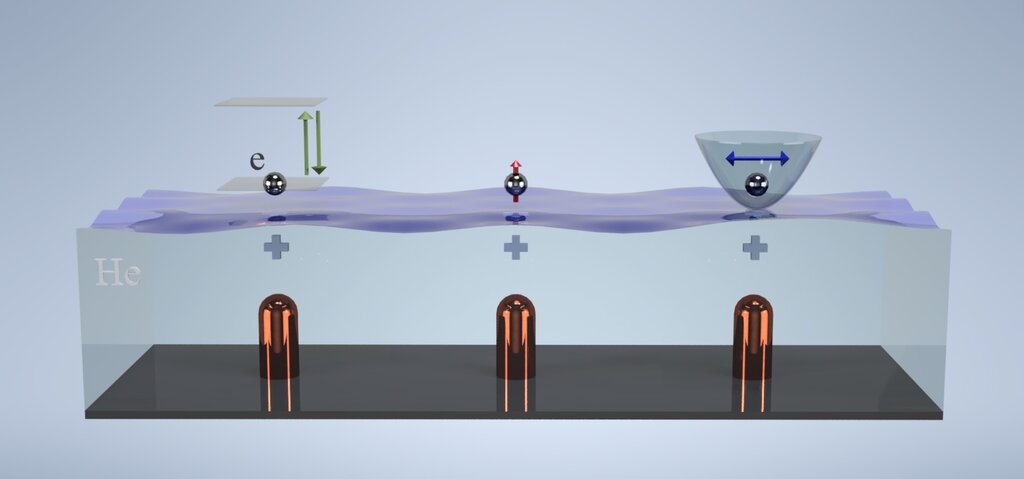
These are called two-level quantum systems, and they form the physical basis for qubits.
The Language of Quantum States
To describe the state of a qubit, we use a special notation called Dirac notation, or bra-ket notation. The two basic states, corresponding to the classical 0 and 1, are written as kets:
You can read these as "ket zero" and "ket one." They are known as the basis states. In terms of the math used in quantum mechanics, these states are represented by vectors.
This mathematical framework is what allows us to describe the more complex behaviors of a qubit, going beyond the simple on-or-off nature of a classical bit.
Living in Superposition
Here's where qubits become truly different. Unlike a classical bit, a qubit can exist in a superposition of both its basis states at the same time.
You may have heard that a qubit in superposition is both 0 and 1 at the same time.
Think of a spinning coin. While it's in the air, it's neither heads nor tails. It's in a combination of both possibilities. Only when it lands—when we measure it—does it settle into one definite state. A qubit in superposition is like that spinning coin. It holds the potential for being a 0 and the potential for being a 1 simultaneously.
Mathematically, we write a qubit's state, often called |\[\psi\]⟩ (psi), as a combination of its basis states:
The symbols (alpha) and (beta) are numbers called probability amplitudes. They tell us the likelihood of finding the qubit in each state when we measure it. Specifically, the probability of measuring the state as is |\[\alpha\]|^2, and the probability of measuring it as is |\[\beta\]|^2.
Because these are probabilities, their sum must always equal 1 (or 100%).
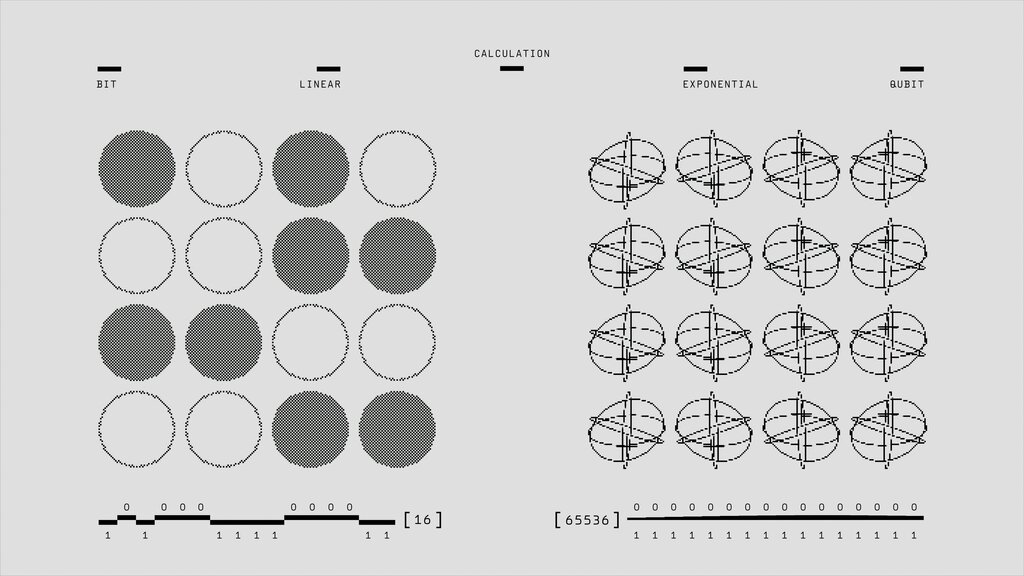
This ability to exist in a blend of states is what gives quantum computers their power. A single qubit can hold more information than a simple on/off switch, and as you add more qubits, the computational space they can explore grows exponentially.
What is the fundamental unit of information in a classical computer?
The key property that allows a qubit to hold more information than a classical bit is its ability to be in a superposition.