The Birth of Cosmic Extremes
Iron Core Limit
The Ultimate Fuel
A massive star spends its life in a constant battle. Gravity relentlessly tries to crush it, while the outward pressure from nuclear fusion pushes back. This cosmic balancing act works well as long as the star has fuel to burn. It starts with hydrogen, then helium, carbon, and so on, fusing lighter elements into heavier ones. Each step up this elemental ladder releases energy, keeping the star stable.
But this process has a hard limit. The energy released from fusion comes from the fact that the resulting nucleus is more tightly bound than the ones that created it. We can measure this with a concept called binding energy per nucleon, which is the average energy required to remove a single proton or neutron from a nucleus. The higher this value, the more stable the nucleus. This trend of increasing stability, however, doesn't continue forever. It peaks at iron-56.
Fusing elements lighter than iron releases energy. Fusing elements heavier than iron requires energy. Iron is the ash at the bottom of the stellar furnace. When a massive star builds up a core of iron, it has reached an evolutionary dead end. The star can no longer generate energy through fusion to fight gravity.
The Silicon Meltdown
The final stage before the iron catastrophe is silicon burning. Unlike previous stages that fuse two distinct nuclei, this process is a chaotic scramble. The star's core is so hot, exceeding 3 billion Kelvin, that high-energy photons start blasting apart the newly formed silicon nuclei. This process is called photodisintegration .
The silicon nuclei break down into lighter nuclei, like helium. These fragments are then immediately captured by other silicon nuclei, building up heavier elements in a rapid, chaotic sequence. This frantic reshuffling of protons and neutrons produces a range of elements, but the inexorable trend is toward the most stable element: iron. The whole process is incredibly fast, lasting only about a day. An inert iron core begins to form and grow at the center of the star.
photodisintegration
noun
A nuclear process in which an atomic nucleus absorbs a high-energy gamma ray (photon), enters an excited state, and immediately decays by emitting a subatomic particle, like a proton, neutron, or alpha particle.
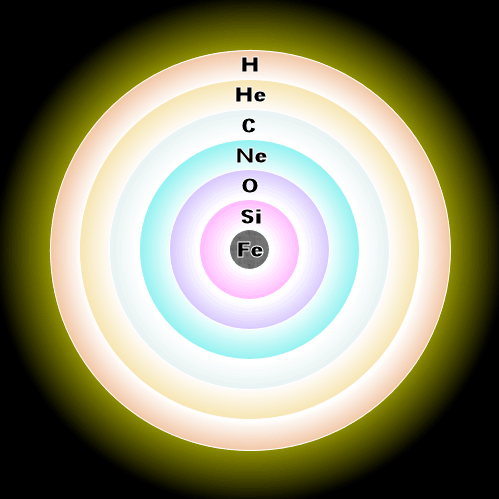
As the silicon-burning shell deposits iron ash onto the core, the core's mass grows. Without fusion to generate outward pressure, the iron core is held up against gravity only by the strange physics of the subatomic world.
A Core Under Pressure
The core is supported by something called electron degeneracy pressure. The Pauli exclusion principle, a fundamental rule of quantum mechanics, states that no two electrons can occupy the same quantum state. In the incredibly dense stellar core, electrons are packed together so tightly that they resist further compression. This creates a powerful outward pressure, independent of temperature.
But this pressure has a limit. As the iron core grows, its mass approaches a critical threshold known as the , which is about 1.4 times the mass of our Sun. Once the core exceeds this mass, electron degeneracy pressure is no longer strong enough to resist the crushing force of gravity.
To make matters worse, another process kicks in that weakens the core's support. The immense pressure forces protons in the iron nuclei to merge with electrons, a process called . This converts a proton into a neutron and releases a neutrino.
This reaction is a double blow. It removes the very electrons that were providing the degeneracy pressure, and it converts the core into a dense ball of neutrons. Gravity now has the upper hand. The core has no defense left.
With its nuclear fuel exhausted and its structural support failing, the iron core is on the brink of a catastrophic collapse.
Let's review the key ideas before seeing what happens next.
Ready to check your understanding?
Why is the formation of an iron core considered an 'evolutionary dead end' for a massive star?
The process where high-energy photons break apart silicon nuclei during the final stage of stellar fusion is called _________.
The stage is now set for one of the most violent events in the universe. The core's collapse will trigger a supernova, an explosion that can outshine an entire galaxy.