The Biology of Age-Related Hearing Loss
Introduction to Hearing
The Journey of Sound
Hearing starts long before sound reaches your brain. It begins with the part of the ear you can see, the fleshy curve of cartilage on the side of your head. This isn't just for holding up your sunglasses; it’s the opening act in a complex biological performance.
Pinna
noun
The visible part of the outer ear.
The pinna, also known as the auricle, acts like a satellite dish. Its unique shape is designed to capture sound waves from the environment and funnel them into the ear canal. This canal isn't just a simple tube—it amplifies certain frequencies, helping us hear human speech more clearly.
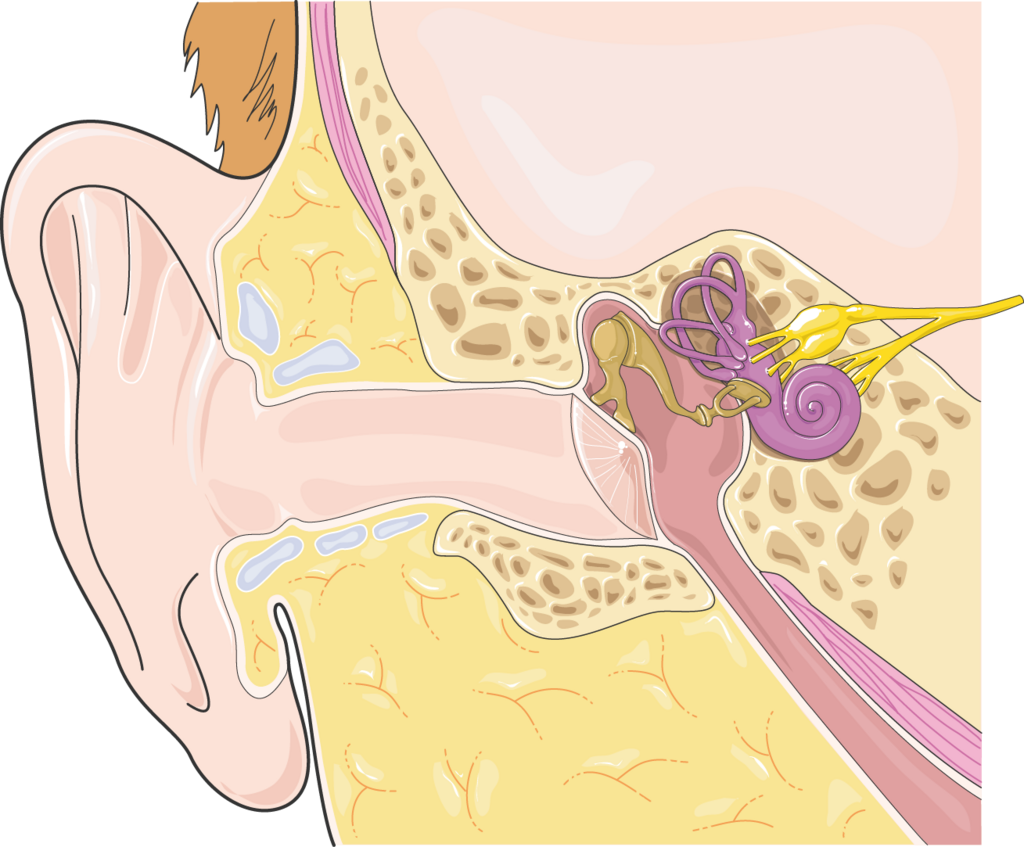
At the end of this canal lies a thin, taut membrane: the eardrum, or tympanic membrane. When sound waves hit it, they cause it to vibrate. This vibration is the key that unlocks the next stage of hearing in the middle ear.
The Middle Ear Amplifier
The middle ear is a small, air-filled chamber that sits just behind the eardrum. Its main job is to take the vibrations from the eardrum and make them stronger. Think of it as a mechanical amplifier. Inside this chamber are the three smallest bones in the human body, known collectively as the ossicles.
| Bone | Common Name | Function |
|---|---|---|
| Malleus | Hammer | Attached to the eardrum; vibrates when sound hits. |
| Incus | Anvil | Acts as a bridge, passing vibrations from the malleus. |
| Stapes | Stirrup | Pushes against the oval window, a gateway to the inner ear. |
When the eardrum vibrates, it moves the malleus. The malleus pushes the incus, which in turn moves the stapes. This chain reaction doesn't just transfer the vibration; it concentrates the force. The eardrum has a much larger surface area than the tiny footplate of the stapes pushing on the inner ear. By focusing the energy onto a smaller spot, the ossicles amplify the sound pressure significantly. This amplification is crucial because the inner ear is filled with fluid, and it takes more energy to move sound through fluid than through air.
Without the middle ear's amplification, most sound energy would simply bounce off the fluid of the inner ear, and our hearing would be far less sensitive.
The Inner Ear's Transducer
The inner ear is where the magic really happens. Here, mechanical vibrations are converted into electrical signals that the brain can understand. The main player in this process is a snail-shaped, fluid-filled structure called the cochlea.
Cochlea
noun
A spiral-shaped, fluid-filled structure in the inner ear that contains the organ of Corti.
When the stapes bone pushes against the oval window, it creates waves in the cochlear fluid. These waves travel down the length of the cochlea, causing a thin membrane called the basilar membrane to move. Lining this membrane are thousands of tiny sensory cells called hair cells.
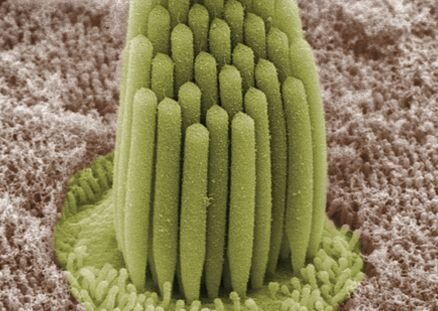
As the basilar membrane ripples, the microscopic
bristles on top of the hair cells, called stereocilia, bend against another membrane. This bending action opens tiny channels in the hair cells, allowing electrically charged ions to rush in. This influx of ions creates an electrical signal, a process known as mechanoelectrical transduction. High-frequency sounds cause vibrations near the base of the cochlea, while low-frequency sounds travel further, causing vibrations near its apex. This elegant design allows the cochlea to act as a frequency analyzer, sorting sounds by pitch before they even leave the ear.
From Ear to Brain
Once the hair cells generate an electrical signal, the journey is almost complete. The signal is picked up by the auditory nerve, which acts like a highway connecting the cochlea to the brain. This nerve is a bundle of fibers, with each fiber carrying information about a specific sound frequency.
The signals first travel to the brainstem, which is involved in basic auditory functions, like identifying where a sound is coming from. From there, the information is relayed to a structure called the thalamus, which acts as a central switchboard for sensory information. Finally, the signals arrive at their ultimate destination: the auditory cortex, located in the temporal lobe of the brain. Here, the brain interprets these signals as meaningful sounds—speech, music, or the rustling of leaves.
Now let's test your understanding of how hearing works.
What is the primary function of the pinna, the visible part of the ear?
The main purpose of the ossicles (malleus, incus, and stapes) in the middle ear is to:
This entire process, from sound wave to brain signal, happens almost instantaneously. It's a beautifully coordinated system that connects us to the world through sound.