The Big Family of Smart Machines
The Russian Doll Concept
The Russian Doll Concept
The terms Artificial Intelligence, Machine Learning, Deep Learning, and Generative AI are often used interchangeably, but they represent distinct layers of a single concept. Think of them like a set of Russian nesting dolls. Each doll fits snugly inside a slightly larger one, representing a more specialized version of the concept it's nested within.
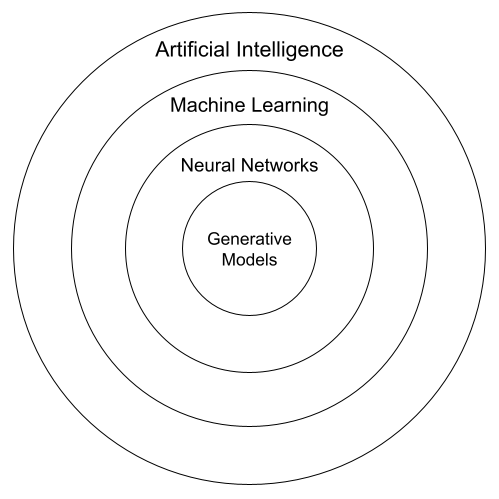
The Outermost Doll: AI
(AI) is the largest, outermost doll. It represents the broad, overarching goal of creating machines that can simulate human intelligence. This includes everything from reasoning and problem-solving to perception and language understanding. If a machine performs a task that would typically require human intellect, it falls under the vast umbrella of AI.
Early AI systems were often based on complex sets of hand-coded rules. For example, a chess program might have rules like, "If the opponent's queen is in this position, move the knight here." This approach, known as symbolic AI or "Good Old-Fashioned AI," can be powerful but is brittle. It breaks down when faced with a situation the programmers didn't explicitly anticipate.
The Inner Dolls: ML and DL
Inside the AI doll, we find Machine Learning (ML). ML is not the whole of AI, but a specific and powerful subfield. Instead of being programmed with explicit rules, an ML system learns patterns directly from data. You don't tell a spam filter exactly what a spam email looks like; you show it thousands of examples of spam and legitimate emails, and it learns to tell the difference on its own.
Tucked inside Machine Learning is an even more specialized doll: Deep Learning (DL). Deep Learning is a type of machine learning that uses complex, multi-layered structures called to learn from enormous datasets. The “deep” in the name refers to the depth of these layers.
This layered approach allows the network to learn features at different levels of abstraction. For example, when analyzing an image of a cat, the first layer might learn to recognize simple edges and colors. The next layer might combine those edges to recognize shapes like ears and whiskers. A deeper layer might combine those shapes to recognize a complete cat face. This hierarchical learning is what makes DL so powerful for tasks like image recognition and natural language processing.
The Core: Generative AI
At the very center of our nesting dolls, inside Deep Learning, is the smallest and most recent doll: (GenAI). While most ML and DL models are trained to classify data (e.g., "Is this a cat?") or make predictions (e.g., "Will this stock go up?"), Generative AI is designed to create something new. It learns the underlying patterns and structures of the data it's trained on and then uses that knowledge to generate novel, original content. This could be new text, images, music, or code that resembles the data it learned from but isn't a direct copy.
The hierarchy is key. All Generative AI is a form of Deep Learning. All Deep Learning is a type of Machine Learning. And all Machine Learning is a branch of Artificial Intelligence. But the reverse is not true. Not all AI uses machine learning, and not all machine learning is deep learning.
Understanding this layered relationship provides a mental map for navigating the world of AI. Each layer represents a more specific and often more powerful approach to building intelligent systems.
Which of the following correctly orders the AI concepts from the broadest category to the most specific?
What is the key difference between a system based on Machine Learning and an earlier, 'symbolic AI' system?