The Battle of Chosin Reservoir Strategy
Korean War Overview
A Divided Peninsula
After World War II ended in 1945, Korea, previously under Japanese rule, was split in two. The Soviet Union occupied the northern half, and the United States occupied the southern half. The dividing line was the 38th parallel, a line of latitude that would soon become a heavily fortified border.
This temporary division quickly hardened. In the north, the Soviets supported the establishment of the Democratic People's Republic of Korea (DPRK), a communist state led by Kim Il-sung. In the south, the U.S. backed the creation of the Republic of Korea (ROK), a capitalist state led by Syngman Rhee. Both leaders dreamed of reunifying the peninsula under their own system, creating a tense and volatile situation.
The Invasion Begins
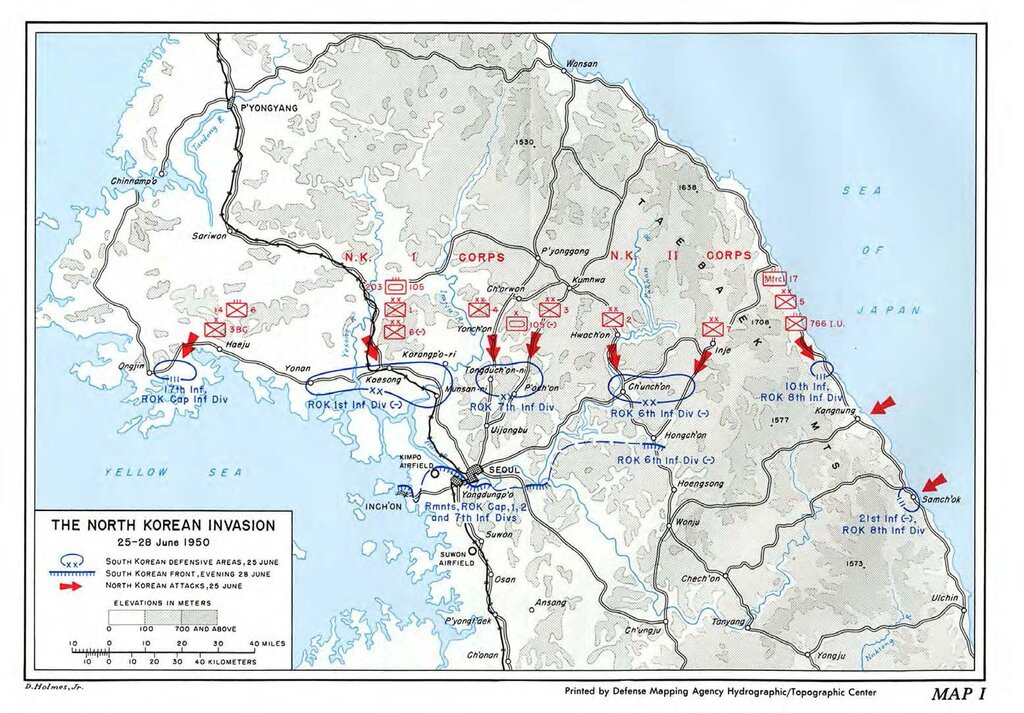
On June 25, 1950, the tension broke. Supported by Soviet tanks and aircraft, the North Korean People's Army (NKPA) stormed across the 38th parallel, launching a full-scale invasion of South Korea. The Republic of Korea Army (ROK) was caught by surprise and quickly overwhelmed.
Within days, the NKPA captured Seoul, the southern capital, and continued its rapid advance down the peninsula. The invasion triggered immediate international alarm.
The United States swiftly brought the issue to the United Nations Security Council. Condemning the invasion as an act of aggression, the UN passed a resolution calling on its members to assist South Korea. This led to the formation of a multinational UN Command, with the United States providing the vast majority of the troops, equipment, and leadership. General Douglas MacArthur was appointed commander-in-chief.
Meanwhile, another major player watched from across its border with North Korea: the People's Republic of China, led by Mao Zedong. Though not yet involved, China viewed the advance of U.S. and allied forces toward its border with growing concern.
Turning the Tide
By August 1950, the situation looked bleak for South Korea and its allies. The NKPA had pushed the UN and ROK forces into a small corner in the southeastern tip of the peninsula, an area known as the Pusan Perimeter. But here, the defenders held their ground.
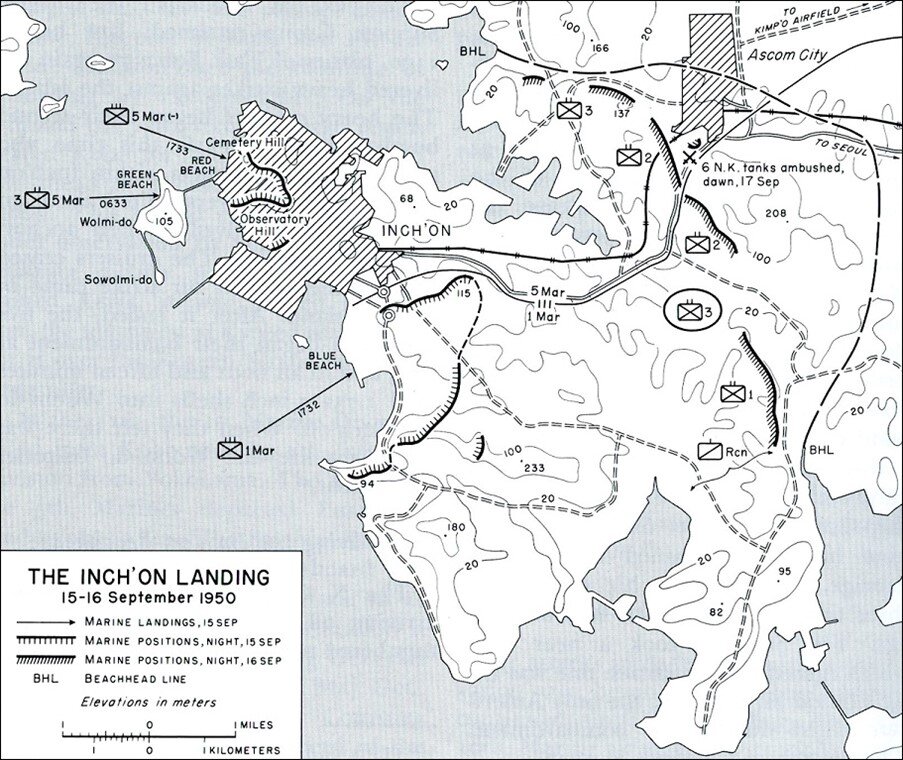
With the front stabilized, General MacArthur executed a daring masterstroke. On September 15, 1950, he launched a massive amphibious assault at Inchon, a port city far behind enemy lines and near Seoul. The landing was a stunning success. It caught the NKPA completely by surprise, severed their supply lines, and forced them into a hasty retreat.
Following the success at Inchon, UN forces recaptured Seoul and pushed the NKPA back across the 38th parallel. The initial war aim of defending South Korea had been achieved. However, buoyed by the victory, the UN leadership changed its goal to the reunification of Korea. UN forces crossed into North Korea in October, advancing rapidly towards the Yalu River, the border between North Korea and China.
Confidence was high. Many believed the war would be over by Christmas. But this push deep into North Korea was a critical gamble.
The advance to the Yalu River brought UN forces face-to-face with a new and powerful adversary. China had repeatedly issued warnings against such a move, but they were largely dismissed by UN commanders.
In late October 1950, unbeknownst to UN intelligence, hundreds of thousands of Chinese soldiers of the People's Volunteer Army (PVA) had secretly crossed the Yalu River into the mountainous terrain of North Korea. They were waiting to spring a trap. The stage was now set for a brutal new phase of the war and one of its most legendary battles: the Battle of Chosin Reservoir.