The Basics of Electricity
Electricity Basics
The Nature of Charge
At the heart of all things electric is charge. It's a fundamental property of matter, just like mass. Charge comes in two flavors: positive and negative. Protons, found in the nucleus of an atom, carry a positive charge. Electrons, which orbit the nucleus, carry a negative charge.
The basic rule is simple: opposite charges attract, while like charges repel. A positive charge and a negative charge will pull toward each other. Two positive charges, or two negative charges, will push each other away. This force of attraction or repulsion is what makes electricity work.
When we talk about how much charge something has, we measure it in units called coulombs (C). A single electron has a tiny negative charge, and a proton has an equally tiny positive charge. It takes about electrons to equal one coulomb of negative charge.
Fields, Flow, and Pressure
Charges don't need to touch to push or pull on each other. They exert their influence through an invisible force field called an electric field. Every charged particle is surrounded by one. When you bring another charge into this field, it feels a force.
To get charges to move in a useful way, like powering a lightbulb, we need to give them a consistent push. This push is called voltage.
Voltage
noun
The difference in electric potential energy between two points. It's the pressure that pushes electric charges to move.
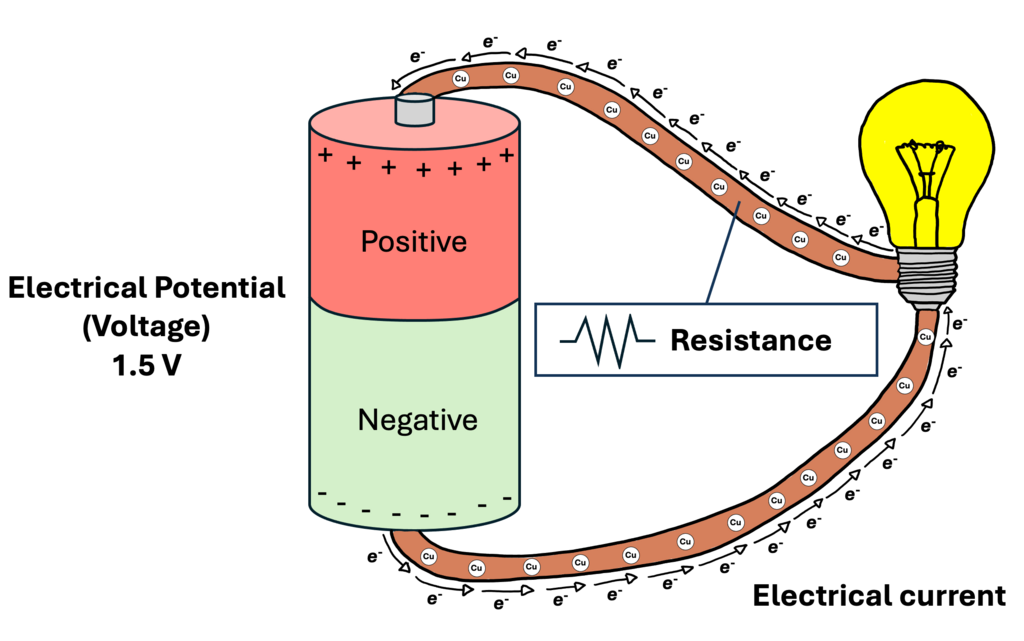
Think of voltage like water pressure. A water tower creates pressure that pushes water through pipes. Similarly, a battery creates a voltage that pushes electrons through wires. The higher the voltage, the stronger the push. We measure voltage in units called volts (V).
When voltage pushes charges, they start to flow. This flow of electric charge is called current.
Current
noun
The rate at which electric charge flows past a point in a circuit.
In our water analogy, current is like the flow rate of the water—how many gallons are moving through the pipe each minute. Electrical current is measured in amperes (A), or amps for short. One amp means that one coulomb of charge is flowing past a point every second.
Getting in the Way
Current doesn't always flow freely. Some materials let charge pass through easily, while others block it. The measure of how much a material opposes the flow of current is called resistance.
Resistance
noun
A measure of the opposition to current flow in an electrical circuit.
Materials with low resistance are called conductors. Metals like copper and aluminum are great conductors, which is why they're used for electrical wires. Materials with very high resistance are called insulators. Rubber, glass, and plastic are good insulators; they are used to cover wires and prevent electricity from going where it shouldn't.
Resistance is measured in ohms (Ω). In the water pipe analogy, resistance is like a narrow section of the pipe or a section clogged with gravel. It slows down the flow of water.
These three concepts—voltage, current, and resistance—are all connected. Their relationship is described by a simple but powerful rule called Ohm's Law.
Ohm's Law means that if you keep the resistance the same and increase the voltage (the push), the current (the flow) will also increase. If you keep the voltage the same but increase the resistance (the obstacle), the current will decrease.
Let's try a quick example. If a small heater has a resistance of 10 Ω and is plugged into a wall outlet providing a voltage of 120 V, what is the current flowing through it?
Using Ohm's Law, we can rearrange the formula to solve for current: .
So, . The heater draws 12 amps of current.
Ready to check your understanding? Let's see what you've learned about the fundamentals of electricity.
What happens when a particle with a positive charge and a particle with a negative charge are brought near each other?
The flow of electric charge is called ________, and it is measured in ________.
Understanding these basic building blocks—charge, voltage, current, and resistance—is the first step to understanding how all electrical and electronic devices work.