The Basics of Electricity
Electric Charge
The Source of Electricity
At the heart of all electrical phenomena is a fundamental property of matter called electric charge. Just like mass is a property that gives objects weight in a gravitational field, electric charge is what allows objects to feel the electric force. It’s an invisible property, but we see its effects everywhere, from static cling in our laundry to the lightning that splits the sky.
Electric Charge
noun
A fundamental physical property of matter that causes it to experience a force when placed in an electromagnetic field.
Positive and Negative
Electric charge comes in two types: positive (+) and negative (-). These aren't just arbitrary labels; they describe how charges behave. The source of these charges lies within the atom.
Atoms are made of three smaller particles: protons, neutrons, and electrons. Protons carry a positive charge, while electrons carry a negative charge. Neutrons, as their name suggests, are neutral and have no charge at all. Protons and neutrons are packed together in the center of the atom, called the nucleus. Electrons orbit this nucleus.
Most of the time, objects are electrically neutral. This means they have an equal number of protons and electrons. The positive and negative charges cancel each other out, so there's no overall charge.
An object becomes charged when this balance is upset. This usually happens when electrons are transferred from one object to another. If an object gains electrons, it has more negative charges than positive ones, giving it a net negative charge. If it loses electrons, it has more positive charges left behind, giving it a net positive charge.
How Charges Interact
The way charges interact is governed by a simple, fundamental rule. You may have heard it before.
Opposite charges attract, and like charges repel.
This means that a positive charge and a negative charge will pull toward each other. In contrast, two positive charges will push each other away, and two negative charges will do the same.
This is why a balloon rubbed against your hair sticks to a wall. Rubbing the balloon transfers electrons to it, giving the balloon a negative charge. When you bring it near a neutral wall, the balloon's negative charge pushes away the electrons in the wall and attracts the positive nuclei. This attraction is strong enough to hold the light balloon in place.
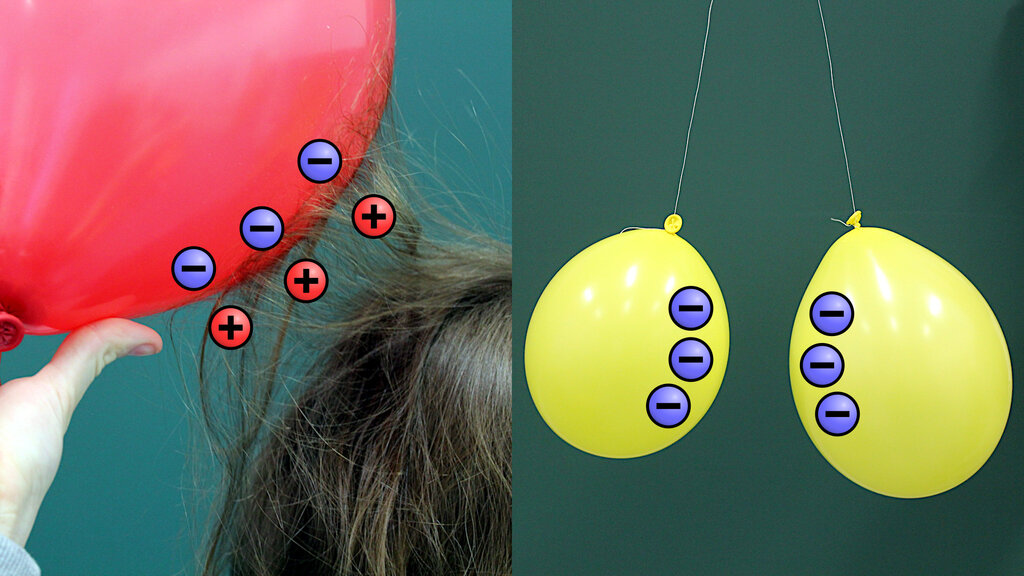
This simple rule of attraction and repulsion is the foundation for understanding all of electricity. It explains why atoms hold together and how electrical devices work.
Ready to check your understanding?
What is the charge of an electron?
An object becomes positively charged when it...
Understanding charge is the first step. This fundamental property is behind everything from tiny sparks to powerful currents.